Description
The Funeral is an unfinished work by Édouard Manet, painted about 1867–1870: under a heavy, stormy sky the skyline of Paris, crowned by the dome of the Panthéon, rises above dark green trees, while at the lower right a small procession with a hearse moves along a path. The original is oil on canvas, 72.7 x 90.5 cm, and belongs to the Metropolitan Museum of Art in New York. Our painter paints The Funeral for you by hand in oil on canvas, in 8 landscape sizes from 40 x 31 to 200 x 159 cm, or made to measure.
| Title: | The Funeral |
| Other titles: | L’Enterrement (French title) · Burial at the Glacière |
| Painter: | Édouard Manet (1832–1883) |
| Year painted: | about 1867–1870 |
| Original size: | 72.7 cm x 90.5 cm (height x width) |
| Original technique: | Oil on canvas |
| Painting style: | Realism and Impressionism |
| Located at: | The Metropolitan Museum of Art, New York, United States |
| Our reproduction: | Hand-painted in oil on canvas, 8 sizes or made to measure |
The Funeral – Édouard Manet
What does The Funeral show?
Most of the canvas belongs to the sky: grey and blue-grey clouds, broken by a patch of blue or a dense white cloud. Beneath it, on a rise, lies the outline of Paris: a large dome on the left with a smaller one beside it, the Panthéon right of centre, and a bell tower and towers at the far right.
Below the skyline, white and pale ochre houses are sketched in a few broad strokes, with slender dark green trees between them and a cluster of thin-trunked trees in the left foreground. To the right a pale green slope opens out.
Only at the lower right do people appear. A dark hearse, its coachman on the box holding a whip, leads a small group of mourners in black. The figures are tiny and almost lost in the landscape, so the painting feels quiet and collected rather than sombre. The brushwork is loose, and in places the paint lies thin, because the work was never finished.
Whose funeral is this?
The scene was most probably inspired by the funeral of Manet’s friend Charles Baudelaire on 2 September 1867, which the painter attended. The weather that day was stormy and the sky heavy, and the cortège was small because, according to Charles Asselineau, many people were away from Paris and could not return in time.
The hearse and its attendants are at the bottom of the quartier Mouffetard, heading for the Montparnasse Cemetery. According to Adolphe Tabarant, the scene is set in the rue de l’Estrapade. In the distance stand the Paris Observatory, the church of Notre-Dame du Val-de-Grâce, the Panthéon, the bell tower of Saint-Étienne-du-Mont and the tour Clovis, now part of the Lycée Henri-IV.
The date is not quite settled. Tabarant first placed the work in 1870 but later preferred the earlier date as more probable. Henri Loyrette points to a horse grenadier of the Imperial Guard at the back of the procession and concludes that the scene comes before the end of the Second Empire.
Why is this painting so admired?
Édouard Manet (1832–1883), among the first nineteenth-century artists to paint modern life and a pivotal figure between Realism and Impressionism, shows another side here: not a large Salon piece but an unfinished canvas of moderate size, in which the city matters more than the people.
In style it is very close to Effect of Snow on Petit-Montrouge, a winter view Manet painted during the Siege of Paris.
Charles Sterling-Salinger noticed that Manet moved the domes of the Observatory and the Val-de-Grâce closer together to improve the composition. The Wikipedia article on The Funeral gives more detail, in English.
Where is the original, and how did it get there?
The original, oil on canvas measuring 72.7 x 90.5 cm (height x width), belongs to the Metropolitan Museum of Art in New York, under accession number 10.36.
After Manet’s death his widow, Suzanne Manet, sold it to the dealer Portier in August 1894. By 1902 it belonged to the painter Camille Pissarro, who had known Manet well and frequented the Café Guerbois. It was next acquired by Ambroise Vollard, who sold it to the New York museum.
Denis Rouart and Daniel Wildenstein’s inventory of Manet’s works lists it under a second title naming the Glacière, shown in the table above.
The Funeral or another Manet?
This is a canvas painting for anyone who loves Paris, city views and quiet, restrained landscape.
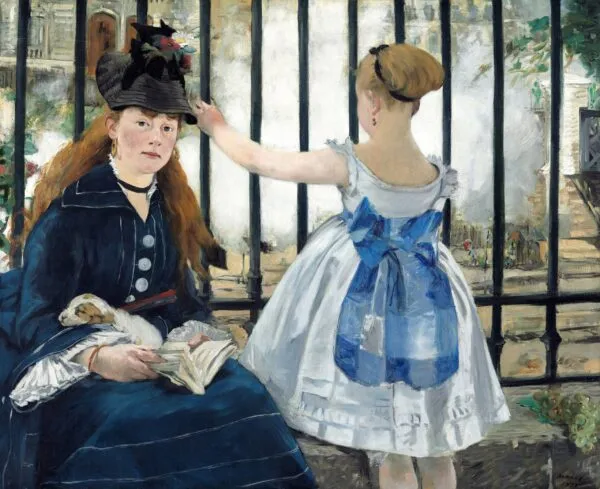
If Manet’s Spanish period draws you, look at Young Man in the Costume of a Majo, where his youngest brother Gustave wears a short black jacket with a striped blanket over his arm, or The Matador Saluting, in which his brother Eugène raises a black hat and holds a red cape. For a brighter mood there is The Croquet Game of 1873, a game in a sunlit garden under trees.
The Funeral sits among other famous Manet paintings on our Édouard Manet page, each one painted to order.
How do we hand-paint The Funeral?
Manet’s original is an oil on canvas of moderate size, 90.5 cm wide. Ours is an oil painting reproduction made in oil on canvas in the size you choose, built up layer by layer.
First he sets the horizon with its domes and towers and the border between the pale houses and the green slope, the two bands that carry the composition. Then come the blue-grey sky and the dark trees, and last of all the small figures of the procession and the hearse.
Manet left the work unfinished, so his strokes are quick and open. Our painter keeps them that way and adds no details the original lacks.
Which size suits which wall?
In short: 40 x 31 or 50 x 40 cm for a narrow wall or a shelf, 64 x 50 and 80 x 63 cm above a chest of drawers or in a study, 100 x 79 and 125 x 99 cm above a sofa, and 160 x 123 or 200 x 159 cm for a large empty wall.
We paint The Funeral in 8 landscape sizes (width x height): 40 x 31, 50 x 40, 64 x 50, 80 x 63, 100 x 79, 125 x 99, 160 x 123 and 200 x 159 cm. The original measures 90.5 x 72.7 cm (width x height), so the four sizes up to 80 x 63 cm are smaller than it, 100 x 79 cm already goes slightly beyond it, and 125 x 99, 160 x 123 and 200 x 159 cm are much larger.
As a painting for the living room it works best at 100 x 79 or 125 x 99 cm above the sofa, where the domes on the skyline and the procession at the lower right read clearly.
Can I order a different size or a frame?
Yes. For other proportions we keep the domed skyline and the procession whole and adjust the sky or the trees on the left. Tell us the size you need for The Funeral, and we will quote a price and a date.
The Funeral travels rolled, stretched on a stretcher bar or framed. Our workshop in Slovenia stretches and frames this Paris view.
You pick a moulding for The Funeral in our 3D app, which serves only to choose the frame; seeing the painting on your own wall is a separate service.
When will my painting arrive?
The painter starts on the Paris skyline as soon as you confirm the order, and the painting is ready to ship within 15 to 45 working days. Before packing you get a photograph of the finished work, and we make any changes you ask for.
This view of Paris also travels within Slovenia and across the EU without customs duties, and every order is covered by our returns policy.
A city view under a storm sky makes a good gift for anyone who loves Paris. If you do not know the wall yet, a wall art voucher lets them choose the painting and its size.
Frequently asked questions
Where can I see the original?
At the Metropolitan Museum of Art in New York, under accession number 10.36.
Is the painting linked to Baudelaire?
Most probably: it was inspired by the funeral of Manet’s friend Charles Baudelaire on 2 September 1867.
Is this a print?
No. Each one is a hand-painted copy, for which our painter lays oil onto canvas with a brush.
How big is the original?
It measures 72.7 x 90.5 cm (height x width); our 100 x 79 cm size and every larger one exceed it.
Can I have The Funeral in a size that is not listed?
Yes. Give us the width and height you want, and we will send an offer for The Funeral with a price and a delivery time.
How long does it take to make?
Between 15 and 45 working days, and before dispatch you get a photograph of the finished Paris view.
Is The Funeral right for a living room, or as a gift?
Yes. It is above all a calm view of Paris, so it suits a living room, a study or a library.
Which Paris buildings appear on the skyline?
The Observatory, the church of the Val-de-Grâce, the Panthéon, the bell tower of Saint-Étienne-du-Mont and the tour Clovis.
- Subject: the Paris skyline with the Panthéon under a storm sky, a small procession with a hearse at the lower right.
- Original: oil on canvas, about 1867–1870, 72.7 x 90.5 cm, Metropolitan Museum of Art, New York.
- Ours: an Édouard Manet reproduction of The Funeral, painted by hand in oil on canvas, 8 sizes from 40 x 31 to 200 x 159 cm, or made to measure.
- Worth knowing: an unfinished work; in 1902 it belonged to the painter Camille Pissarro.