







































Description
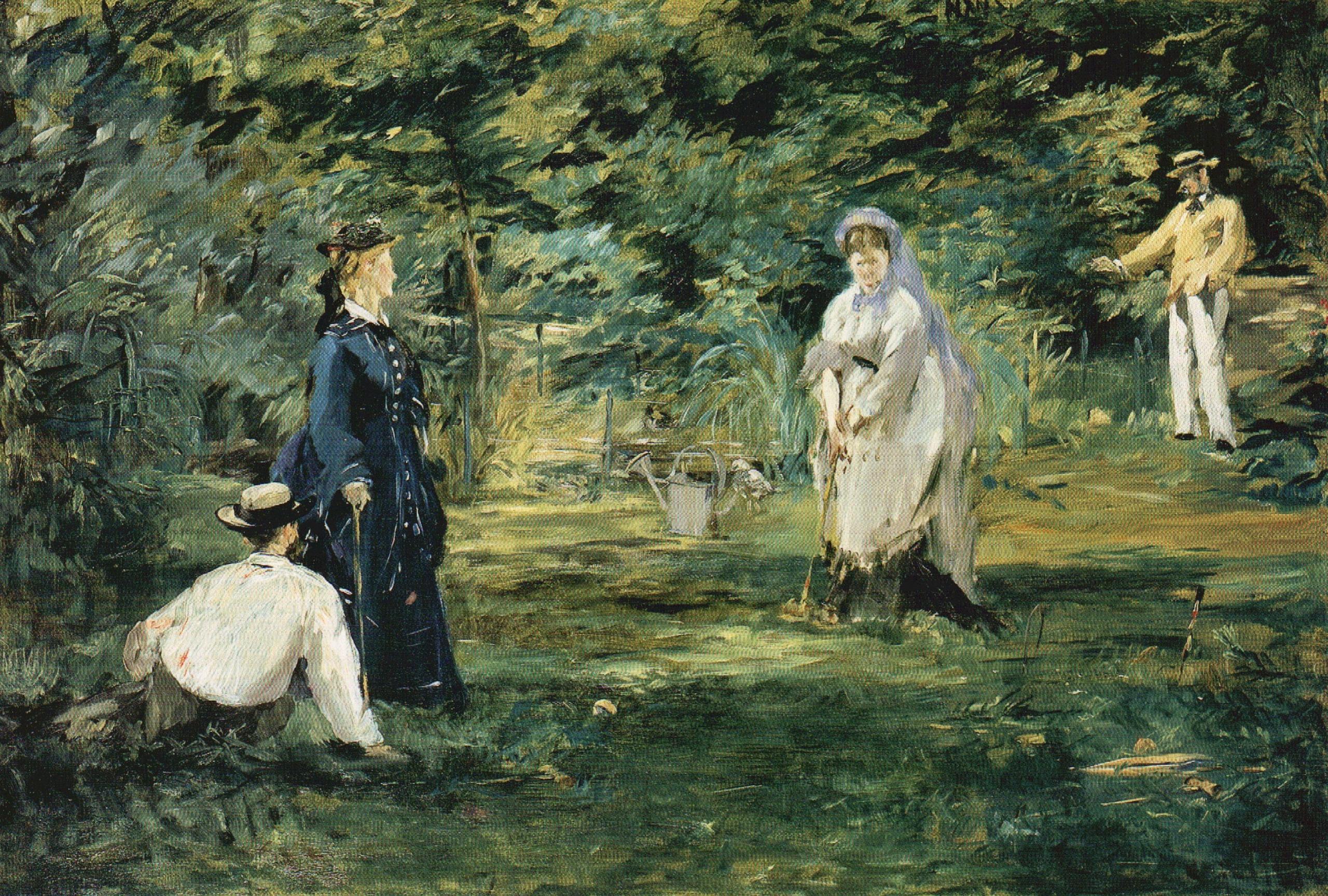
The Croquet Game is a sunlit garden scene that Édouard Manet painted in 1873: two women and two men play croquet beneath the trees, while light filters through the leaves and falls on the lawn in patches of green and gold. The original is oil on canvas, 72.5 x 106 cm, and belongs to the Städel Museum in Frankfurt. We hand-paint it for you in oil on canvas, in 8 landscape sizes from 45 x 30 to 200 x 130 cm or made to measure. Before it ships, you see the finished garden in a photograph.
| Title: | The Croquet Game |
| Other titles: | La Partie de croquet (French title) |
| Painter: | Édouard Manet (1832–1883) |
| Year painted: | 1873 |
| Original size: | 72.5 cm x 106 cm (height x width) |
| Original technique: | Oil on canvas |
| Painting style: | Realism and Impressionism |
| Located at: | Städel Museum, Frankfurt am Main, Germany |
| Our reproduction: | Hand-painted in oil on canvas, 8 sizes or made to measure |
The Croquet Game – Édouard Manet
What does The Croquet Game show?
At the front left a man in a white shirt and a straw boater sits on the grass. He props himself on one arm, half turned away from us. Beside him stands a woman in a long dark blue dress buttoned down the front, a small dark hat on her pinned-up hair, one hand resting on the handle of her upright mallet.
In the centre a second woman in a white dress, a pale lilac veil falling from her hat, bends over her mallet and lines up her shot. Further back on the right a man in a straw hat, a pale yellow jacket and white trousers watches her, one hand in his pocket. A grey watering can stands by a low fence, a striped post and an iron hoop mark the course on the right, and a ball lies in the grass near the front.
Trees close the garden in on every side. Sunlight breaks through the canopy and spots the lawn with dark green, yellow-green and gold, laid in with quick strokes.
Who are the players, and what does the game tell us?
All four are real people from Manet’s circle: the painter Alfred Stevens, the artists’ models Victorine Meurent and Alice Lecouvé and, in the background, Manet’s friend Paul Roudier. The German Wikipedia names Stevens’s own garden as the playing field.
Croquet was a highly fashionable game at the time, much loved by the French middle class. It let men and women mix with an ease that few other pastimes allowed. That ease shows in the poses: the man in front lounges on the grass, while the one at the back follows play with a hand in his pocket, every inch the dandy.
The figures are staggered one behind another along a diagonal that runs from the seated man in front to the gentleman at the back. This carefully planned depth gives the scene a calm, almost still look next to other Impressionist works painted outdoors.
Why does this painting hold a special place in Manet’s work?
Édouard Manet (1832–1883) was born in Paris into a wealthy family and was one of the first artists of the nineteenth century to paint modern life. He is seen as a pivotal figure between Realism and Impressionism.
He only took up painting in the open air from 1870, after his fellow painter Berthe Morisot suggested it. In style, The Croquet Game is his closest approach to Impressionism, even though he never exhibited with the Impressionists and preferred the Salon.
Do not confuse it with an earlier canvas of 1871 that carries the same French name and is now in the Nelson-Atkins Museum of Art in Kansas City. More on the players and owners is in the Wikipedia article on The Croquet Game, written in English.
Where is the original, and who owned it?
The original is oil on canvas, 72.5 x 106 cm (height x width). It is kept at the Städel Museum in Frankfurt am Main under inventory number 1476.
It was bought by Albert Hecht, a collector of Impressionist art, and after his death it passed to his daughter Suzanne Hecht Pontremoli.
Is The Croquet Game right for you, or another Manet?
This is a canvas painting for anyone who loves summer gardens and light playing through leaves.
In the same year, 1873, Manet painted Woman with Fans: Nina de Callias in a black dress reclines on a divan before a wall hung with Japanese fans. For a child’s portrait there is Little Lange, a boy of about five in a wide black hat and a long dark cape. For a still life, see Dead Eagle Owl, painted at Versailles in 1881; for a religious scene, Jesus Mocked by the Soldiers, Manet’s last religious work.
From portraits to still lifes, all the famous Manet paintings we paint to order are gathered on our Édouard Manet page.
How do we hand-paint The Croquet Game?
Manet’s original is an oil on canvas 106 cm wide, a medium size. Ours is an oil painting reproduction made on new canvas: the painter works it in oil on canvas, in the size you pick, and builds it up layer by layer.
He first sets out the diagonal of the four figures and the edge of the lawn, then the dark masses of trees and shade. Only after that come the patches of sun on the grass, the white dress and veil, the two straw hats and the grey watering can.
Our painter keeps Manet’s contrast between loose leaves and clearer faces, so the garden stays lively and the players easy to read.
Which size fits which wall?
In short: 45 x 30 or 56 x 40 cm for a shelf or a narrow wall, 63 x 45 and 83 x 57 cm above a chest of drawers or a bed, 105 x 75 and 120 x 83 cm above a sofa, and 155 x 105 or 200 x 130 cm for a large wall in a lounge or dining room.
We paint The Croquet Game in 8 landscape sizes (width x height): 45 x 30, 56 x 40, 63 x 45, 83 x 57, 105 x 75, 120 x 83, 155 x 105 and 200 x 130 cm. The original measures 106 x 72.5 cm (width x height): the four sizes up to 83 x 57 cm are smaller, 105 x 75 cm is almost exactly as large, and 120 x 83, 155 x 105 and 200 x 130 cm are larger than the original.
As a painting for the living room it opens up best at 120 x 83 or 155 x 105 cm above the sofa, where all four players read clearly.
Can I order another size or a frame?
Yes. If your wall needs different proportions, we keep all four players and the diagonal between them and adjust only the band of trees around the garden. Send us the size you need and we will quote a price and a completion date.
The Croquet Game ships rolled, stretched on a stretcher bar or framed, and our workshop in Slovenia does the stretching and framing. The moulding for this garden scene is picked in our 3D app, used only to choose frames; seeing the painting on your own wall is a separate service. Narrow gold echoes the sunlit grass; pale wood suits the greens.
When will my painting arrive?
The painter starts on the garden and the players once you confirm, and the painting is ready to ship within 15 to 45 working days. Before packing, we send you a photograph of the finished croquet scene and make any changes you ask for.
Within Slovenia and to every EU country it travels with no customs duties, and each order is covered by our returns policy.
This summer garden scene makes a lovely gift for gardeners and croquet players. Not sure which wall it is for? Give a gift voucher and let the recipient choose the size.
Frequently asked questions
Where can I see the original?
At the Städel Museum in Frankfurt am Main, under inventory number 1476.
Who are the people in the painting?
The painter Alfred Stevens, the models Victorine Meurent and Alice Lecouvé and, at the back, Manet’s friend Paul Roudier.
Is it a print?
No. Each of our versions is a hand-painted copy on real canvas, with no printing involved.
How big is the original?
It measures 72.5 x 106 cm (height x width); our 120 x 83, 155 x 105 and 200 x 130 cm sizes are larger.
Can I get it in a size that is not listed?
Yes. Tell us the width and height you want, and we will send you an offer with a delivery time.
How long does it take to make?
From 15 to 45 working days, and before it ships you also receive a photograph of the finished painting.
Would this garden scene suit a bedroom, or make a good gift?
Yes. The calm palette of greens and gold works well in a bedroom, and as a gift it pleases anyone who loves gardens.
Is The Croquet Game an Impressionist painting?
In style it is Manet’s closest approach to Impressionism; he painted outdoors only from 1870, encouraged by Berthe Morisot.
- Subject: four croquet players in a sunny garden under trees, among them a woman in dark blue and a woman in white with a veil.
- Original: oil on canvas, 1873, 72.5 x 106 cm, Städel Museum, Frankfurt am Main.
- Ours: an Édouard Manet reproduction hand-painted in oil on canvas by our painter, in 8 sizes from 45 x 30 to 200 x 130 cm or to measure.
- Worth knowing: in style, Manet’s closest approach to Impressionism; the painter Alfred Stevens is among the players.