







































Description
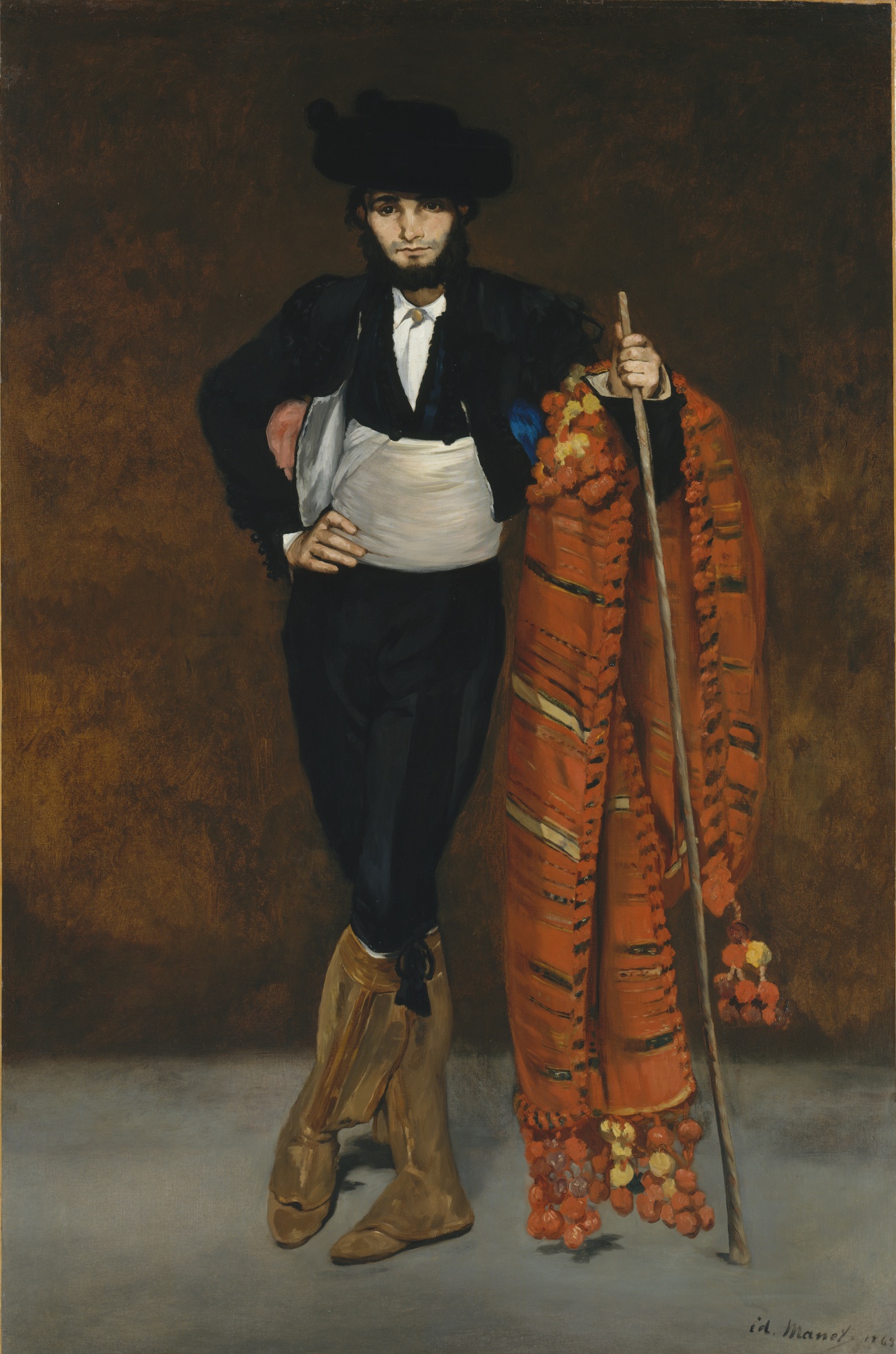
Young Man in the Costume of a Majo is a full-length portrait Édouard Manet painted in 1863: a young bearded man in a round black hat, short black jacket and white shirt stands against a brown ground, one hand on his hip, a striped red-orange blanket with tassels hanging over the other arm. The original is oil on canvas, 188 x 124.8 cm, and belongs to the Metropolitan Museum of Art in New York. One of our painters hand-paints it for you in oil on canvas, in 8 portrait sizes from 30 x 45 to 100 x 155 cm, or made to measure. Before it leaves us, you receive a photograph of the finished painting.
| Title: | Young Man in the Costume of a Majo |
| Other titles: | Jeune Homme en costume de majo (French title) · Young Man Dressed as a Majo |
| Painter: | Édouard Manet (1832–1883) |
| Year painted: | 1863 |
| Original size: | 188 cm x 124.8 cm (height x width) |
| Original technique: | Oil on canvas |
| Painting style: | Realism and Impressionism |
| Located at: | The Metropolitan Museum of Art, New York, United States |
| Our reproduction: | Hand-painted in oil on canvas, 8 sizes or made to measure |
Young Man in the Costume of a Majo – Édouard Manet
What does Young Man in the Costume of a Majo show?
The young man stands full length, with a dark beard and moustache and a round black hat with a wide brim. He wears a short black jacket, a white shirt with a gold stud at the collar and a broad white sash wound round his waist. Flashes of pink and blue lining show beneath the jacket. One hand rests on his hip; the other grips a long, thin stick.
Over his forearm hangs a striped blanket, a manta, in red-orange, yellow and dark bands, edged with thick tassels and pompoms that reach almost to the floor. His tight black breeches end in light tan leather gaiters, tied below the knee with a black cord and tassel.
There is no setting: behind him lies only a smooth brown ground that turns into a grey floor at the bottom. Manet’s signature and the date 1863 sit at the lower right. The young man looks straight at us, composed and a little proud.
Who is the man in the Spanish costume?
The model was Gustave Manet, the youngest of the three brothers, born in 1835. Édouard dressed him in the outfit of the majos, as dashing young Spaniards were colloquially known.
The painting belongs to Manet’s Spanish period, when Diego Velázquez and Spanish art shaped his work strongly. As a young painter he had copied Velázquez and Titian in the Louvre, and Frans Hals and Goya influenced him too.
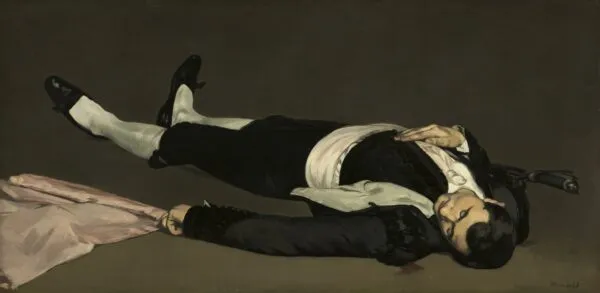
According to the French Wikipedia, critics were puzzled by the sharp contrast between the red blanket, worked in careful detail, and the barely sketched face. The middle brother, Eugène, later posed for The Matador Saluting.
Why is this painting well known?
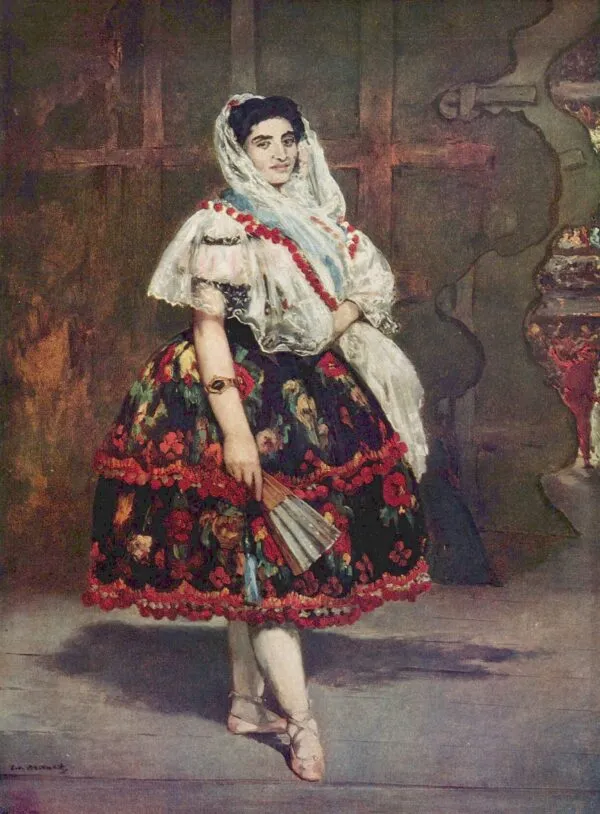
In 1863 Manet showed it at the Salon des Refusés, the parallel exhibition Emperor Napoleon III allowed for works the official Paris Salon had turned down. Beside it hung Le Déjeuner sur l’herbe and Mademoiselle V. in the Costume of an Espada, and it was Le Déjeuner sur l’herbe that set off a huge controversy.
Édouard Manet (1832–1883) was born in Paris into a wealthy family, trained under Thomas Couture and became one of the first nineteenth-century artists to paint modern life. He is seen as a pivotal figure between Realism and Impressionism, and Le Déjeuner sur l’herbe and Olympia are taken as the start of modern art.
A short entry on the work is in the English Wikipedia article on the painting, written in English.
Where is the original today?
The original is an upright oil on canvas, 188 cm high and 124.8 cm wide. It belongs to the Metropolitan Museum of Art in New York, accession number 29.100.54.
Because the painter’s brother posed for it, the work is also a family record: the youngest Manet in a foreign, splendid costume, painted in the year all Paris began talking about Édouard after the Salon des Refusés.
Young Man in the Costume of a Majo or another Manet?
This canvas painting suits anyone who loves Spain, rich costume and proud upright figures that fill a tall wall.
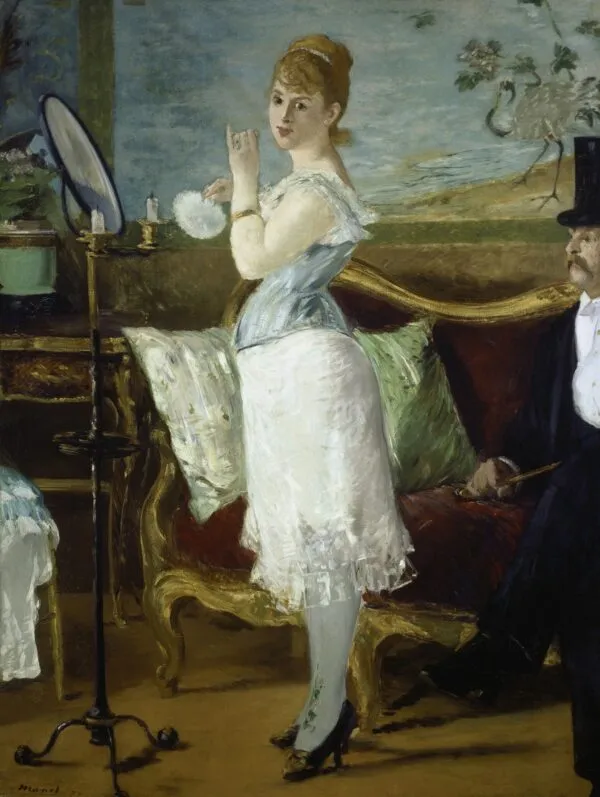
Another child portrait in dark Spanish tones is Little Lange, a small boy in a wide black hat and a long brown cape. Lighter and summery is The Croquet Game, with players in a sunlit garden, while Dead Eagle Owl is a hunting still life of an owl hanging on a wooden wall.
You will find the rest of our famous Manet paintings, every one painted to order, on the Édouard Manet page.
How do we hand-paint Young Man in the Costume of a Majo?
Manet’s original is an oil on canvas almost two metres tall. What we make is an oil painting reproduction: the painter lays oil colours onto fresh canvas in layers, at the size you picked.
He starts with the figure from hat to gaiters and the stick, which gives the painting its vertical axis. Then come the warm brown ground and the grey floor, followed by the black clothes with their deep tones, the shirt and the sash.
He spends longest on the blanket: the stripes, orange and yellow tassels and pompoms go on with denser strokes, while the face stays softer, as Manet left it. That keeps the contrast that puzzled the critics of 1863.
Which size suits which wall?
In short: 30 x 45 and 38 x 55 cm for a narrow wall or a shelf, 42 x 65 and 48 x 75 cm for a hallway or beside a door, 64 x 95 and 70 x 110 cm above a chest of drawers or in a bedroom, and 90 x 135 or 100 x 155 cm for a tall wall in a living area or entrance hall.
We paint it in 8 portrait sizes (width x height): 30 x 45, 38 x 55, 42 x 65, 48 x 75, 64 x 95, 70 x 110, 90 x 135 and 100 x 155 cm. The original measures 124.8 x 188 cm (width x height), so every one of our sizes is smaller; the largest, 100 x 155 cm, reaches about four-fifths of its height.
We stop there because the available photograph of the original does not hold enough detail for a bigger canvas. As a painting for the living room it works best at 90 x 135 or 100 x 155 cm, where the tasselled blanket and the young man’s stance read clearly from across the room.
Can I order a different size or a frame?
Yes. For other proportions we keep the whole figure, blanket and stick intact and adjust only the brown ground at the sides. Because of the photograph of the original, a custom size also stays within 100 x 155 cm. Send us the size you need, and you will hear back from us with a price and a delivery date for your majo.
Your majo leaves us rolled, stretched on a stretcher bar or framed, and our workshop in Slovenia does the stretching and framing. The moulding is picked in our 3D app, whose only job is the frame choice; seeing the painting on your own wall is a separate service.
A black or dark wood moulding repeats Gustave’s black clothes, while a warm gold or ochre one brings out the orange blanket.
When will my painting arrive, and how is it shipped?
The painter starts on Gustave as soon as you confirm the order, and the young majo is ready to ship within 15 to 45 working days. Before we pack him, you get a photograph of the finished canvas, and we adjust anything you want changed.
Your majo travels without customs duties within Slovenia and across the EU, and like every order he is covered by our returns policy.
This proud young man in Spanish dress makes a fine gift for anyone who loves Spain or the old masters. If you do not know the wall, a wall art voucher lets the recipient pick the size of their majo.
Frequently asked questions
Where can I see the original?
At the Metropolitan Museum of Art in New York, accession number 29.100.54.
Who posed for Manet?
His youngest brother, Gustave Manet, born in 1835, dressed as a Spanish majo.
Is this a print?
No print is involved: it is a hand-painted copy, worked with brushes in oil on canvas.
How big is the original?
It measures 188 x 124.8 cm (height x width); all our sizes are smaller, the largest being 100 x 155 cm.
Can I have a size that is not listed?
Yes, as long as it stays within 100 x 155 cm; send us the width and height and we will make you an offer.
How long does it take?
Between 15 and 45 working days, and before dispatch you get a photograph of the finished painting.
Does it suit a hallway, or work as a gift?
Yes. The slim upright format fits a hallway, entrance or stairwell, and as a present it pleases anyone who loves Spain.
What does the word majo mean?
It was the colloquial name for the dashing young Spaniards whose typical outfit Gustave wears here.
- Subject: a young bearded man in black Spanish costume with a red-orange blanket and a stick, before a brown ground.
- Original: oil on canvas, 1863, 188 x 124.8 cm, Metropolitan Museum of Art, New York.
- Ours: an Édouard Manet reproduction, hand-painted in oil on canvas in 8 sizes from 30 x 45 to 100 x 155 cm or to measure.
- Worth knowing: the model was Manet’s youngest brother Gustave; the painting hung at the Salon des Refusés in 1863.