







































Description
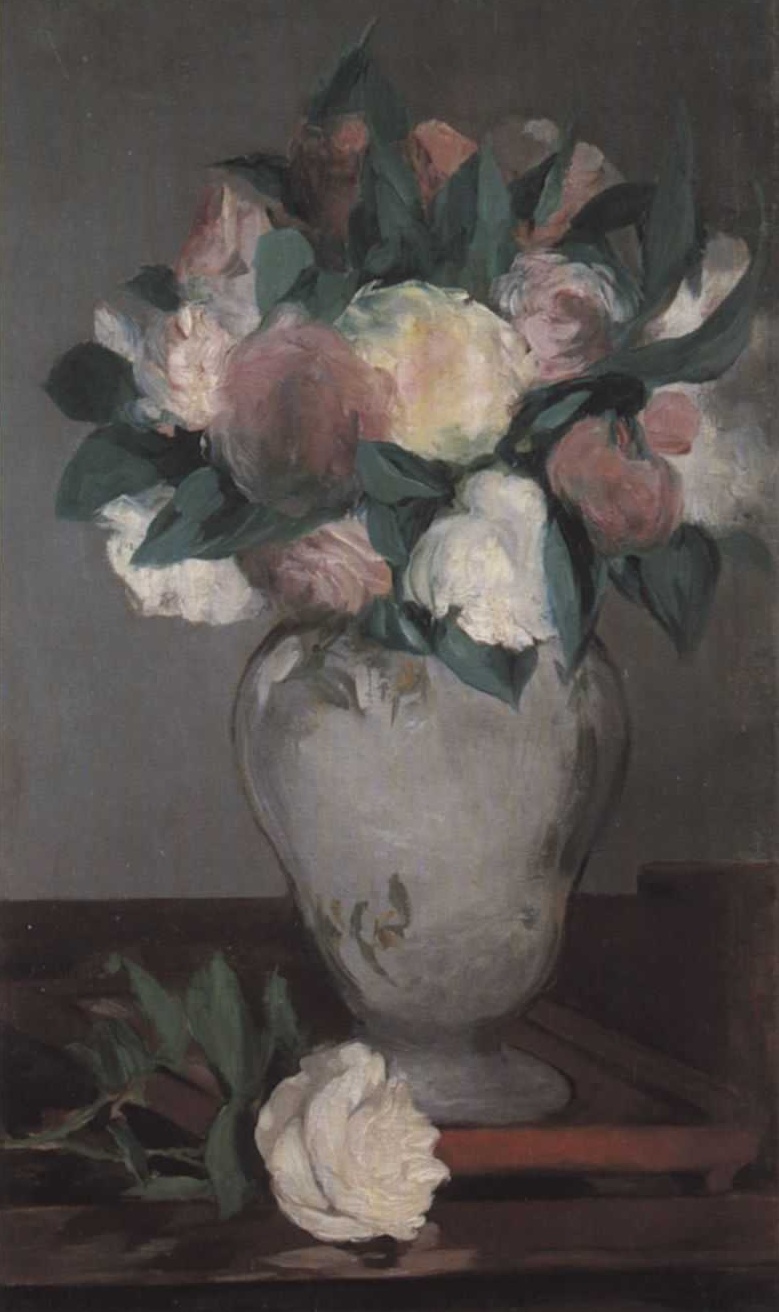
Vase of Peonies is a flower still life Édouard Manet painted in 1864–65: a tall, pale grey porcelain vase on a dark lacquered tray holds a lavish bunch of pink, white and dusky-red peonies, and a single white peony lies on the table in front. The original is oil on canvas, 59.4 x 35.2 cm, and belongs to the Metropolitan Museum of Art in New York. We paint it for you by hand in oil on canvas, in 5 portrait sizes from 29 x 47 to 60 x 105 cm, or made to measure within that range. Before your peonies leave us, you see the finished painting in a photograph.
| Title: | Vase of Peonies |
| Other titles: | Vase de pivoines sur un plateau laqué (French title) |
| Painter: | Édouard Manet (1832–1883) |
| Year painted: | 1864–65 |
| Original size: | 59.4 cm x 35.2 cm (height x width) |
| Original technique: | Oil on canvas |
| Painting style: | Realism and Impressionism |
| Located at: | The Metropolitan Museum of Art, New York, United States |
| Our reproduction: | Hand-painted in oil on canvas, 5 sizes or made to measure |
Vase of Peonies – Édouard Manet
What does Vase of Peonies show?
In the middle of the upright canvas stands a tall vase of pale grey, almost white porcelain, round-bellied with a narrow neck. With a few quick touches Manet suggested small painted flower sprigs on it. The vase sits on a dark lacquered tray with a reddish rim, and the tray on a dark wooden table.
A big bunch of peonies spills out of the vase. Some blooms are pink, others white with a creamy yellow heart, and near the top dark red buds and half-open flowers hide among the leaves. Pointed dark green leaves push out between them and give the bouquet its shape and depth.
At the lower left a single white peony lies on the table with a long stem and a few leaves, as if someone had just put it down. The background is an even grey with a faint green cast, so the flowers stand out as patches of light.
Where do peonies fit in Manet’s work?
This bouquet belongs to a group of flower still lifes Manet painted in 1864 and 1865. From the same years comes Branch of White Peonies and Shears, which we also offer: a branch of white peonies with a pair of shears and no vase.
The painting tells no story, and the sources give it no special symbolism; its subject is the flowers themselves, their colours and shapes.
Manet is credited with saying that an artist can say everything he has to say with flowers, fruit and clouds. Flowers stayed with him to the end: his last paintings show flowers in glass vases, twenty of them are known, and he painted the last in March 1883, barely two months before his death.
Why is this peony painting worth a closer look?
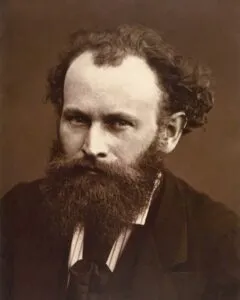
A Parisian from a wealthy family, Édouard Manet (1832–1883) learned his craft under Thomas Couture and copied Velázquez and Titian in the Louvre. He is seen as one of the first nineteenth-century artists to paint modern life and as a pivotal figure in the move from Realism to Impressionism.
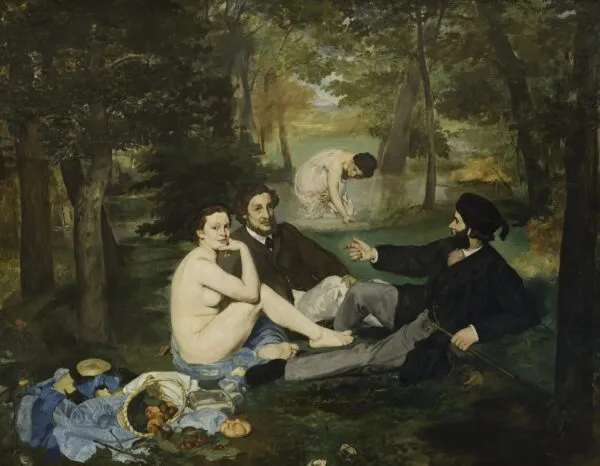
He painted these peonies in stormy years. At the Salon des Refusés of 1863 he showed Le Déjeuner sur l’herbe, and at the Salon of 1865 Olympia caused a scandal; both are now seen as the start of modern art. This calm canvas came into being between those two storms.
From his early years his style was marked by loose brushstrokes, simplified detail and the suppression of transitional tones, and all of it shows in these peonies. For more about the painter, read the Wikipedia article on Édouard Manet, written in English; the painting has no article of its own.
Where is the original kept?
The Metropolitan Museum of Art in New York holds the original under accession number 1976.201.16; it is oil on canvas and measures 59.4 x 35.2 cm (height x width).
Its French title also names the lacquered tray, which you can see on the canvas as the dark, red-rimmed surface beneath the vase.
Vase of Peonies or another Manet?
This is a canvas painting for anyone who loves flowers, soft colour and quiet, with no figures and no plot. Its narrow upright format sits well between two windows, beside a door or above a bedside table.
Also from 1864 is The Dead Christ with Angels, one of Manet’s rare religious subjects, held by the same New York museum; it also owns Boy Carrying a Sword, a boy dressed as a Spanish page with a heavy sword. If bright whites and greens draw you, look at The Reading, Manet’s wife Suzanne in a white muslin dress, or Madame Manet at the Piano, her profile at an upright piano.
More famous Manet paintings, from portraits to still lifes, are on our Édouard Manet page.
How do we hand-paint Vase of Peonies?
Manet’s original is a small oil on canvas, 59.4 cm high. Ours is an oil painting reproduction on new canvas: the painter works it in oil on canvas, in the size you choose, building it up in layers.
He first lays in the grey-green ground, the dark table and the outline of vase and tray in thinner paint. Then he builds the flowers from dark to light: the red buds and green leaves first, then the pink blooms, and last the white peonies in thicker paint.
Manet painted the petals with loose, soft strokes and no fussy detail. Our painter keeps that lightness, since a carefully outlined peony would lose its life.
Which size suits which wall?
In short: 29 x 47 cm for a shelf or a narrow strip of wall, 40 x 65 and 48 x 80 cm above a chest of drawers or in a hallway, and 55 x 90 or 60 x 105 cm between two windows or beside a sofa.
We paint it in 5 portrait sizes (width x height): 29 x 47, 40 x 65, 48 x 80, 55 x 90 and 60 x 105 cm. The original measures 35.2 x 59.4 cm (width x height), so only 29 x 47 cm is smaller, 40 x 65 cm is slightly larger, and 48 x 80, 55 x 90 and 60 x 105 cm are clearly larger than the original.
We stop at 60 x 105 cm on purpose. The only good photograph of the original that we paint from is small, and at a bigger size we could no longer follow the strokes and colours precisely.
As a painting for the living room it works best at 55 x 90 or 60 x 105 cm, where the bouquet still fills the eye from the sofa.
Can I order another size or a frame?
Yes, within the same range: up to 60 cm wide and 105 cm high. If your wall needs other proportions, we keep the vase, the bouquet and the fallen peony whole and adjust only the grey background. Tell us your preferred size for the peonies, and we will come back with a price and a date.
Your peonies travel rolled, stretched on a stretcher bar or ready framed. Our workshop in Slovenia does the stretching and framing and packs each painting safely for the road. You choose the moulding in our 3D app, which is there only for picking a frame; viewing the painting on your own wall is a separate service.
When will the painting arrive, and how is it sent?
The painter starts on your peonies once you confirm the order, and they are ready to ship within 15 to 45 working days. Before we pack it, we send you a photograph of your finished painting and make any changes you ask for.
Within Slovenia and to every other EU country it travels with no customs duties, and every order is covered by our returns policy.
A bunch of peonies makes a lovely gift for a birthday, a wedding or a new home. Not sure which wall it will hang on? Give a wall art voucher and let the person you give it to choose the size.
Frequently asked questions
Where can I see the original?
At the Metropolitan Museum of Art in New York, accession number 1976.201.16.
Which flowers are in the painting?
Peonies in pink, white and dusky red in a porcelain vase; one white peony lies on the table.
Is this a print?
No. You receive a hand-painted copy, worked stroke by stroke in oil on canvas.
How big is the original?
It measures 59.4 x 35.2 cm (height x width); our sizes from 40 x 65 cm up are larger.
Why is there nothing above 60 x 105 cm?
Because the only good photograph of the original is small; made to measure, we paint any size up to 60 x 105 cm.
How long does it take?
Usually 15 to 45 working days, and you see the finished peonies in a photograph before they ship.
Is it right for a bedroom, or as a gift?
Yes. The quiet bouquet in soft colours sits well in a bedroom, and as a gift it pleases anyone who loves flowers.
Did Manet paint other flowers?
Yes. He painted flower still lifes in 1864–65, and his last paintings show flowers in glass vases.
- Subject: pink, white and dusky-red peonies in a porcelain vase on a lacquered tray, with one white bloom on the table.
- Original: oil on canvas, 1864–65, 59.4 x 35.2 cm, The Metropolitan Museum of Art, New York.
- Ours: an Édouard Manet reproduction hand-painted in oil on canvas, 5 sizes from 29 x 47 to 60 x 105 cm, or made to measure within that range.
- Worth knowing: its sister picture, Branch of White Peonies and Shears, dates from the same years.