







































Description
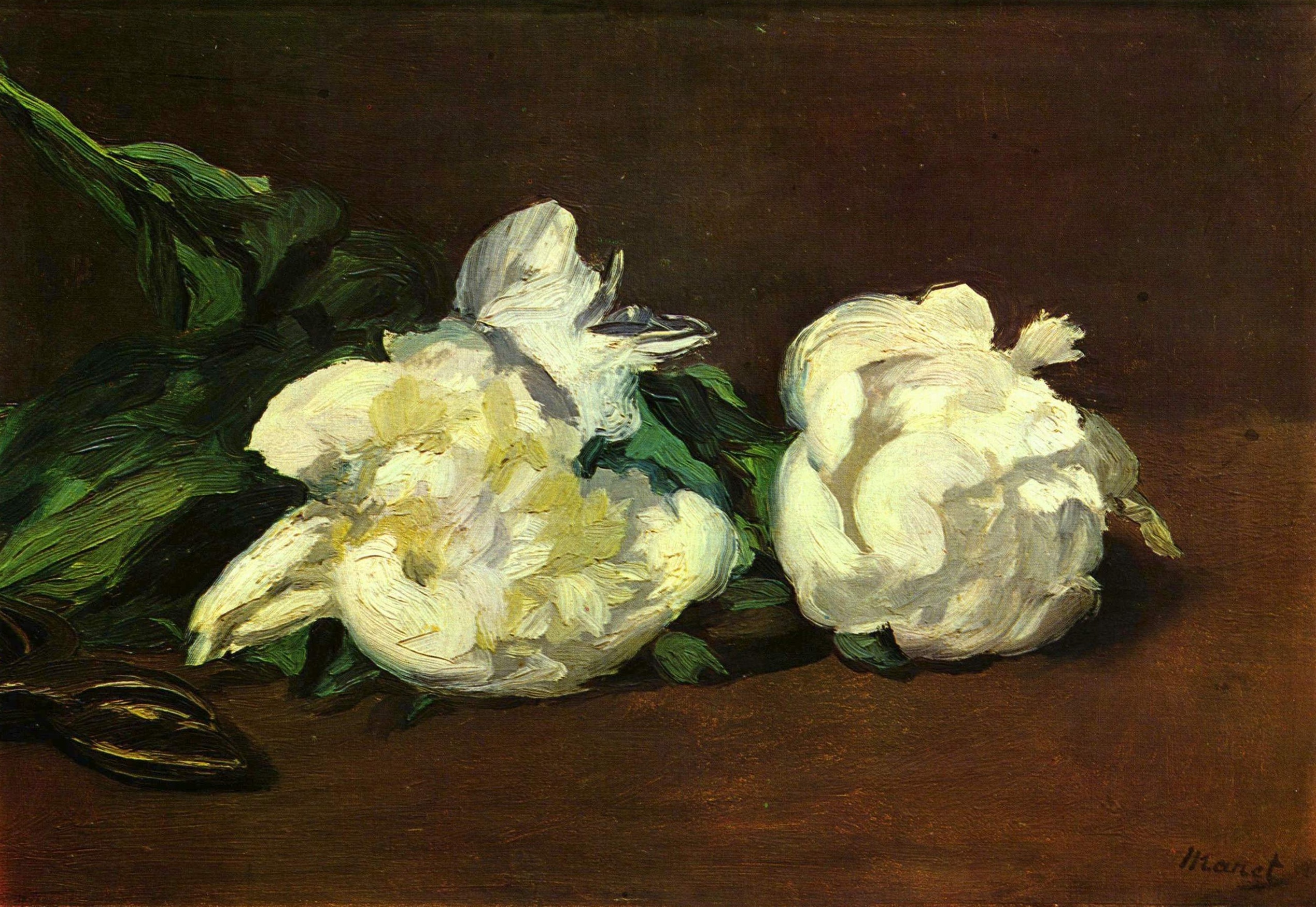
Branch of White Peonies and Shears is a still life by Édouard Manet from 1864: two large white peonies, one fully open and one half open, lie with their green leaves on a dark table, with a pair of pruning shears at the lower left. The original is a small oil on canvas, 31.8 x 46.5 cm, held by the Musée d’Orsay in Paris. Our painter paints it for you by hand in oil on canvas, in 8 landscape sizes from 45 x 30 to 200 x 130 cm, or made to measure. Before the peonies leave us, you receive a photograph of your finished painting.
| Title: | Branch of White Peonies and Shears |
| Other titles: | Branche de pivoines blanches et sécateur (French title) · Due peonie bianche e un paio di forbici (Italian title) |
| Painter: | Édouard Manet (1832–1883) |
| Year painted: | 1864 |
| Original size: | 31.8 cm x 46.5 cm (height x width) |
| Original technique: | Oil on canvas |
| Painting style: | Realism and Impressionism |
| Located at: | Musée d’Orsay, Paris, France |
| Our reproduction: | Hand-painted in oil on canvas, 8 sizes or made to measure |
Branch of White Peonies and Shears – Édouard Manet
What does Branch of White Peonies and Shears show?
Two big white peony blooms lie on a dark brown tabletop. The one on the left is fully open, its dense, fleshy petals folded around yellowish, grey and bluish shadows. The one on the right is still half closed, round as a ball of wool, with only a few upper petals pulling away.
Behind the flowers a sheaf of dark green leaves reaches in from the left edge of the canvas, as if the branch had just been laid down. At the lower left, almost lost in shadow, lie the shears, their metal catching only a few glints of light.
The background is an even dark brown, with no window, vase or cloth, which is exactly why the white of the flowers glows so strongly. Manet’s signature sits on the tabletop at the lower right.
What does this still life mean?
The painting tells no story, and the sources assign it no hidden message. Its subject is painting itself: how white paint, laid on in thick, generous strokes, turns into a soft, almost downy flower. The Italian Wikipedia notes that Manet cares less here for fine detail than for how colours sit beside and against each other.
Manet often worked still-life passages into his big compositions, such as the bouquet in Olympia or the overturned basket of fruit in Le Déjeuner sur l’herbe. He painted still lifes as works in their own right only in 1864 and 1865 and again in the early 1880s.
He liked to say that his greatest ambition was to become the Saint Francis of still life. Branch of White Peonies and Shears ranks among the finest examples of that side of his work.
Why is this still life so admired?
It dates from 1864, between two great upheavals in Manet’s career: a year earlier Le Déjeuner sur l’herbe had caused an uproar at the Salon des Refusés, and a year later Olympia would do the same at the Salon. Édouard Manet (1832–1883) was among the first painters of modern life and a pivotal figure in the move from Realism to Impressionism.
The flowers fill almost the whole canvas and stand out sharply from the dark ground in tone and in the liveliness of the brushwork. The white is never smoothed to a porcelain sheen; it stays visible as thick paint, so up close you can follow every stroke.
For more on the work, see the Italian Wikipedia article on the painting, which is written in Italian.
Where is the original, and how did it get there?
The original, oil on canvas measuring just 31.8 x 46.5 cm (height x width), belongs to the Musée d’Orsay in Paris, under inventory number RF 1995.
Soon after painting it, Manet gave it to his friend Champfleury, a well-known Realist novelist. Count Isaac de Camondo bought it in 1899 and gave it to the Louvre in 1908; since 1986 it has hung at the Musée d’Orsay.
Branch of White Peonies and Shears or another Manet?
This canvas painting suits anyone who prefers calm to narrative: no face, no crowd, just two flowers, some leaves and a piece of metal on a dark table.
If you are after a Manet portrait, look at Berthe Morisot Reclining, the head and shoulders of a dark-haired young woman in a black dress leaning against a dark cushion, or Autumn (Méry Laurent), a woman in profile in a fur coat before a pale blue fabric strewn with flowers.
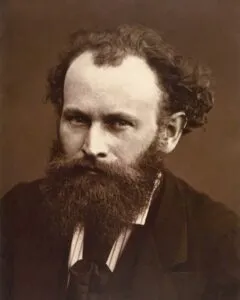
The painter himself, standing in an ochre-gold jacket with a skull-cap on his head, appears in Self-Portrait, and a young nude woman beside a pool in a wooded glade in La Nymphe surprise.
Our Édouard Manet page gathers more famous Manet paintings, from still lifes to portraits.
How do we hand-paint Branch of White Peonies and Shears?
Manet’s original is a small oil on canvas, barely 46.5 cm wide. Ours is an oil painting reproduction worked by hand: the painter lays it down in oil on fresh canvas, layer upon layer, in the size you pick.
He first lays the dark brown ground of table and background and marks the table edge, then draws the outlines of both blooms, the leaves and the shears. The white flowers are built from shadow to light: first the yellowish, grey and bluish tones, last the densest white on the petal tips.
Manet painted the blooms in thick, decisive strokes, so our painter does not smooth them away. In the larger sizes those strokes show even more clearly, and they are what gives the peonies their softness.
Which size suits which wall?
In short: 45 x 30 or 56 x 40 cm for a shelf, above a bedside table or in a kitchen, 63 x 45 and 83 x 57 cm above a chest of drawers or in a bedroom, 105 x 75 and 120 x 83 cm above a sofa, and 155 x 105 or 200 x 130 cm for a large wall.
We paint it in 8 landscape sizes (width x height): 45 x 30, 56 x 40, 63 x 45, 83 x 57, 105 x 75, 120 x 83, 155 x 105 and 200 x 130 cm. The original measures 46.5 x 31.8 cm (width x height), so 45 x 30 cm is almost the same and just slightly smaller, while every other size enlarges it, the largest to more than four times its width.
As a painting for the living room it looks best at 105 x 75 or 120 x 83 cm above the sofa, where the white blooms shine from the doorway.
Can I order another size or a frame?
Yes. If your wall needs different proportions, we keep both blooms, the leaves and the shears whole and adjust only the amount of dark ground and table around them, so nothing essential is lost. Send us the size you need, and we reply with a price and a production time.
The peonies travel rolled, stretched on a stretcher bar or framed. Our workshop in Slovenia does the stretching and framing and packs each piece carefully. The moulding for your peonies is chosen in our 3D app, which serves only to pick a frame; seeing the painting on your own wall is a separate service.
Dark wood continues the brown ground; a slim gold moulding echoes the gleam of the shears.
When will my painting arrive?
The painter starts on the peonies as soon as you confirm your order, and the painting is ready to ship within 15 to 45 working days. Before packing we send you a photograph of your peonies, and any change you ask for is made.
Within Slovenia and across the European Union there are no customs duties, and our returns policy covers every order.
White peonies make a lovely gift for a wedding, an anniversary, a new home or anyone who loves a garden. Unsure of the wall? With a wall art voucher, the recipient picks the size of the peonies.
Frequently asked questions
Where can I see the original?
At the Musée d’Orsay in Paris, where it is listed under inventory number RF 1995.
Which flowers are in the painting?
Two white peonies, one in full bloom and one half open, with green leaves and a pair of pruning shears beside them.
Is this a print?
No, each one is a hand-painted copy, with every stroke set down by our painter with a brush and oil paint.
How big is the original?
Only 31.8 x 46.5 cm (height x width), so almost every one of our sizes enlarges it.
Can I have the peonies in a size that is not listed?
Yes. Write to us with the width and height you need, and we will prepare an offer with a price and a deadline.
How long does it take to make?
Between 15 and 45 working days; before shipping you receive a photograph of the finished painting to approve.
Do white peonies suit a bedroom or make a good gift?
Yes. Calm white flowers on a dark ground settle a bedroom, and as a present they delight anyone who loves flowers.
What did Manet say about still life?
He liked to say that above all he wanted to become the Saint Francis of still life.
- Subject: two white peonies with green leaves and a pair of pruning shears on a dark table.
- Original: oil on canvas, 1864, 31.8 x 46.5 cm, Musée d’Orsay, Paris.
- Ours: an Édouard Manet reproduction hand-painted in oil on canvas, 8 sizes from 45 x 30 to 200 x 130 cm, or made to measure.
- Worth knowing: one of Manet’s finest still lifes; he gave it to the writer Champfleury.