







































Description
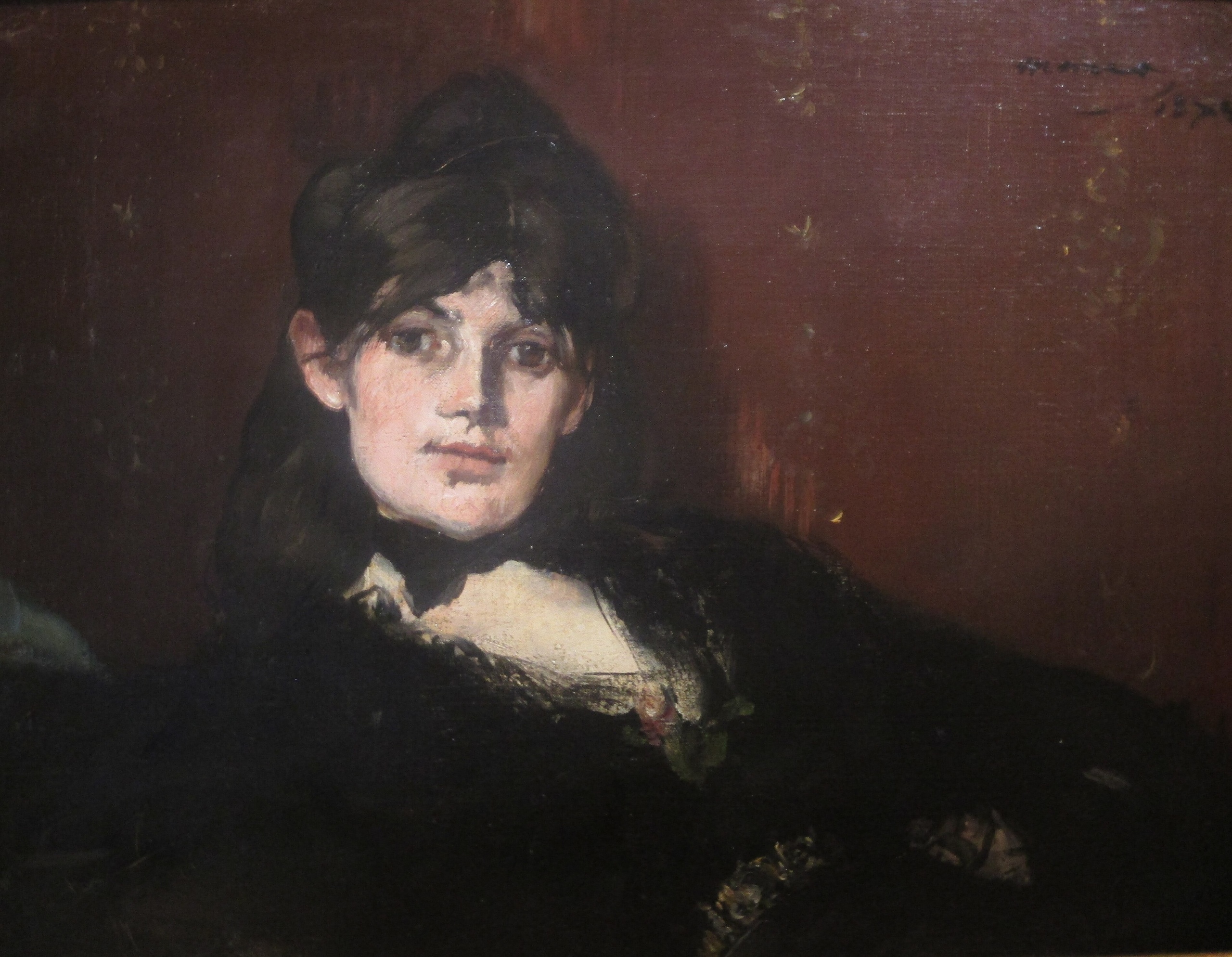
Berthe Morisot Reclining is a small portrait Édouard Manet painted in 1873: the painter Berthe Morisot, with dark hair and large dark eyes, in a black dress with a black ribbon at her throat, leans back against a dark cushion in front of a deep red-brown ground. The original is oil on canvas, only 26 x 34 cm, and it belongs to the Musée Marmottan Monet in Paris. Our painter paints it for you by hand in oil on canvas, in 8 landscape sizes from 40 x 30 to 190 x 150 cm, or made to measure. Before it ships, you receive a photograph of the finished portrait.
| Title: | Berthe Morisot Reclining |
| Other titles: | Portrait de Berthe Morisot étendue (French title) |
| Painter: | Édouard Manet (1832–1883) |
| Year painted: | 1873 |
| Original size: | 26 cm x 34 cm (height x width) |
| Original technique: | Oil on canvas |
| Painting style: | Realism and Impressionism |
| Located at: | Musée Marmottan Monet, Paris, France |
| Our reproduction: | Hand-painted in oil on canvas, 8 sizes or made to measure |
Berthe Morisot Reclining – Édouard Manet
What does Berthe Morisot Reclining show?
We see the head and shoulders of a young woman propped against a cushion, her body slipping away diagonally towards the right edge. Her dark hair is pinned up high, and a short lock falls across her forehead. Her large dark eyes look straight at the viewer; her lips are pink, her face pale and brightly lit.
She wears a black dress laid in with broad, loose strokes across the lower half of the canvas. A black ribbon is tied beneath her chin, a white collar shows above the neckline, and a small pink flower with green leaves sits at her breast. At the left edge there is a pale, bluish patch.
The background is an even, dark red-brown, flecked with tiny touches of gold. At the upper right Manet signed with a few dark strokes.
Who was Berthe Morisot, and why do we see only her head and shoulders?
Berthe Morisot was a painter and a member of the Impressionist group. The Paris Salon accepted her first painting in 1864, and she went on showing there for the next ten years. She and Manet became friends and colleagues in 1868.
She is credited with persuading Manet to try painting outdoors, which she had practised since her friend Camille Corot introduced her to it. The exchange ran both ways, and Manet took some of her techniques into his own work. In 1874 she married his brother Eugène and became his sister-in-law.
The portrait you see is not the whole of the first composition. It is a cropped fragment of a larger canvas that showed the young woman lying on a sofa; what remains is her face, her shoulders and part of her dress, which brings her gaze very close.
Why is this portrait so loved?
Édouard Manet (1832–1883) was among the first nineteenth-century artists to paint modern life and is seen as a pivotal figure between Realism and Impressionism. Through Berthe Morisot, who drew him into the group’s activities, he befriended Degas, Monet, Renoir, Sisley, Cézanne and Pissarro, yet he did not exhibit with the Impressionists and stayed loyal to the Salon.
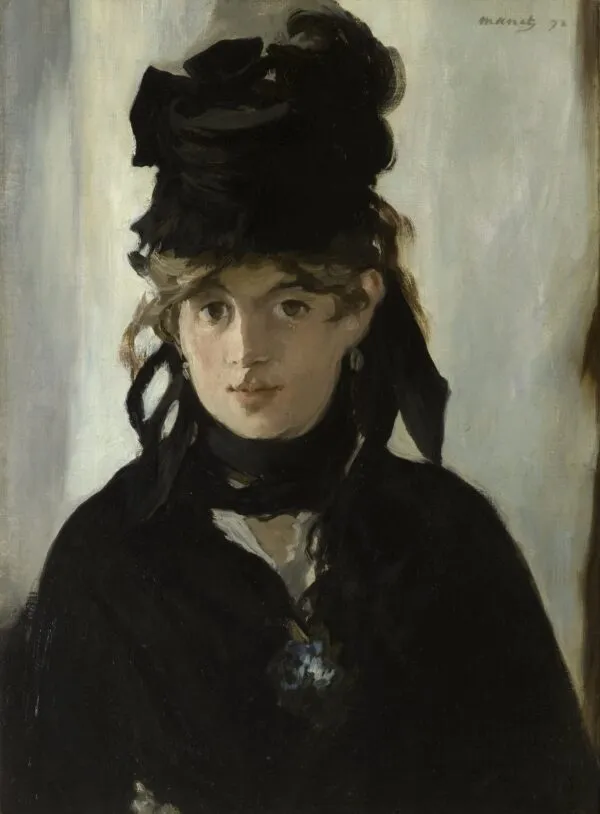
Before her marriage Manet painted her in numerous portraits. Two more of our paintings show her as well: Berthe Morisot with a Bouquet of Violets and Repose.
The Impressionists, Monet and Morisot above all, led Manet towards lighter colours, but he kept his distinctive black. Here that black carries the dress, the ribbon and the hair and frames the pale face. A short entry on the work is in the French Wikipedia article, written in French.
Where is the original today?
The original is oil on canvas, 26 x 34 cm (height x width), smaller than a sheet of A3 paper. It belongs to the Musée Marmottan Monet in Paris, under inventory number 6086.
It came to the museum through a bequest in 1993.
Berthe Morisot Reclining or another Manet?
This is a canvas painting for anyone who prefers one face and one gaze to a crowd of details. Its dark tones and intimate format suit a bedroom, a home office or a reading corner.
Manet’s own face appears in his Self-Portrait, where he stands full-length in an ochre jacket with a small skull-cap on his head. Another woman in profile, Méry Laurent in a fur coat before a flowered Japanese fabric, is the subject of Autumn (Méry Laurent).
From his early years come La Nymphe surprise, a nude of Suzanne Leenhoff, whom Manet married in 1863, and Boy with Cherries, a smiling boy in a red cap with his hands full of cherries. You will find more famous Manet paintings, all painted to order, on the Édouard Manet shelf.
How do we hand-paint Berthe Morisot Reclining?
Manet’s original is an oil on canvas barely 34 cm wide. Ours is an oil painting reproduction on new canvas: the painter lays on oil colour in thin and thicker layers, in the size you have chosen.
He starts with the warm red-brown ground and the dark mass of dress and cushion, because those two tones set the balance of light and shadow. Then he builds the face: the pale skin, the shadows beside the nose, the pink lips and above all the eyes, on which it depends whether the portrait meets you as directly as the original does.
Manet painted the dress with quick, broad strokes and the face more densely and carefully. Our painter keeps that difference and adds the white collar, the pink flower, the gold flecks and the signature last.
Which size suits which wall?
In short: 40 x 30 or 50 x 40 cm for a bedside table, a shelf or a desk, 60 x 45 and 75 x 58 cm above a chest of drawers or in a bedroom, 95 x 75 and 120 x 95 cm above a sofa or a bed, and 150 x 120 or 190 x 150 cm for a large wall.
We paint the portrait in 8 landscape sizes (width x height): 40 x 30, 50 x 40, 60 x 45, 75 x 58, 95 x 75, 120 x 95, 150 x 120 and 190 x 150 cm. The original measures only 34 x 26 cm (width x height), so every one of our sizes is larger: 40 x 30 cm only just exceeds it, while 190 x 150 cm is more than five times as wide.
As a painting for the living room it works best at 95 x 75 or 120 x 95 cm above the sofa, where her dark gaze greets everyone who comes in.
Can I order another size or a frame?
Yes. If your wall needs other proportions, we adjust only the edge of the red ground and the cushion and keep the face, the ribbon and the flower whole. Tell us the size you have in mind for her portrait, and we will quote a price and a date.
The portrait leaves us rolled, stretched on a stretcher bar or framed, as you prefer. Stretching and framing are done in our workshop in Slovenia, which also packs the portrait for its journey. Our 3D app lets you pick the moulding and serves that purpose alone; a view of the painting on your own wall is a separate service.
A narrow black moulding continues the black of the dress, while a warm gold one lifts the red ground and its gold flecks.
When will your painting arrive?
Work on the red ground and her face begins once you confirm the order, and the portrait is ready to ship within 15 to 45 working days. We send you a photograph of the finished portrait before packing and touch it up in line with your comments.
Delivery within Slovenia and across the EU carries no customs duties, and every order falls under our returns policy.
A portrait of a painter makes a fine gift for someone who paints or loves Impressionism. If you do not know the wall, give a wall art voucher and let the recipient choose.
Frequently asked questions
Where can I see the original?
At the Musée Marmottan Monet in Paris, where it arrived through a bequest in 1993.
Who is the woman in the portrait?
The painter Berthe Morisot, Manet’s friend, who became his sister-in-law a year later.
Is this a print?
No. You get a canvas our painter has worked with a brush in oil colours: a hand-painted copy with no printing involved.
How big is the original?
Only 26 x 34 cm (height x width); all eight of our sizes are larger.
Can I order it in a size that is not on the list?
Yes. Send us the width and height you need, and we will prepare an offer with a delivery time.
How long does it take to make?
Between 15 and 45 working days, and before it leaves you see it in a photograph.
Is it right for a bedroom, or as a gift?
Yes. The calm, dark portrait suits a bedroom or a home office, and as a present it pleases anyone who likes to paint.
Why is only the upper body visible?
Because it is a cropped fragment of a larger composition in which Berthe Morisot lay on a sofa.
- Subject: Berthe Morisot in a black dress with a black ribbon, leaning on a dark cushion before a red-brown ground.
- Original: oil on canvas, 1873, 26 x 34 cm, Musée Marmottan Monet, Paris.
- Ours: this Édouard Manet reproduction, hand-painted in oil on canvas in 8 sizes from 40 x 30 to 190 x 150 cm or made to measure.
- Worth knowing: Berthe Morisot was a painter in the Impressionist circle and, from 1874, Manet’s sister-in-law.