







































Description
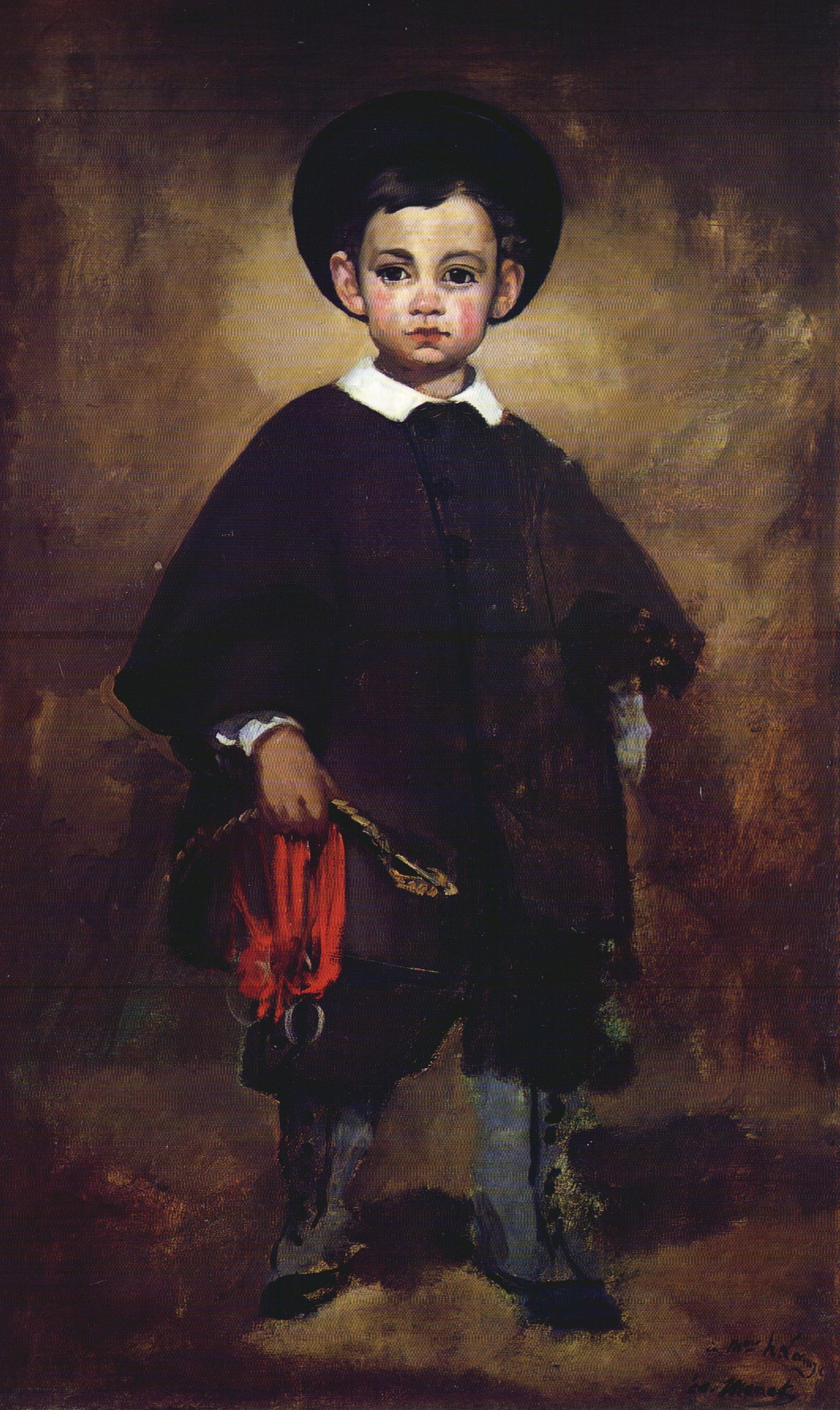
Little Lange is Édouard Manet’s portrait of a boy of about five, painted around 1861: in a wide black hat and a long dark cape with a white collar, the child stands before a warm brown ground, holding red reins and a whip. The original is oil on canvas, 117 x 71 cm, and it belongs to the Staatliche Kunsthalle Karlsruhe in Germany. Our painter paints it for you by hand in oil on canvas, in 8 portrait sizes from 29 x 46 to 120 x 188 cm, or made to measure.
| Title: | Little Lange |
| Other titles: | Le Petit Lange (French title) |
| Painter: | Édouard Manet (1832–1883) |
| Year painted: | about 1861 |
| Original size: | 117 cm x 71 cm (height x width) |
| Original technique: | Oil on canvas |
| Painting style: | Realism and Impressionism |
| Located at: | Staatliche Kunsthalle Karlsruhe, Karlsruhe, Germany |
| Our reproduction: | Hand-painted in oil on canvas, 8 sizes or made to measure |
Little Lange – Édouard Manet
What does Little Lange show?
The boy faces us squarely, feet slightly apart, with large dark eyes, pink cheeks and a grave, closed mouth. His broad-brimmed black hat is pushed back to show dark, side-parted hair.
He wears a dark brown, almost black cape with a row of buttons, his white shirt collar turned over it and a white cuff at the wrist. Below come knee breeches, grey gaiters with black buttons and dark shoes.
In his right hand he grips red tasselled reins and a plaited whip, toys of the day; the other arm is only hinted at. Broad, loose strokes of brown and grey-green make the background, lightest around the head, with the dedication and signature at the lower right.
Who is the boy in the black hat?
Art historians long struggled to name the boy. Manet wrote the dedication “à Mme h. Lange” on the canvas, which suggests he meant the portrait for a Mrs Lange and that the child was her son. The initial before the surname is unexplained; Juliet Wilson-Bareau notes that the “h” could be an “n”.
According to the biographer Adolphe Tabarant, Madame Lange came to the Tuesday salon of Manet’s mother and wife. In the Manet family album the name Lange appears under a photograph of a seated man, beside a girl’s photograph marked 1861 on the back; hence the date.
In 1916 Théodore Duret, Manet’s friend and biographer, told the Danish collector Vilhelm Hansen that the boy was a son of a Monsieur Lange, a colleague of Ferdinand de Lesseps on the Suez Canal. The Wildenstein Institute names the father as Daniel Adolphus Lange, but which son sat for Manet is still unknown.
Why is this portrait so admired?
It is an early work by Édouard Manet (1832–1883), the Paris painter who was among the first of his century to paint modern life and a pivotal figure between Realism and Impressionism. Its sketchy handling in places already points to his later Impressionist work.
Spain was in fashion in early-1860s Paris, partly thanks to the Spanish-born Empress Eugénie, and Manet was copying Velázquez, his favourite Spanish painter, in the Louvre; the dark palette recalls Spanish Golden Age painting. It is often compared with his Boy with a Sword and The Old Musician (1862).
Goya is present too: in his portrait of Pepito Costa y Bonelis a boy stands in a similar pose among his toys, and the red plume on the hat may return in the red reins. Watteau’s Gilles in the Louvre is cited too, for its pose, hat and melancholy. The dating and the models are set out in the Wikipedia article on the painting, written in English.
Where is the original, and how did it reach Karlsruhe?
The original, oil on canvas measuring 117 x 71 cm (height x width), belongs to the Staatliche Kunsthalle Karlsruhe, under inventory number 2482.
It stayed with the Lange family for decades. Bernheim-Jeune in Paris offered it in 1911; by way of Alexander von Frey and a 1913 showing at Thannhauser in Munich it reached the Leipzig industrialist Paul von Bleichert.
Later it belonged to the New York dealer Howard Young, uncle of the actress Elizabeth Taylor, and then to Annie Swan Coburn of Chicago. For some years it hung at the Art Institute of Chicago, home also to Manet’s Jesus Mocked by the Soldiers, the bound Christ with his crown of thorns among three soldiers.
After a 1944 auction at Parke-Bernet in New York, it reached Karlsruhe in 1962 through the Düsseldorf dealer Wilhelm Grosshenning, bought with state lottery money from Baden-Württemberg.
Little Lange or another Manet?
This is a canvas painting for anyone moved by a serious child’s gaze and a warm, dark palette; the upright format suits a wall beside a door or between two windows.
From the same early years comes Fishing, a river landscape with a rainbow and a couple in seventeenth-century dress. The Manet of the 1870s appears in Woman with Fans, a woman in black reclining before Japanese fans, and The Waitress, a young woman carrying beer glasses before a stage.
Our Édouard Manet page gathers the other famous Manet paintings we paint to order.
How do we hand-paint Little Lange?
Manet’s original is an oil on canvas 117 cm tall, with the boy shown close to life size. Ours, an oil painting reproduction, is built up in thin layers of oil on canvas at whatever size you pick.
First he draws the figure, hat and cape and checks the face, since the whole portrait rests on the boy’s gaze. Then he lays in the warm browns of the ground and the near-black clothes, with in-between tones so the cape does not sink into the dark.
Last come the pink cheeks, the light in the eyes, the white collar, the grey gaiters and the red reins. He works the face with more care and leaves the background and the other arm loose, as Manet left them.
Which size suits which wall?
In short: 29 x 46 or 40 x 63 cm for a shelf or a narrow wall, 48 x 80 and 55 x 90 cm for a hallway or a child’s room, 62 x 106 and 81 x 130 cm above a chest of drawers or beside a sofa, and 90 x 150 or 120 x 188 cm for a tall wall or a stairwell.
We paint it in 8 portrait sizes (width x height): 29 x 46, 40 x 63, 48 x 80, 55 x 90, 62 x 106, 81 x 130, 90 x 150 and 120 x 188 cm. The original measures 71 x 117 cm (width x height), so the five sizes up to 62 x 106 cm are smaller than it, 62 x 106 cm comes close, and 81 x 130, 90 x 150 and 120 x 188 cm are larger than the original.
As a painting for the living room it works best at 81 x 130 cm beside the sofa or a bookcase, where the boy’s grave look greets everyone who walks in.
Can I order a custom size and a frame?
Yes. For other proportions we keep the boy whole, from hat to shoes, and adjust only the edge of the brown ground. Tell us the size you need and we quote a price and a date for this portrait.
It travels rolled, on a stretcher bar or framed, and the stretching and framing are done in our workshop in Slovenia. Mouldings are picked in our 3D app, which handles frame choice alone; a view of the painting on your own wall is a separate service.
When will my painting arrive?
Work on the boy starts the day you confirm, and the portrait is ready to ship within 15 to 45 working days. You see it in a photograph before packing, and we adjust anything you ask.
The portrait crosses Slovenia and the rest of the EU with no customs duties, and our returns policy applies.
It makes a fine present for new parents or a christening. If the wall is a mystery, a wall art voucher leaves the size to the person receiving it.
Frequently asked questions
Where can I see the original?
At the Staatliche Kunsthalle Karlsruhe in Germany, under inventory number 2482.
Who is the boy in the portrait?
One of the sons of the Lange family, friends of Manet; exactly which son remains unknown.
Is this a print?
No. You receive a hand-painted copy, made stroke by stroke by our painter in oil on canvas.
How big is the original?
It measures 117 x 71 cm (height x width); our 81 x 130, 90 x 150 and 120 x 188 cm sizes are larger.
Is there a size that is not on the list?
Yes. Send the width and height you need and we will quote.
How long does it take to make?
15 to 45 working days; you see the finished boy in a photograph before he ships.
Is it right for a nursery or as a present?
Yes: it sits quietly in a child’s room and pleases new parents as a gift.
What do the whip and the red reins mean?
They are children’s toys of the period; they may echo Goya’s portrait of a boy with a wooden horse and red plumes.
- Subject: a boy in a black hat and a dark cape with a white collar, red reins and a whip in his hand.
- Original: oil on canvas, about 1861, 117 x 71 cm, Staatliche Kunsthalle Karlsruhe.
- Ours: an Édouard Manet reproduction painted by hand in oil on canvas, 8 sizes from 29 x 46 to 120 x 188 cm, or made to measure.
- Worth knowing: Manet wrote the dedication “à Mme h. Lange” straight onto the canvas.