







































Description
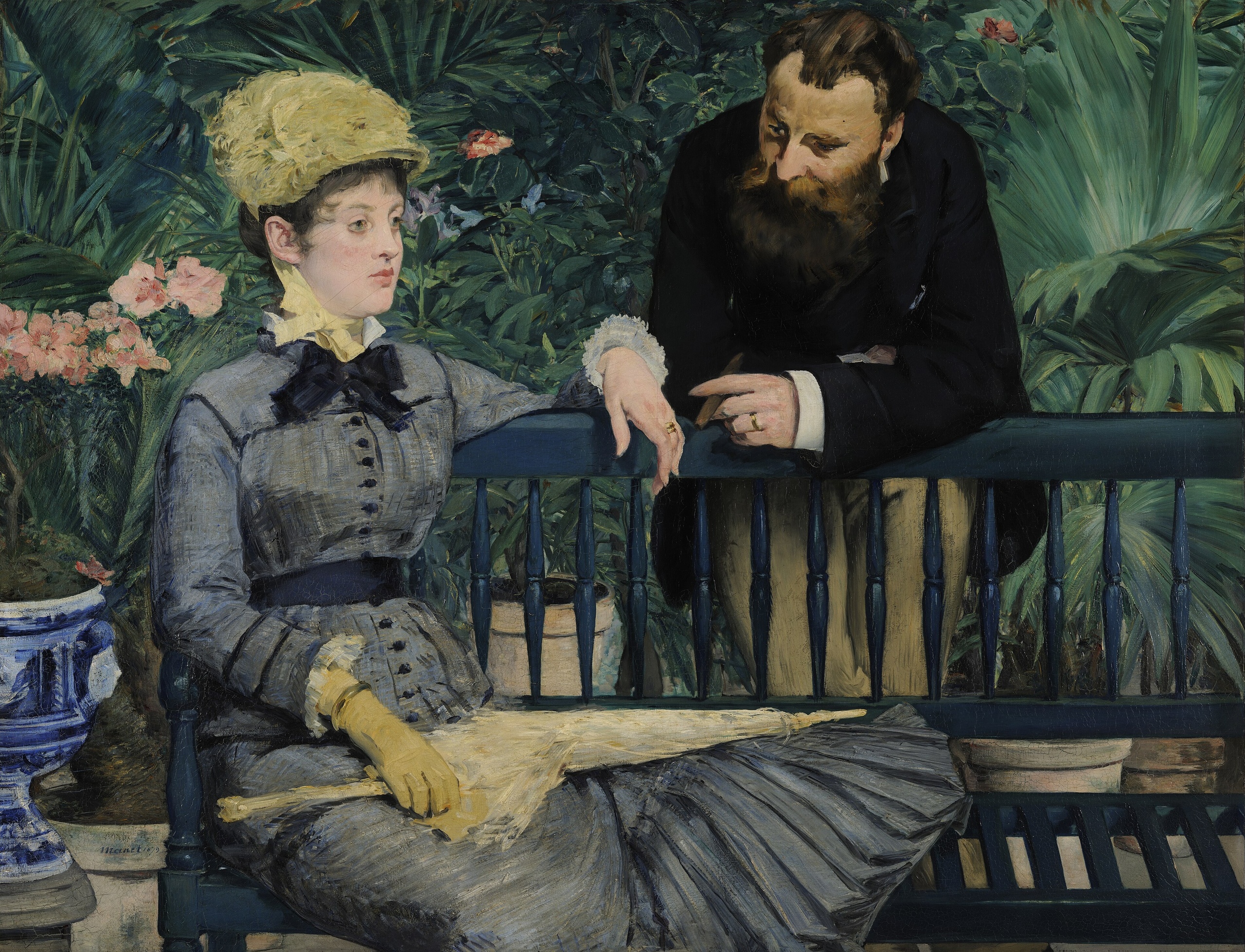
In the Conservatory is a painting by Édouard Manet from 1879: among dense green plants a lady in grey, with a yellow straw hat and yellow gloves, sits on a dark green bench, while a bearded man in a dark coat leans towards her over its back. The original, oil on canvas, 115 x 150 cm, hangs in the Alte Nationalgalerie in Berlin. Our painter paints it for you by hand in oil on canvas, in 8 landscape sizes from 40 x 30 to 190 x 150 cm or made to measure. You will see a photograph of your finished painting before we dispatch it.
| Title: | In the Conservatory |
| Other titles: | Dans la serre (original French title) · Im Wintergarten (German title) |
| Painter: | Édouard Manet (1832–1883) |
| Year painted: | 1879 |
| Original size: | 115 cm x 150 cm (height x width) |
| Original technique: | Oil on canvas |
| Painting style: | Realism and Impressionism |
| Located at: | Alte Nationalgalerie, Berlin, Germany |
| Our reproduction: | Hand-painted in oil on canvas, 8 sizes or made to measure |
In the Conservatory – Édouard Manet
What does In the Conservatory show?
The scene is a winter garden, where thick foliage of palms closes off the background like a living wall. In the left foreground a young woman sits on a dark green wooden bench. She wears a grey dress with dark buttons, a dark bow under a yellow collar, lace cuffs and a yellow straw hat. In her yellow-gloved hand she holds a closed pale parasol across her lap.
Behind the backrest a bearded man in a dark coat leans on his forearms. He holds a cigar, and his hand is very close to hers, which hangs loosely over the back of the bench. Both wear wedding rings. She looks not at him but past him, out of the picture, while his gaze is lowered.
Pink flowers bloom on the left, a large blue-and-white pot stands at the edge, and terracotta pots line up behind the bench. Manet signed at the lower left.
Who are the couple on the bench?
They are friends of Manet, the Guillemets, who owned a clothing shop; English Wikipedia names the husband as Jules. Their rings tell us they are married, and their almost touching hands are the only hint of closeness.
The wife is the focus: she sits further forward and is more brightly dressed, while the husband in his dark suit stays behind the bench, and neither meets our eye. That sense of distance is the main theme of modern writing on the work.
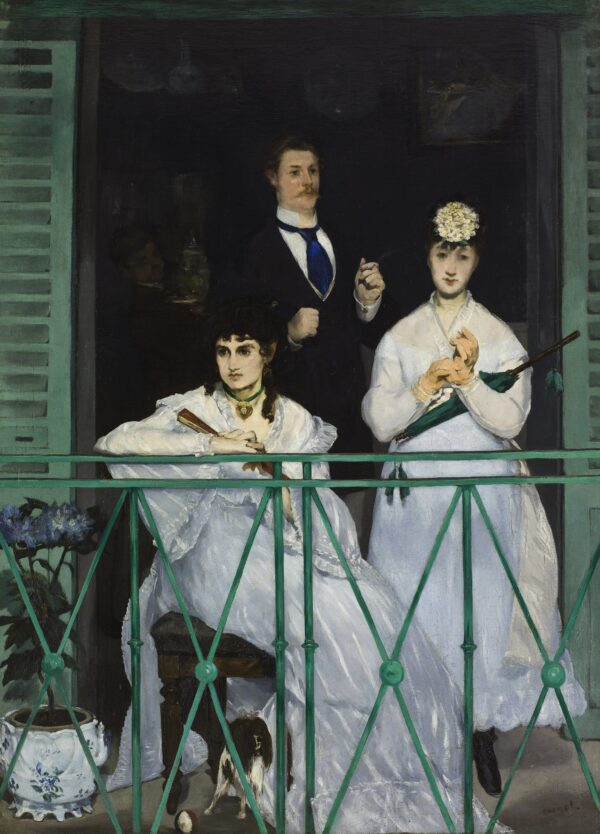
Critics have never agreed on the pair. Huysmans saw the wife as a lively flirt, another writer as sulky. Banville had the husband gazing at the rich moiré silk of her skirt, Duret had him chatting with her. Castagnary, a contemporary of Manet, thought nothing could be more natural than their poses. George Heard Hamilton spoke of a strange tension that recalls Manet’s The Balcony.
Why is this painting special?
Manet was born in Paris in 1832, a judge’s son. He trained under Thomas Couture and copied Velázquez and Titian in the Louvre. He was one of the first 19th-century artists to paint modern life and a pivotal figure between Realism and Impressionism.
At the Paris Salon of 1879 the work was thought surprisingly conservative for Manet. Castagnary asked, half in jest, whether the painter was making concessions to the public, since face and hands were drawn more carefully than usual, and said the scene showed the elegance of fashionable life.
Later that year Manet painted Chez le Père Lathuille, a similar subject and a likely companion piece, absent from the 1879 Salon. The Wikipedia article on the painting, in English, covers the couple in more detail.
Where is the original, and what is its history?
The original belongs to the Alte Nationalgalerie in Berlin, inventory number A I 550, and measures 115 x 150 cm (height x width). Manet painted it in the conservatory at 70 Rue d’Amsterdam in Paris, then owned by the painter Georg von Rosen, where he worked for nine months in 1878 and 1879.
Jean-Baptiste Faure bought it from Manet himself, with three other works. In 1896 the Nationalgalerie in Berlin acquired it, becoming the first museum anywhere to buy a Manet.
In 1945 it was evacuated with other Berlin holdings to a mine at Merkers, where the Monuments Men secured it; photographs of American soldiers posing with it are now often wrongly used to illustrate Nazi-looted art.
In the Conservatory or another Manet?
In the Conservatory is a canvas painting for lovers of quiet middle-class scenes and greenery; it suits a long sideboard or dining table.
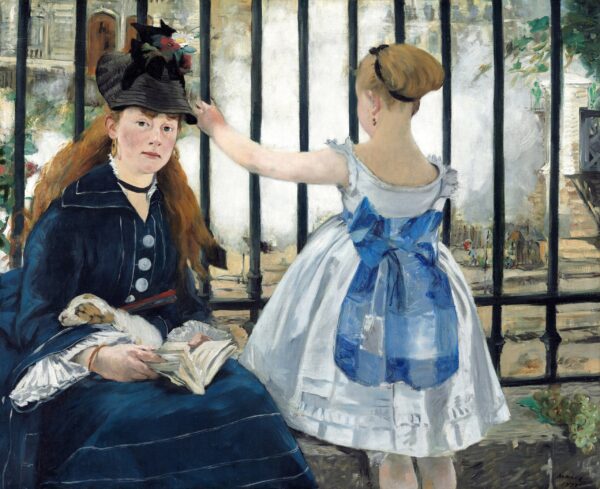
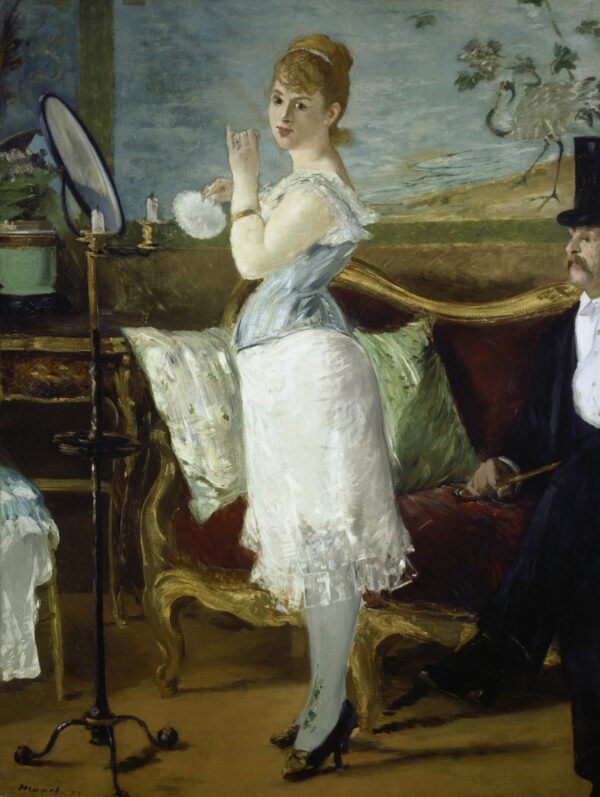
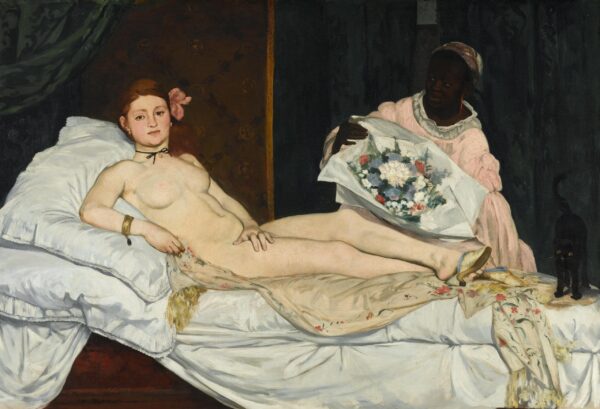
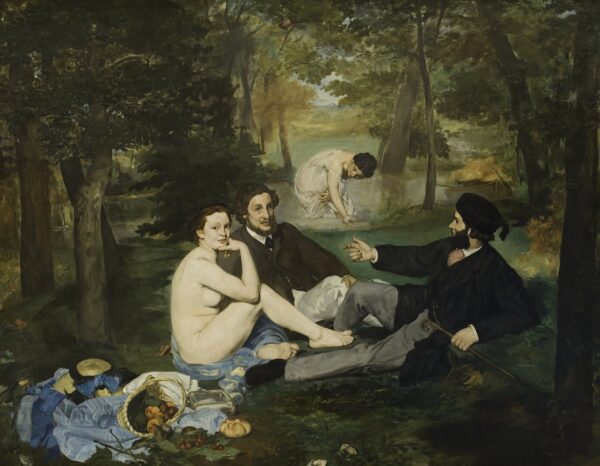
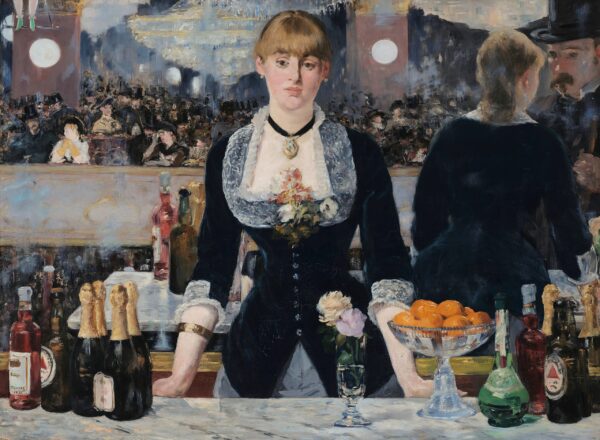
For Manet’s Paris, look at The Railway of 1873, a young woman with a puppy by an iron railing. Modern city life is also the subject of Nana. For one of the works with which Manet caused his biggest scandals, choose between Le Déjeuner sur l’herbe, shown at the Salon des Refusés in 1863, and Olympia, which stirred up the Salon of 1865.
All the famous Manet paintings we paint to order are on our Édouard Manet page.
How do we hand-paint In the Conservatory?
Manet’s original is oil on canvas, 150 cm wide. Ours is an oil painting reproduction that the painter makes in oil on canvas in the size you choose, layer by layer, starting only once you order.
First he sets out the structure: the upright woman, the bench with its slats and the man leaning over the backrest. Then he lays in the green wall of leaves, where Manet’s brushstrokes stay quick and visible, followed by the grey dress with its folds and the dark bench.
The most care goes into faces and hands, gloves, rings and cigar; the pink blossoms and the highlights on hat and parasol come last.
Which size suits which wall?
In short: 40 x 30 or 50 x 40 cm for a hallway or reading corner, 60 x 45 and 75 x 58 cm above a chest of drawers or a bed, 95 x 75 and 120 x 95 cm above a sofa, and 150 x 120 or 190 x 150 cm for a large living or dining room wall.
We paint it in 8 landscape sizes (width x height): 40 x 30, 50 x 40, 60 x 45, 75 x 58, 95 x 75, 120 x 95, 150 x 120 and 190 x 150 cm. The original measures 150 x 115 cm (width x height). So the six smaller sizes are smaller than the original, 150 x 120 cm is just as wide and only a little taller, and 190 x 150 cm is larger.
As a painting for the living room it looks best at 120 x 95 or 150 x 120 cm above the sofa, where the greenery freshens the room like a real winter garden.
Can I order a custom size and a frame?
Yes. If your wall needs other proportions, the couple and the bench stay whole and we change only the band of greenery at the edges. Send us your own measurements and we will reply with a price and a lead time.
The conservatory scene travels rolled, stretched on a stretcher bar or framed, the last two done by our workshop in Slovenia. You pick the moulding in our 3D app, which is for that choice only; seeing this couple on your own wall is a separate service. A dark walnut frame or a slim gold moulding suits the greys and greens.
When will my painting arrive?
From your confirmation, the painter needs 15 to 45 working days for foliage, clothes and faces before the painting ships. First we send you a photograph of the finished painting and make any corrections you ask for.
Within Slovenia and the rest of the EU there are no customs duties, and every purchase is covered by our returns policy.
The couple on the bench make a lovely wedding, anniversary or housewarming gift. If you do not know the recipient’s wall, give a wall art voucher and let them choose the size.
Frequently asked questions
Where can I see the original?
In the Alte Nationalgalerie in Berlin, under inventory number A I 550.
Who are the man and woman in the painting?
Manet’s friends, the married couple Guillemet, who owned a clothing shop.
Is it a print or a real painting?
Not a print: you receive a hand-painted copy, made with brushes in oil on canvas.
How large is the original?
It measures 115 x 150 cm (height x width); our largest size, 190 x 150 cm, is bigger.
Could you paint it in a size that is not listed?
Yes. Give us the width and height, and we will fit the couple and the bench into that format and quote you.
How long will I wait for it?
15 to 45 working days until dispatch; before that you get a photograph of the finished painting.
Is it right for a bedroom, or as a gift?
Yes. The calm greens and greys are restful in a bedroom, and the couple on the bench make a fine wedding or anniversary present.
Why do the husband and wife not look at each other?
Readings differ: some see detachment, others a natural pause in a conversation; the painting does not settle it.
- Subject: the Guillemets in a winter garden: the lady in grey with hat and parasol on the bench, her husband leaning over the backrest.
- Original: oil on canvas, 1879, 115 x 150 cm, Alte Nationalgalerie, Berlin.
- Ours: an Édouard Manet reproduction painted by hand in oil on canvas, 8 sizes from 40 x 30 to 190 x 150 cm, or made to measure.
- Worth knowing: with this work the Berlin Nationalgalerie became, in 1896, the first museum to buy a Manet.