







































Description
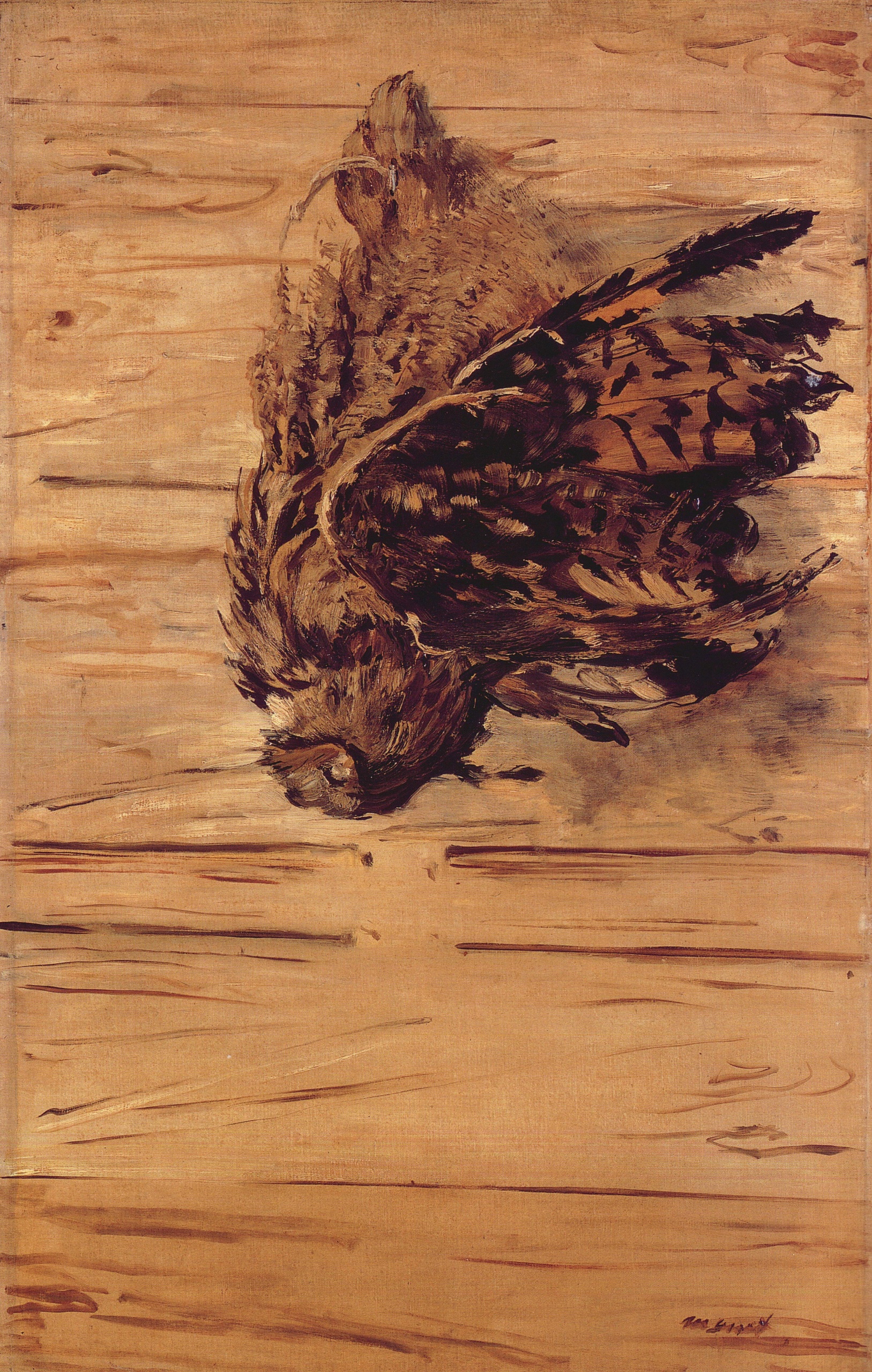
Dead Eagle Owl is a hunting still life that Édouard Manet painted at Versailles in 1881: a large eagle owl hangs head down against a wall of pale boards, its brown, black and cream feathers spread. The original is oil on canvas, 97 x 64 cm, and belongs to the Foundation E.G. Bührle Collection in Zurich. Our owl is painted by hand in oil on canvas, in 8 portrait sizes from 29 x 46 to 128 x 191 cm, or made to measure. Before the owl leaves us, we send you a photograph of it.
| Title: | Dead Eagle Owl |
| Other titles: | Le Grand-duc (French title) |
| Painter: | Édouard Manet (1832–1883) |
| Year painted: | 1881 |
| Original size: | 97 cm x 64 cm (height x width) |
| Original technique: | Oil on canvas |
| Painting style: | Realism and Impressionism |
| Located at: | Foundation E.G. Bührle Collection, Zurich, Switzerland |
| Our reproduction: | Hand-painted in oil on canvas, 8 sizes or made to measure |
Dead Eagle Owl – Édouard Manet
What does Dead Eagle Owl show?
There is a single bird on the canvas: a Eurasian eagle owl hanging upside down on a wooden wall. A nail sits between its feet, and from it hang the knotted ends of a thin cord, probably used to hang the bird up as a hunting trophy. The owl is turned to the left, so we see almost only its right side, one eye and the right wing, which hides nearly all of the left.
Manet painted the plumage very loosely, yet he still set each part of the body apart. Head, trunk, legs and wings differ in shape, colour, pattern and brushstroke.
The owl fills the top three-fifths of the canvas; the bottom two-fifths belong to the boards alone. They glow a warm honey colour, with dark grain running across the full width. A shadow is hinted at to the right of the bird, suggesting light from the upper left. The signature Manet sits in the lower right corner.
What does this hunting still life mean?
Manet had precedents in eighteenth-century French still life, above all in Jean-Siméon Chardin, and in seventeenth-century Dutch painting, such as Jan Baptist Weenix. Because the canvas shows no space beyond the wall, it belongs to the trompe-l’œil tradition, painting that tries to fool the eye with things that look real.
To be honest, this is not a cheerful painting. A dead animal is a serious subject, and art historians read the owl, like many of Manet’s still lifes, as a reminder of transience. The art historian Ina Conzen called the subject sober and matter-of-fact, with no rhetoric at all.
Yet the handling is remarkably lively. The bird is built from short strokes and dabs of colour, the boards from long, wave-like strokes that follow the grain.
Why does it stand out in Manet’s work?
Édouard Manet (1832–1883) was a Paris-born painter, one of the first artists of the nineteenth century to paint modern life and a pivotal figure in the move from Realism to Impressionism.
A hunting still life is a rarity for him. He painted this one in the summer of 1881 at Versailles, where he was recovering from a serious illness, and it belongs to a group of comparable still lifes made that year.
The summer was wet, and instead of the park he painted his own garden and a few still lifes. Of the four nearly equal-sized still lifes from Versailles, he signed only the owl, which is therefore regarded as the one fully finished work. There is more in the English-language Wikipedia article on the owl painting.
Where is the original today?
The original, oil on canvas measuring 97 x 64 cm (height x width), belongs to the Foundation E.G. Bührle Collection in Zurich, inventory number 61. Since 2021 it has been on view at the Kunsthaus Zürich on long-term loan.
After Manet’s death the painting stayed in his estate and was sold in 1884 at the auction of his works at the Hôtel Drouot in Paris. It later passed through collections in Brussels and was bought in 1955 by the collector Emil Georg Bührle.
Dead Eagle Owl or another Manet?
This canvas painting suits anyone who values the old hunting tradition and plain good craft: one bird, one wooden wall, nothing extra. It is most at home in a study, a library or a hunting lodge, and with collectors of still life.
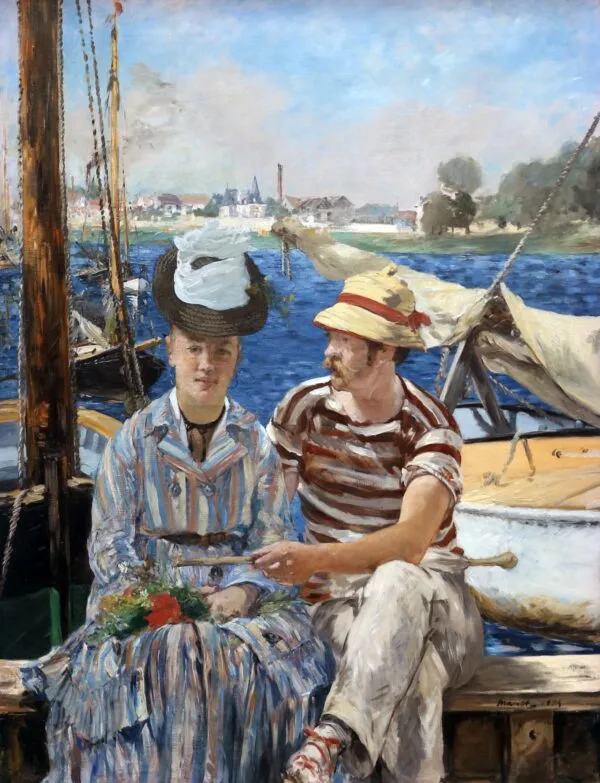
If the warm brown palette appeals, look at Little Lange, a small boy in a dark cape and wide black hat against a brown ground. Just as serious in mood is Jesus Mocked by the Soldiers, Manet’s last religious work. Nature lovers will find a river landscape with a rainbow and anglers in Fishing, and lovers of decorated walls a reclining lady before a wall of Japanese fans in Woman with Fans.
You will find the rest of our famous Manet paintings, each made to order, on the Édouard Manet page.
How do we hand-paint Dead Eagle Owl?
Manet’s original is an oil on canvas 97 cm tall. What we make is an oil painting reproduction: the painter works the owl in oil on canvas, at the size you pick, building it up gradually in several layers.
First he lays in the warm boards and sketches the bird, the nail and the cord. Then he builds the plumage in short strokes and dabs, from the dark flecks on the wing to the paler down on the breast, keeping head, trunk and legs apart.
Last he draws the grain in long, wavy strokes and adds the shadow to the right of the bird and the signature at the lower right. As in Manet’s canvas, the palette stays limited to browns and black.
Which size suits which wall?
In short: 29 x 46 or 38 x 55 cm for a narrow wall or a shelf, 42 x 65 and 55 x 85 cm above a desk or in a library, 70 x 110 and 81 x 120 cm for a hunting lodge or a hallway, and 100 x 155 or 128 x 191 cm for a tall wall with room to spare.
We paint the owl in 8 portrait sizes (width x height): 29 x 46, 38 x 55, 42 x 65, 55 x 85, 70 x 110, 81 x 120, 100 x 155 and 128 x 191 cm. The original measures 64 x 97 cm (width x height), so the four sizes up to 55 x 85 cm are smaller, 70 x 110 cm is already slightly larger, and 81 x 120, 100 x 155 and 128 x 191 cm clearly exceed it; the largest is roughly twice its size.
As a painting for the living room it suits people who enjoy hunting still lifes; above a chest of drawers or a fireplace, 70 x 110 or 81 x 120 cm works best.
Can I order a custom size and a frame?
Yes. For other proportions we keep the bird, the nail and the signature and adjust only the lower and side margins of the boards. Send us the size you need, and we will reply with a price and a delivery time.
The owl ships rolled, stretched on a stretcher bar or already framed, and our workshop in Slovenia handles the stretching and framing. You choose the moulding in our 3D app, which serves only for picking the frame; seeing the painting on your own wall is a separate service. Warm wood suits the honey-coloured boards; dark walnut brings out the black in the feathers.
When and how does the painting arrive?
The painter starts on the owl as soon as you confirm, and it is ready to leave within 15 to 45 working days. Before packing we send you a photograph of the finished work and make corrections if you ask.
The owl travels without customs duties within Slovenia and the rest of the EU, under our usual returns policy.
For a hunter, a bird lover or a still-life collector it is a considered gift, but not one for everybody; if in doubt, give a wall art voucher and let the recipient choose.
Frequently asked questions
Where can I see the original?
It belongs to the Foundation E.G. Bührle Collection and is on view at the Kunsthaus Zürich.
What is on the canvas?
A dead eagle owl hanging head down from a nail on a board wall, as a hunting trophy.
Is this a print?
No. Your owl is a hand-painted copy, worked with brushes in oil on canvas.
How big is the original?
It measures 97 x 64 cm (height x width); our sizes from 70 x 110 cm up are larger.
Can I order a size that is not listed?
Yes. Tell us the width and height your wall needs, and we will price the owl and give a delivery date.
How long does it take?
15 to 45 working days, and you see the finished painting in a photograph before it ships.
Is it right for a bedroom or a child’s room?
Probably not, since the subject is a dead animal; a study, a library or a hunting lodge suits it better.
Why did Manet paint a dead bird?
He followed the hunting still lifes of Chardin and Weenix; the painting is also read as a reminder of transience.
- Subject: a dead eagle owl hanging head down on a wall of honey-coloured boards.
- Original: oil on canvas, 1881, 97 x 64 cm, Foundation E.G. Bührle Collection, Zurich.
- Ours: an Édouard Manet reproduction, hand-painted in oil on canvas, in 8 portrait sizes from 29 x 46 to 128 x 191 cm or made to measure.
- Worth knowing: one of Manet’s very few hunting still lifes, painted at Versailles in 1881.