







































Description

Puberty by Edvard Munch is a symbolist painting from 1894, held under accession number NG.M.00807 by the National Museum (Nasjonalmuseet) in Oslo: a young girl sits on the edge of a bed, turned straight towards the viewer, and behind her a large dark shadow rises up the wall. With us it is made as a hand-painted reproduction in oil, brushed onto canvas; you receive a photograph of the finished work for approval before dispatch, and you choose between ten sizes or a size of your own.
| Title: | Puberty |
| Other titles: | Pubertet · Pubertät · Pubertà · Serdülőkor · Puberteta |
| Painter: | Edvard Munch (1863–1944) |
| Year: | 1894 |
| Original size: | 110 cm x 151.5 cm |
| Original technique: | Oil on canvas |
| Painting style: | Symbolism |
| Location: | National Museum (Nasjonalmuseet), Oslo (inv. no. NG.M.00807) |
| Our reproduction: | hand-painted work in oil, 10 sizes from 40 x 60 cm to 150 x 205 cm, custom on request |
Puberty – Edvard Munch
What is shown?
The figure stands at the centre of the canvas and takes up almost its whole height. The girl sits upright on the edge of the bed, her arms crossed in her lap, her knees pressed together, her bare feet resting on the dark floor. Long dark brown hair falls over both shoulders. The face is pale, the eyes large and dark, and the gaze goes straight out, serious and held back. The body is painted in pale pink-cream tones, and greenish-grey shades put the sides into shadow. The museum record describes the scene as a naked young girl on the edge of a bed and gives no name; there is no name on the canvas either, so we do not claim that this is a particular person.
What is painted on the original?
The bed is indicated by a white and pale grey sheet, and below and behind it runs a dark red-brown horizontal band. The edge of the bed crosses the whole width horizontally and divides the surface into two halves. The background is an olive-green and grey-brown wall, thinly and unevenly painted, with no window and no furniture. To the right behind the figure a large dark shadow rises, blue-black and violet, oval in shape and noticeably larger than the body casting it; it climbs from the shoulders upward, widens at the top and has no sharp edge. The sheet is the only truly light part of the canvas. The colour is laid on thinly, and in places the weave of the canvas shows through. In the lower right corner there is a small red signature, which the museum gives as the signature E. Munch.
Why does this painting matter?
Symbolism works here through a single inconsistency: the shadow does not obey the light in the scene. It is larger than the body that should be casting it, it has a shape of its own and reads more like a presence than an optical effect. That is exactly what carries the work over the edge of the naturalism it comes from: the body is painted observantly and soberly, the shadow is not. The museum notes that with one side the work still belongs to the naturalism of the 1880s, and with the other to what came after. As a symbolist work, Puberty is the one among Munch’s paintings where the gap between the observed and the added is most plainly visible.
What does the painting mean?
The title speaks of a passage out of childhood, yet the scene tells no story: no event, no second person, no object that would explain anything. We keep to what is visible: the posture is closed and collected, the gaze is not. The shadow is the one thing on the canvas that goes unexplained, and whatever the viewer puts into it stays the viewer’s and not Munch’s. Anyone who sees a particular person or a particular story in the figure is adding it; the canvas does not confirm it.
Where does Puberty sit among Munch’s works?
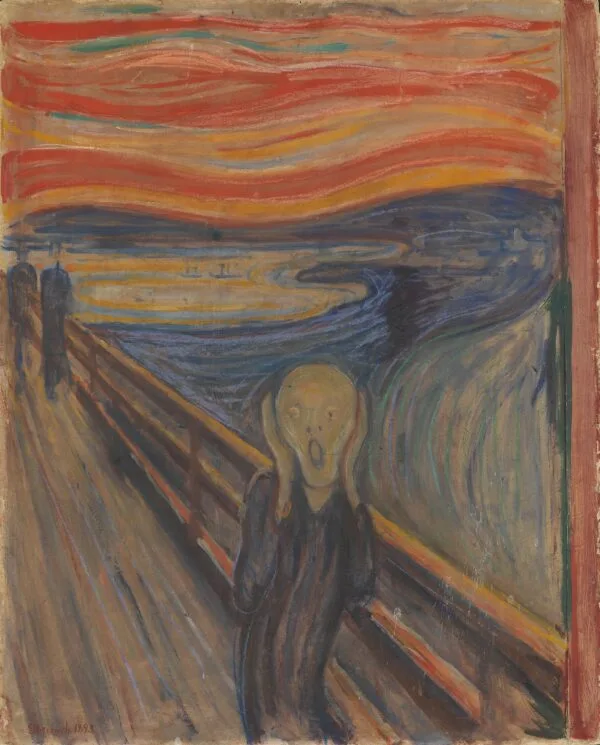
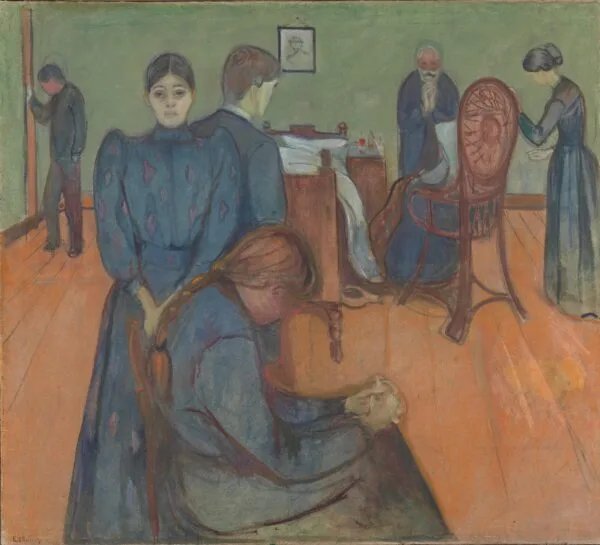
The motif exists in more than one painted version. The Nasjonalmuseet states on its own record page that in Berlin in the 1890s Munch painted two related works, which today belong to the National Museum and the Munch Museum, and that theirs was painted in the winter of 1894–95. Our reproduction follows the National Museum version, NG.M.00807, and no other; we do not give the measurements of the other version here, because we have not read them at the institution that holds it. The young body as the central motif turns another way in The Sick Child, and the female figure as a symbol in its own right in Madonna. The same passage of life is stretched across three figures in The Woman in Three Stages, and the scene beside a bed returns in The Dead Mother. The whole range is in the Edvard Munch gallery.
How is our hand-painted version made?
This is a painting on canvas made with brush and oil colour, not with a printer. The painter works from a high-resolution reference and builds the scene from the back forward: the thin wall to begin with, then the sheet and the bed, and last the body and the shadow. The hardest parts are the transitions on the body, which are soft and have no outline, and the edge of the shadow, which has to stay blurred; drawn sharply, the shadow becomes an object and the scene loses its one mystery. Because every hand-painted copy is made for its own order, no two match down to the detail, and small differences in the laying-on are a mark of the human hand and not a fault. For this work we have no photographs of our own from the workshop, so you will not find any on this page; the photograph of the finished canvas always reaches you for approval before dispatch.
Which size for which wall?
If you are unsure: 80 x 110 cm. At that size the figure is large enough for the gaze to read from several metres away, and the work still fits an ordinary wall. The 110 x 152 cm size is the closest to the proportion of the original and the only one at which the work stands almost life-size. The format is upright and markedly tall, so it asks for height, not width. The 40 x 60 and 50 x 70 cm sizes belong in a hallway or among several smaller works; 60 x 80 and 70 x 100 cm sit well above a chest of drawers; 80 x 110 and 90 x 120 cm are the real painting for the living room or a quiet corner of a bedroom; 130 x 180, 140 x 190 and 150 x 205 cm are for large walls and rooms with enough distance. It works best on a calm wall without pattern, in light that falls from the side. All ten sizes are made to order; none is held in stock as an already painted work.
Custom size, stretcher bar and frame
If none of the ten sizes suits your wall, we paint to your measurements and keep the proportion of the reference, so the figure stays slender and is not stretched sideways; that is our painting made to measure. Every example arrives stretched on a wooden stretcher bar, ready to hang; the stretcher bar can be left off at the order. On this page the canvas is offered without a frame; the frame is chosen separately with our 3D application, which shows every one of our frame profiles on this motif: gold, silver, black, white and natural wood. The application is for frame choice only. If you would like to see how the work will look on your own wall, that is our separate room-placement service.
Delivery and guarantee
Every example is made to order in our studio in Slovenia, so allow 15 to 45 days depending on size. We ship it stretched and protected for transport, without customs inside the European Union. Before dispatch you receive a photograph of the finished work for approval, and our returns policy applies to every order. Every canvas painting we make is made the same way, including paintings by famous painters from other periods; we write about Munch’s path in our article on Edvard Munch.
Frequently asked questions
Where is the original?
In the National Museum (Nasjonalmuseet) in Oslo, under accession number NG.M.00807. We read the detail on the museum’s own record page.
Who is the person in it?
Nobody by name. The museum record speaks of a naked young girl and gives no name, and there is none on the canvas; she is a nameless figure.
Why is the shadow larger than the figure?
Because that is how it is painted on the original. The shadow does not obey the light in the scene and is the central stroke of the work, so we reproduce it faithfully and do not correct it.
Is this a print?
No. The order is painted by hand in oil colour onto canvas; the brushstrokes can be seen and felt.
Which size should I choose?
At 80 x 110 cm the figure’s gaze stays readable from several metres; for other walls see the guide above.
Which size is closest to the original?
The 110 x 152 cm size. The original measures 110 x 151.5 cm, so that rung of the ten stands almost life-size.
Can I have a size that is not listed?
Yes, we paint to measure and keep the side ratio of the reference.
How is it delivered?
Stretched on the stretcher bar and protected for transport, in 15 to 45 days, once you confirm the photograph of the finished work.
When was the work made?
The museum gives 1894 as the year, and adds in the text of its record that it was painted in Berlin in the winter of 1894–95.
Is the original for sale?
No. The work is in a public collection; a hand-painted canvas is the one way to have this scene at home.
Is it suitable as a gift?
It is a demanding gift and does not suit everyone; know the recipient well. At 60 x 80 and 70 x 100 cm it arrives stretched and ready to hang. If you would rather leave the choice to them, a gift voucher is available.
- Subject: a young girl sits on the edge of a bed, and behind her a large dark shadow rises up the wall
- Original: oil on canvas, 1894, 110 x 151.5 cm, National Museum in Oslo, inv. no. NG.M.00807
- Ours: a hand-painted work in oil, ten sizes from 40 x 60 to 150 x 205 cm, stretched on a stretcher bar, unframed
- Worth knowing: the shadow is larger than the figure and does not obey the light in the scene – it is painted that way and is not a fault