













Description
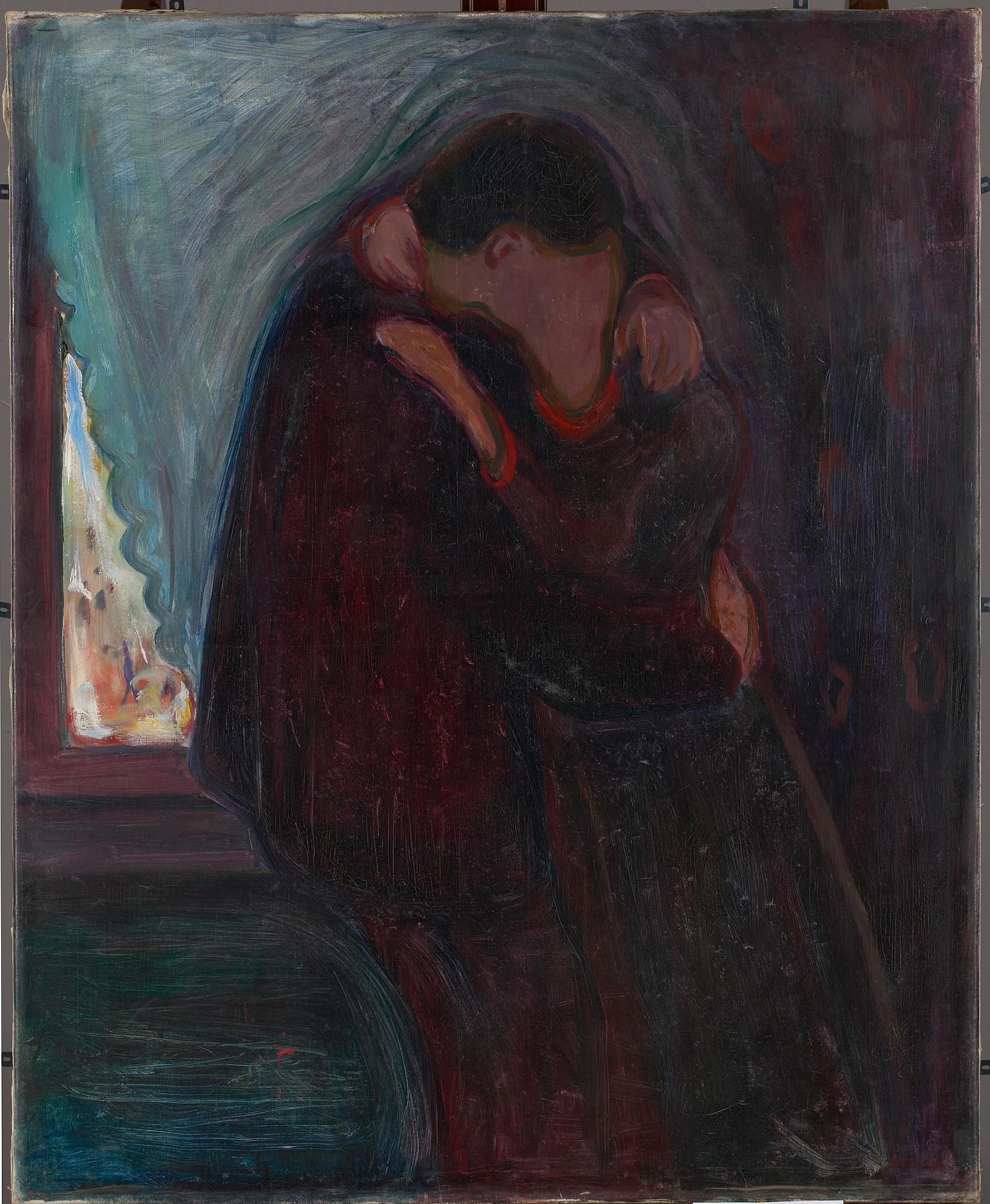
The Kiss by Edvard Munch is a symbolist painting from 1897, held under accession number MM.M.00059 by the Munch Museum in Oslo: in a darkened room beside a tall window a man and a woman stand embracing, and their two faces have merged into one single form. With us it is made as a hand-painted reproduction in oil, brushed onto canvas; you receive a photograph of the finished work for approval before dispatch, and you choose between ten sizes or a size of your own.
| Title: | The Kiss |
| Other titles: | Kyss · Der Kuss · Il bacio · A csók · Poljub · Poljubac |
| Painter: | Edvard Munch (1863–1944) |
| Year: | 1897 |
| Original size: | 81.5 cm x 100 cm |
| Original technique: | Oil on canvas |
| Painting style: | Symbolism |
| Location: | Munch Museum, Oslo (inv. no. MM.M.00059) |
| Our reproduction: | hand-painted oil on canvas, 10 sizes from 40 x 50 cm to 180 x 220 cm, custom on request |
The Kiss – Edvard Munch
What is shown?
Two figures stand embracing in the middle of the canvas and take up almost its whole height. The man is on the left, in a dark reddish brown coat; the woman is on the right, in a darker dress, and her hand reaches up to his shoulder. Along that hand and shoulder runs a thin orange-red line, the only warm contour on either figure. Their heads are pressed together so closely that the features of both faces disappear: we see neither eyes nor mouth, but a single shared surface. That is where the eye falls at the start and where it stays longest. Neither figure can be identified; there are no names on the canvas and none in the museum record, so we do not claim that these are particular people.
What is painted on the original?
On the left stands a tall, narrow window with a pale curtain drawn aside. Through the window comes a pale yellow-cream and blue-grey light with fine pink and blue traces; it is the only source of light in the scene. To the right of the couple the wall is a dark violet-brown, and barely visible reddish circular marks appear on it. In the lower left corner lies a greenish-blue plane of floor with pale curved strokes. The colour is laid on in thin, translucent layers through which the weave of the canvas shows in places, and the transitions between coat, dress and wall are so soft that the edges are lost. The couple is distinguished from the background chiefly by being darker still than it is. The only sharply placed elements are the window and that thin red line. The canvas is painted right to the edge, so that the tacking margin is visible too, and the format is upright and only a little taller than it is wide.
Why does this painting matter?
Symbolism works here through one single stroke: two faces merging into a shared surface. This is not clumsiness and not unfinishedness, but exactly what makes the work what it is – contemporary critics held it against him, and today it is taken to be its substance. Because the merging is not described in words but produced with colour alone, The Kiss appears in surveys of the late nineteenth century as an example of painting that shows an inner state instead of an outward event. As a symbolist work it stands close to the Munch motif that became his best known.
What does the painting mean?
We see two bodies that stop being separate in the embrace. The hand closes the composition from the right, the coat from the left, no gap is left between them, and the faces have lost their features – together they make one form and not two persons. A great deal can be read from that, but we keep to what is visible: closeness is painted on the canvas as the loss of a face, and that is precisely what unsettles or moves the viewer, depending on what they bring to the scene themselves. Anyone who sees a particular story or particular people in the couple is adding it; the canvas does not confirm it.
Where does The Kiss sit among Munch’s works?
Munch worked the kiss motif more than once, in painting and in woodcut, where the bodies merge further still into a single outline; our reproduction takes the painted version of 1897 held by the Munchmuseet in Oslo, and no other. The embrace that ends in the loss of a face turns the other way in Vampire, where the bowed woman’s head lies over the man’s neck. The same two, but without contact, stand in Man and Woman and in Separation. The female figure as a symbol in its own right arrives with Madonna. The whole range is in the Edvard Munch gallery.
How is our hand-painted version made?
This is a canvas painting made with brush and oil colour, not with a printer. The painter works from a high-resolution reference and builds the scene from the back forward: the dark wall to begin with, then the window with its light, and only at the end the couple and that thin red line. This motif is among the hardest, because very narrow differences between dark tones have to be hit: if coat and wall drift too far apart, the embrace opens into two separate figures; if they come too close, the scene disappears into the dark. Because every hand-painted copy is made for its own order, no two match down to the detail, and small differences in the laying-on are a mark of the human hand and not a fault. For this work we have no photographs of our own from the workshop, so you will not find any on this page; the photograph of the finished canvas always reaches you for approval before dispatch.
Which size for which wall?
If you are unsure: 90 x 110 cm. At that size the couple is large enough for the shared surface of the two faces to read from several metres away, and the work still fits an ordinary wall. The 81 x 99 cm size is the closest of all to the proportion of the original. The format is upright and therefore asks for height, not width. The 40 x 50 and 50 x 60 cm sizes belong in a hallway or among several smaller works; 60 x 70 and 70 x 90 cm sit well above a chest of drawers; 90 x 110 and 120 x 150 cm are the real painting for the living room or a quiet corner of a bedroom; 150 x 180, 160 x 195 and 180 x 220 cm are for large walls and rooms with enough distance. Because the work is dark and intimate, do not hang it opposite a window, as the glass mirrors in the dark surface and the scene disappears. All ten sizes are made to order; none is held in stock as an already painted work.
Custom size, stretcher bar and frame
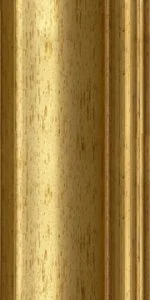
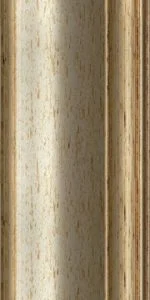
If none of the ten sizes suits your wall, we paint to your measurements and keep the proportion of the reference, so the couple stays upright and is not stretched sideways; that is our painting made to measure. Every example arrives stretched on a wooden stretcher bar, ready to hang; the stretcher bar can be left off at the order. On this page the canvas is offered without a frame; the frame is chosen separately with our 3D application, which shows every one of our frame profiles on this motif: gold, silver, black, white and natural wood. The application is for frame choice only. If you would like to see how the work will look on your own wall, that is our separate room-placement service.
Delivery and guarantee
Every example is made to order in our studio in Slovenia, so allow 15 to 45 days depending on size. We ship it stretched and protected for transport, without customs inside the European Union. Before dispatch you receive a photograph of the finished work for approval, and our returns policy applies to every order. Every painting on canvas we make is made the same way, including paintings by famous painters from other periods; we write about Munch’s path in our article on Edvard Munch.
Frequently asked questions
Where is the original?
In the Munch Museum in Oslo, under accession number MM.M.00059. We read the detail on the museum’s own record page.
Who are the people in it?
Nobody by name. The faces are merged and featureless, and there are no names on the canvas or in the museum record; they are nameless figures.
Why are the faces merged into one form?
Because that is how it is painted on the original. It is not a fault in our making but the central stroke of the work, and we reproduce it faithfully.
Is this a print?
No. The order is painted by hand in oil colour onto canvas; the brushstrokes can be seen and felt.
Which size should I choose?
At 90 x 110 cm the shared surface of the two faces stays readable from several metres; for other walls see the guide above.
Which size is closest to the original?
The 81 x 99 cm size. The original measures 81.5 x 100 cm, so that rung is the nearest of the ten to its proportion.
Can I have a size that is not listed?
Yes, we paint to measure and keep the side ratio of the reference.
How is it delivered?
Stretched on the stretcher bar and protected for transport, in 15 to 45 days, once you confirm the photograph of the finished work.
Is the original for sale?
No. The work is in a public collection; a hand-painted canvas is the one way to have this scene at home.
How high should I hang it?
The centre at eye level, roughly 145–150 cm from the floor; above a sofa 15–25 cm over the back. Because the format is upright, leave some empty wall above and below it.
Is it suitable as a gift?
It is one of the few works people buy as a couple for themselves; at 60 x 70 and 70 x 90 cm it arrives stretched and ready to hang. If you would rather leave the choice to the recipient, a gift voucher is available.
- Subject: a man and a woman embracing beside a tall window, their faces merged into one single shared surface
- Original: oil on canvas, 1897, 81.5 x 100 cm, Munch Museum in Oslo, inv. no. MM.M.00059
- Ours: a hand-painted oil work, ten sizes from 40 x 50 to 180 x 220 cm, stretched on a stretcher bar, unframed
- Worth knowing: contemporaries held the merging of the two faces against him as a shortcoming; today it is taken to be the substance of the work