







































Description
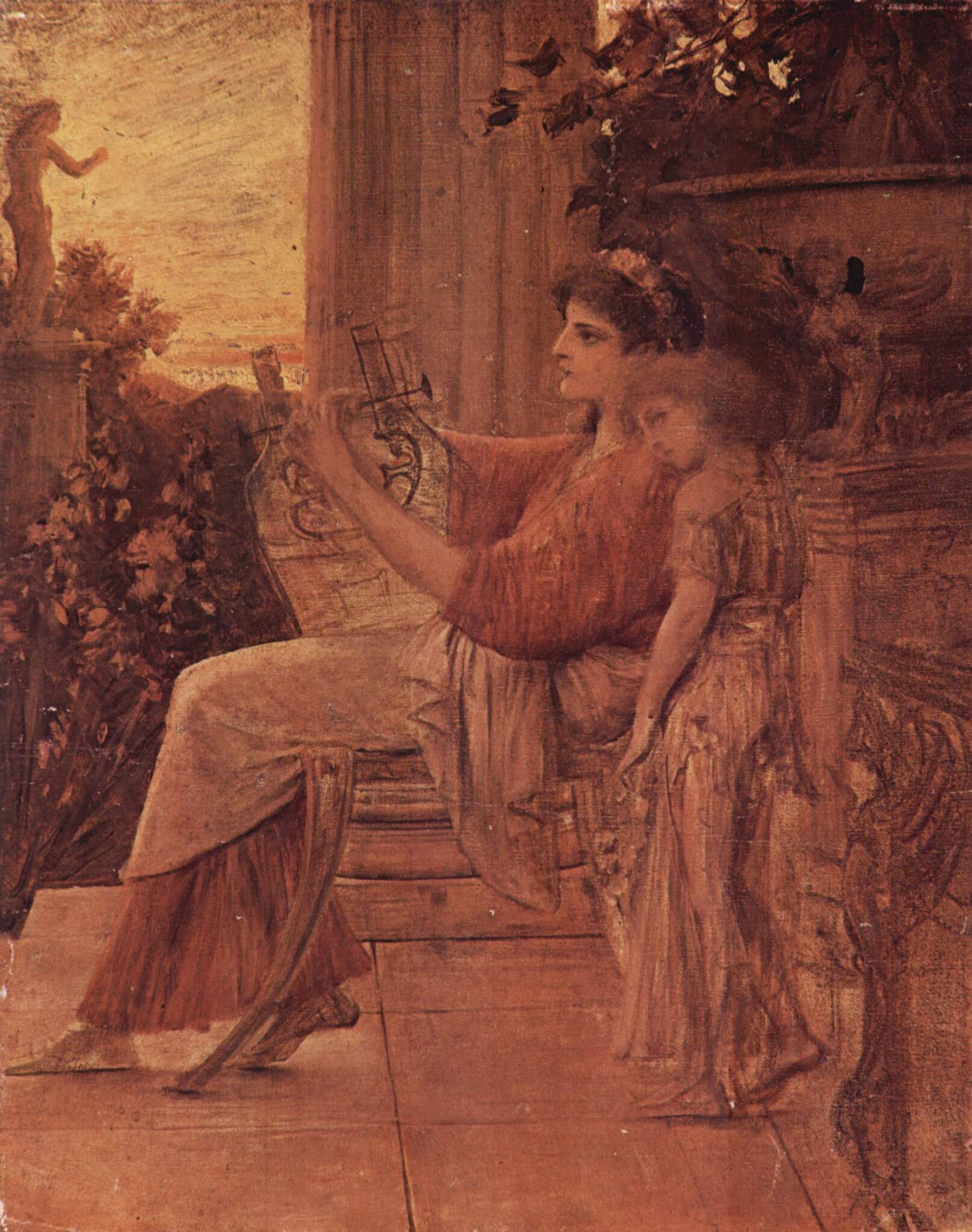
Sappho is a small, warm-toned painting from around 1888, attributed to Klimt: the ancient Greek poet sits on a stone bench with a lyre in her hands, a girl leans against her, and columns, a large vase with plants and a small statue frame the scene in reddish-brown light. The original belongs to the Wien Museum in Vienna. We paint it by hand in oil on canvas in seven upright sizes from 50 x 60 to 120 x 150 cm or to your own measurement, and send you a photograph of the finished work for approval before dispatch.
| Title: | Sappho |
| Other titles: | Saffo · Sapfo · Szapphó |
| Painter: | Gustav Klimt (1862–1918), attributed |
| Year painted: | around 1888 |
| Original size: | 39.4 cm x 31.7 cm |
| Original technique: | Oil on canvas |
| Painting style: | Viennese academic painting of the 1880s, historicism |
| Located at: | Wien Museum, Vienna (inv. 60466) |
| Our reproduction: | Hand-painted oil on canvas, seven upright sizes or made to measure |
Sappho – Gustav Klimt
What does the painting show?
Sappho sits on a stone bench in a long, softly falling robe, holding a lyre on her lap and resting her gaze on the strings. A girl stands close beside her and leans against her shoulder, as if listening. Behind them rise columns and a large vase overflowing with plants, and on a balustrade a small statue stands against a pale sky.
The whole scene is painted in warm, reddish-brown earth tones with darker accents, almost like a single colour in many shades. There is no gold and no ornament here: the painting lives from soft light on the robe, the faces and the stone, and from the quiet between the two figures.
Who was Sappho?
Sappho was a poet of ancient Greece who lived on the island of Lesbos around 600 BC. She wrote lyric poetry – poems meant to be sung to the lyre – and much of it was about love, friendship and longing. Only fragments of her work survive, but already in antiquity she was counted among the greatest poets, and painters have shown her with a lyre ever since.
That tradition explains the scene: the lyre in her hands tells you who she is before you read the title. Klimt’s generation, trained on classical subjects, painted such figures from Greek history and myth as a matter of course, and Sappho with her music was a familiar subject in nineteenth-century painting.
What does the painting mean?
The painting is about poetry and listening. Sappho does not perform for an audience; she plays for a single girl beside her, and the moment feels private. The girl can be read as a pupil or simply as a listener – the painting does not decide, and that openness keeps it gentle rather than grand.
The warm, muted colours add to the mood: nothing shouts, everything glows. For a buyer this makes Sappho a quiet painting, more about atmosphere than about a story, the kind you look at for a while rather than recognise at a glance.
Where is the original, and how did it come about?
The original belongs to the Wien Museum, the museum of the city of Vienna, under inventory number 60466. It is small, only 39.4 by 31.7 cm. The museum lists it as attributed to Gustav Klimt and dates it to around 1888; it also notes that the work was acquired during the Nazi period, and it is researching the painting’s provenance.
Around 1888 Klimt was in his mid-twenties and still working with his brother Ernst Klimt and Franz Matsch, painting theatre and palace decorations in the academic style of the time, among them the ceilings of the Burgtheater staircases in Vienna. Sappho belongs to that world of classical subjects and careful drawing. More about the painter’s life is on Wikipedia. Our version is not a print: it is painted for you, by hand, at the size you choose.
Sappho among Klimt’s works
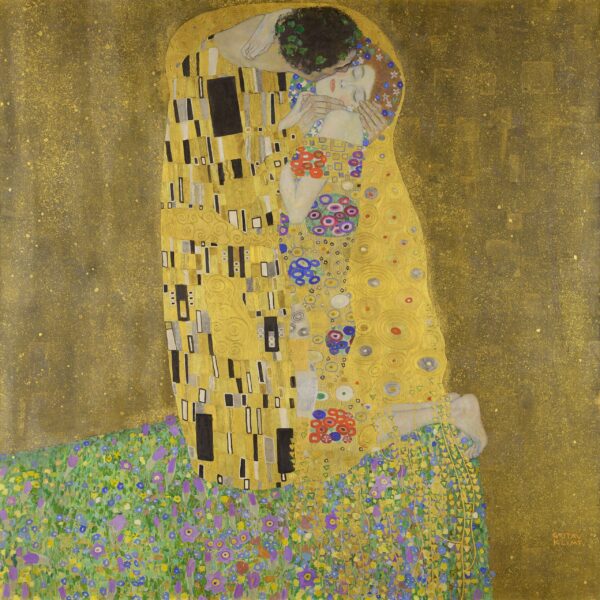
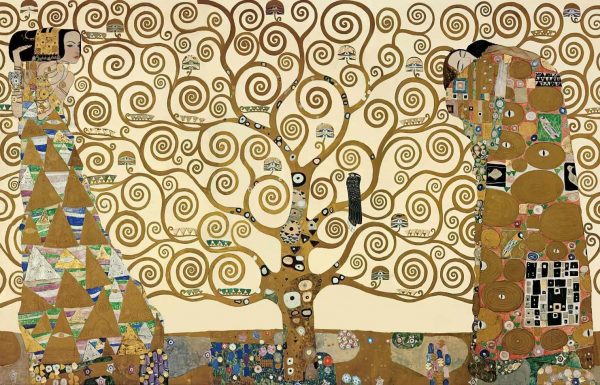
Sappho shows Klimt before he became Klimt, and our gallery lets you follow what came next. Idyll, painted in 1884 for a book of allegories, comes from the same academic years; in Love of 1895 his style already turns dreamy; Music I, also from 1895, again shows a woman with a stringed instrument, now with gold; and The Kiss is the golden painting most people know.
Choose Sappho if you love classical subjects, music and literature, or if you want a Klimt that surprises people who know only his gold. Its warm brown tones sit easily with wood, books and leather. If you want the famous golden Klimt, The Kiss is the obvious choice; Sappho is the quieter discovery.
How do we paint Sappho by hand?
The painter begins with a warm reddish-brown ground over the whole canvas, because the original is built from one family of colours. On it the architecture is drawn first – columns, balustrade, the vase – then the two figures, so that their proportions match the original. The light is then built up in thin layers: the folds of the robe, the faces, the strings of the lyre.
With an almost monochrome painting the difficulty is not colour but tone: dozens of shades of brown, red and ochre must sit next to each other without turning flat. A printed oil painting reproduction loses exactly these small differences; by hand they come back. Every painting is a hand-painted copy made for your order, so no two are ever quite the same.
Which size for which wall?
Short answer: 80 x 100 cm above a sofa, a bed or a chest of drawers, 50 x 60 or 63 x 79 cm for a study, a library corner or a narrow wall, and 100 x 125 or 120 x 150 cm for a large wall. Even our smallest size is larger than the original, which measures only 39.4 by 31.7 cm.
There are seven upright sizes: 50 x 60, 63 x 79, 70 x 90, 80 x 100, 90 x 110, 100 x 125 and 120 x 150 cm, width first. They stay close to the original’s proportion of about four to five, so the figures and the columns keep their place. A painting for the living room should take up about two thirds of the width of the furniture below it; above a chest of drawers 120 cm wide, that is 80 x 100 cm. Because it is upright and calm, Sappho also suits a wall between bookshelves.
Hang it with the centre of the canvas about 150 cm above the floor, and 20 to 30 cm above a sofa or a headboard.
Custom size, stretcher and frame
If none of the seven sizes fits your wall, we paint it to measure; keep it upright and close to four to five, so that the scene is not stretched. Send us the width and height you want and we will quote a price and a lead time. Every painting we make is stretched over a wooden stretcher and ready to hang.
For the moulding, use our 3D application: it shows every one of our frame profiles on this subject, so you can compare gold, silver, black, white and natural wood before deciding – the application is for choosing the frame only. If you would like to see how the painting will look on your own wall, that is our separate room placement service. A warm gold or dark wood frame suits the brown tones; a simple black frame makes it look more modern.
Delivery and guarantee
Every painting is made to order in our studio in Slovenia, so allow 15 to 45 days depending on the size you choose. We ship it stretched and protected for transport, framed if you chose a frame, across the EU with no customs. Before dispatch you receive a photograph of the finished work to approve; if anything is not right, we correct it while the canvas is still in our workshop. Our returns policy applies to every order.
If it is a present and you do not know the right size, there is a wall art voucher. Every other Klimt work we paint is in the Gustav Klimt gallery, and there is more on the painter in our article ten interesting facts about Gustav Klimt.
Frequently asked questions
Where is the original of Klimt’s Sappho?
The original belongs to the Wien Museum in Vienna, the museum of the city, under inventory number 60466. It is a small oil on canvas, only 39.4 by 31.7 cm. The museum dates it to around 1888 and lists it as attributed to Gustav Klimt; it also notes that it is researching how the painting came into its collection.
Is Sappho really painted by Klimt?
The Wien Museum lists Sappho as attributed to Gustav Klimt, which means it is considered his work, but the attribution is not documented with complete certainty. We say so openly. For you as a buyer nothing changes in the copy itself: we paint exactly the scene of the museum’s painting, by hand in oil on canvas, at the size you choose.
What does Klimt’s Sappho show?
It shows the Greek poet Sappho seated on a stone bench with a lyre in her hands, while a girl leans against her shoulder and listens. Behind them are columns, a large vase with plants and a small statue on a balustrade, under a pale sky. The whole scene is painted in warm reddish-brown earth tones.
Who was Sappho, the poet in Klimt’s painting?
Sappho was a poet of ancient Greece who lived on the island of Lesbos around 600 BC. She wrote lyric poems, meant to be sung to the lyre, about love, friendship and longing. Only fragments survive, yet she has been admired for more than two and a half thousand years, which is why painters show her with her lyre.
When did Klimt paint Sappho?
The Wien Museum dates Sappho to around 1888. At that time Klimt was in his mid-twenties and worked with his brother Ernst and Franz Matsch on theatre and palace decorations in the academic style, including the Burgtheater ceilings in Vienna. Sappho comes from those years, long before the golden paintings that made him famous.
How big is the original Sappho, and which size should I choose?
The original is small, 39.4 by 31.7 cm, so even our 50 x 60 cm is larger. For most rooms 80 x 100 cm above a sofa, bed or chest of drawers is the best choice. 50 x 60 or 63 x 79 cm suits a study or a narrow wall, and 100 x 125 or 120 x 150 cm fills a large wall.
Which room does Sappho suit?
Sappho suits a living room, a study, a library corner or a music room especially well. Its warm reddish-brown tones go with wood, leather, books and beige or terracotta walls. Because the scene is calm and classical rather than golden and loud, a canvas painting like this one gives a room a quiet, cultured accent.
Is Sappho a good gift?
Yes, especially for someone who loves poetry, music, literature or ancient Greece: a teacher, a writer, a musician or a reader. It is a Klimt few people expect, which makes it a personal choice. If you are unsure of the size, choose 80 x 100 cm, or give a voucher so the recipient can choose the painting and size.
What is the difference between Sappho and Klimt’s golden paintings?
Sappho comes from Klimt’s academic early years: a classical scene, careful drawing and warm earth tones, with no gold and no ornament. His golden paintings, such as The Kiss, came almost twenty years later and cover the canvas with gold and pattern. Choose Sappho for a quiet, classical mood and The Kiss for the famous golden glow.
- Subject: the Greek poet Sappho with her lyre and a listening girl, between columns and a vase, in warm reddish-brown tones.
- Original: around 1888, oil on canvas, 39.4 x 31.7 cm, Wien Museum, Vienna, attributed to Klimt.
- Ours: a Klimt reproduction painted by hand in oil on canvas, in seven upright sizes or made to measure.
- Worth knowing: you receive a photograph of the finished work for approval before dispatch.