







































Description
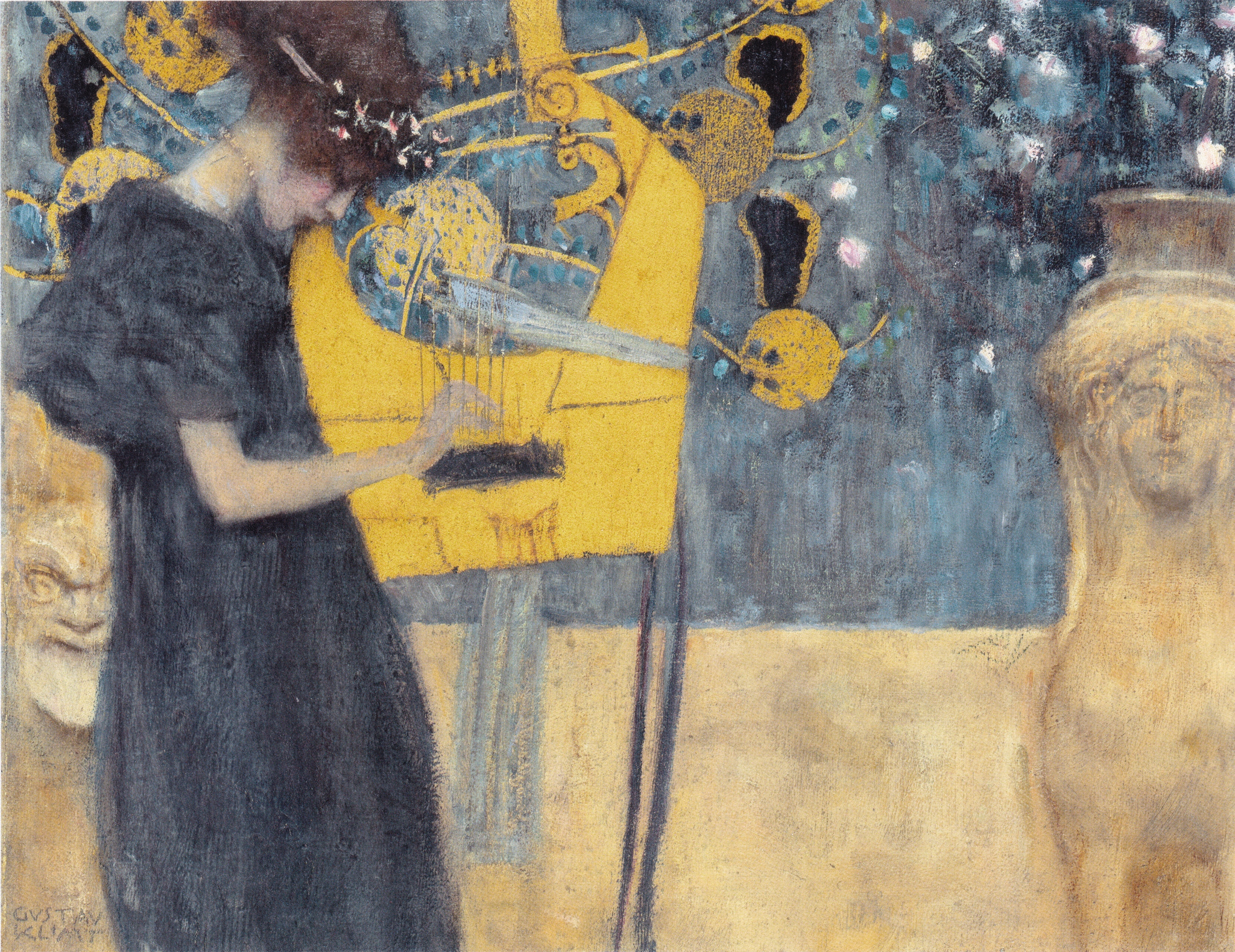
Music I is a small painting of 1895 in which gold already shines: a young woman in a long dark dress plays a golden kithara, the lyre of ancient Greece, while a stone sphinx watches from the right. The original, oil and gold bronze on canvas, belongs to the Neue Pinakothek in Munich. We paint it by hand in oil on canvas, in four sizes or to measure, and send you a photograph of the finished work for approval before dispatch.
| Title: | Music I |
| Other titles: | Die Musik · Music · La musica I |
| Painter: | Gustav Klimt (1862–1918) |
| Year painted: | 1895, signed lower left GUSTAV KLIMT |
| Original size: | 27.5 cm x 35.5 cm (painted surface; 37.2 x 45.1 cm with its edge) |
| Original technique: | Oil and gold bronze on canvas |
| Painting style: | Symbolism, early Vienna years |
| Located at: | Neue Pinakothek, Bavarian State Painting Collections, Munich (inv. 8195) |
| Our reproduction: | Hand-painted oil on canvas, the lyre in gold paint, four sizes or made to measure |
Music I – Gustav Klimt
What is shown?
A young woman with auburn hair stands in profile on the left, in a long, dark blue-black dress that almost merges with the shadow. She leans slightly forward and plucks the strings of a large golden kithara, an instrument from ancient Greece, its frame decorated with gold rings and ornaments. Her face is lowered and her eyes almost closed, as if she were listening to the sound rather than playing for anyone.
On the right sits a stone sphinx, a woman’s head on a lion’s body, pale and calm. At the lower left a grotesque stone mask looks out of the shadow. Behind everything lies a deep blue background scattered with small pale flowers, like stars or blossoms in the dark. The painting is signed GUSTAV KLIMT at the lower left.
Why a kithara and a sphinx?
The kithara was the great string instrument of ancient Greece, the instrument of Apollo, god of music and poetry. By putting it in the woman’s hands, Klimt does not paint a concert but music itself: an old, almost magical power that reaches back to the beginnings of art.
The sphinx and the mask belong to the same world of antiquity and riddles. The sphinx is the guardian of secrets; the mask recalls the theatre and the darker side of art. Together they turn a simple scene of a woman with an instrument into a symbol. Klimt liked such mysterious, layered subjects in the 1890s, while his style was changing.
What does the painting mean?
Most readings see Music I as an allegory: music as a quiet, ancient power that goes further than words. The calm woman, the stone creatures and the dark sky create a mood of listening rather than performance. You do not hear a note, yet you almost feel one.
It also points forward. Klimt used gold bronze for the lyre and its ornaments, so the gold here is already part of the meaning, not only of the decoration. A few years later gold would cover whole canvases in his golden period. Music I is an early step on that road, small in size but clear in its idea.
Why is it called Music I?
Klimt painted the subject twice. This first version of 1895 is small: the painted surface measures only 27.5 x 35.5 cm. In 1898 he painted a second, larger Music, usually called Music II. That second painting was destroyed by fire at Immendorf Castle in 1945, together with other works by Klimt, so today it is known only from photographs.
Music I went a different way. In 1901 it was bought directly from the artist at the Munich annual exhibition in the Glaspalast. Today it belongs to the Bavarian State Painting Collections and is part of the collection of the Neue Pinakothek, inventory number 8195. There is more about the painter’s life on Wikipedia.
Music I among Klimt’s works
Music runs through Klimt’s whole work. A few years after this painting he painted the Beethoven Frieze, a whole wall in honour of Beethoven’s Ninth Symphony; our Beethoven Frieze I (detail) shows part of it. The world of antiquity in Music I returns in Pallas Athena of 1898, with its golden helmet and armour.
If you love the gold that already glows here, you can follow it to its peak in Portrait of Adele Bloch-Bauer I and The Kiss. Choose Music I if you want something quieter and more mysterious than those famous works, a painting that rewards a closer look.
How is our hand-painted version made?
The painter starts with a thin drawing of the woman, the lyre, the sphinx and the mask, then lays in the deep blue background and the dark dress in several layers. Face and hands are painted softly, with warm tones against the cool blue, and the small pale flowers are added one by one with a fine brush.
The gold comes last. Klimt used gold bronze in the original; on our copy the golden kithara and its ornaments are painted by hand in gold paint, layer by layer, never printed and never leaf. When light falls on it, the lyre shines as it does in the original in Munich.
Every painting is a hand-painted copy made for your order, so no two are ever exactly the same. That is what separates it from a printed oil painting reproduction: the brushwork, the depth of the blue and the shine of the gold paint are real.
Which size for which wall?
Short answer: 90 x 70 cm for most walls, 70 x 60 cm for a smaller wall or a bedroom, and 120 x 100 cm if the painting is to be the centre of a large room. These are the four sizes, width by height: 70 x 60, 90 x 70, 100 x 80 and 120 x 100 cm.
Every one of them is larger than the original, which is a small cabinet painting, and their proportions are close to its slightly wide format. As a painting for the living room it sits well above a sofa, but it also suits a music room, a study or a bedroom. It needs warm light to bring the gold to life. Choose a size that takes up about two thirds of the width of the furniture below.
Hang it with the centre about 150 cm above the floor, 20 to 30 cm above a sofa or sideboard.
Custom size, stretcher and frame
If you want Music I closer to the original’s modest size, or in any other format, we paint it to measure. Send us the width and height and we will quote a price and a lead time. Every Klimt reproduction we make is stretched over a wooden stretcher and ready to hang.
For the moulding, use our 3D application: it shows every one of our frame profiles on this subject, so you can compare gold, silver, black, white and natural wood before deciding – the application is for choosing the frame only. If you would like to see how the painting will look on your own wall, that is our separate room placement service. A gold frame picks up the lyre, while a dark wooden frame deepens the blue.
Delivery and guarantee
Every painting is made to order in our studio in Slovenia, so allow 15 to 45 days depending on the size you choose. We ship it stretched and protected for transport, framed if you chose a frame, across the EU with no customs. Before dispatch you receive a photograph of the finished work to approve, and our returns policy applies to every order.
Every other Klimt work we paint is in the Gustav Klimt gallery, and there is more about the painter in our ten facts about Klimt. If the painting is a gift for a musician or a music lover and you are unsure of the size, there is a wall art voucher: the recipient chooses the size and the subject.
Frequently asked questions
Where is Music I by Klimt today?
Music I belongs to the Bavarian State Painting Collections in Munich and is part of the collection of the Neue Pinakothek, inventory number 8195. It was bought directly from Klimt in 1901 at the Munich annual exhibition in the Glaspalast. Before you travel, check on the museum’s website where it is currently on view. It is small, so see it from close up.
What does Music I show?
A young woman in a long dark dress plays a golden kithara, an ancient Greek lyre, seen in profile with her eyes lowered. On the right a stone sphinx sits calmly, at the lower left a stone mask peers out, and behind them a deep blue background is scattered with small pale flowers. The mood is quiet and mysterious.
What instrument is the woman playing in Music I?
She plays a kithara, the large string instrument of ancient Greece and the instrument of Apollo, god of music. Klimt painted it in gold bronze, with gold rings and ornaments on its frame. On our copy the kithara is painted by hand in gold paint, so it stays the brightest point of the painting and catches your eye from across the room.
What does Music I mean?
Music I is usually read as an allegory of music: an ancient, almost magical power rather than a concert. The kithara points to Apollo, the sphinx and the mask to riddles and the theatre. The gold bronze already gives the painting the glow that later fills Klimt’s golden period, which is why it is seen as an early step on that road.
Why is it called Music I – is there a Music II?
Yes. Klimt painted a second, larger Music in 1898, now known as Music II. It was destroyed by fire at Immendorf Castle in 1945, together with other works by Klimt, so today it exists only in photographs. That is why the surviving painting of 1895 in Munich is called Music I. Both share one theme, music as a mysterious power.
How big is the original Music I?
The painted surface measures only 27.5 x 35.5 cm, and 37.2 x 45.1 cm with its edge, according to the Pinakothek. It is a small, intimate painting. All our sizes are larger, from 70 x 60 cm to 120 x 100 cm; if you want it close to the original size, we paint it to measure for you.
Is there gold in Music I, and is the gold on your painting real?
Yes, Klimt painted the kithara and its ornaments in gold bronze, an early use of metallic gold in his work. On our copy the gold is neither leaf nor printed: the painter applies gold paint by hand with a brush, layer by layer, so the lyre glows warmly against the dark blue background.
Which sizes of Music I can I order?
There are four sizes, width by height: 70 x 60, 90 x 70, 100 x 80 and 120 x 100 cm. Their proportions are close to the slightly wide format of the original. If you need another size, we paint Music I to measure and tell you the price and the lead time before we start.
Which room suits Music I?
Music I is a calm canvas painting that suits a living room, a study, a bedroom or a music room, wherever warm light brings out the gold. It is a fitting choice for a room where someone plays an instrument or listens to music. Give it a quiet wall where the deep blue can be seen from a little distance.
- Subject: a woman playing a golden kithara beside a stone sphinx, against a deep blue ground.
- Original: 1895, oil and gold bronze on canvas, 27.5 x 35.5 cm, Neue Pinakothek, Munich.
- Ours: hand-painted in oil on canvas, the lyre in gold paint, four sizes or made to measure.
- Good to know: before dispatch you receive a photograph of the finished work to approve.