


Description

| Title: | Bouquet of Flowers |
| Other titles: | Mazzo di fiori · Blumenstrauß · Šopek cvetja |
| Painter: | Henri Rousseau (1844–1910) |
| Year painted: | c. 1909–1910, as the gallery dates it |
| Original size: | 49.5 cm x 61 cm |
| Original technique: | oil paint on canvas |
| Painting style: | naive art (primitivism), Paris after Impressionism |
| Located at: | Tate, London (inv. N04727) |
| Our reproduction: | hand-painted oil on canvas, eight sizes or a size made to order |
Bouquet of Flowers – Henri Rousseau
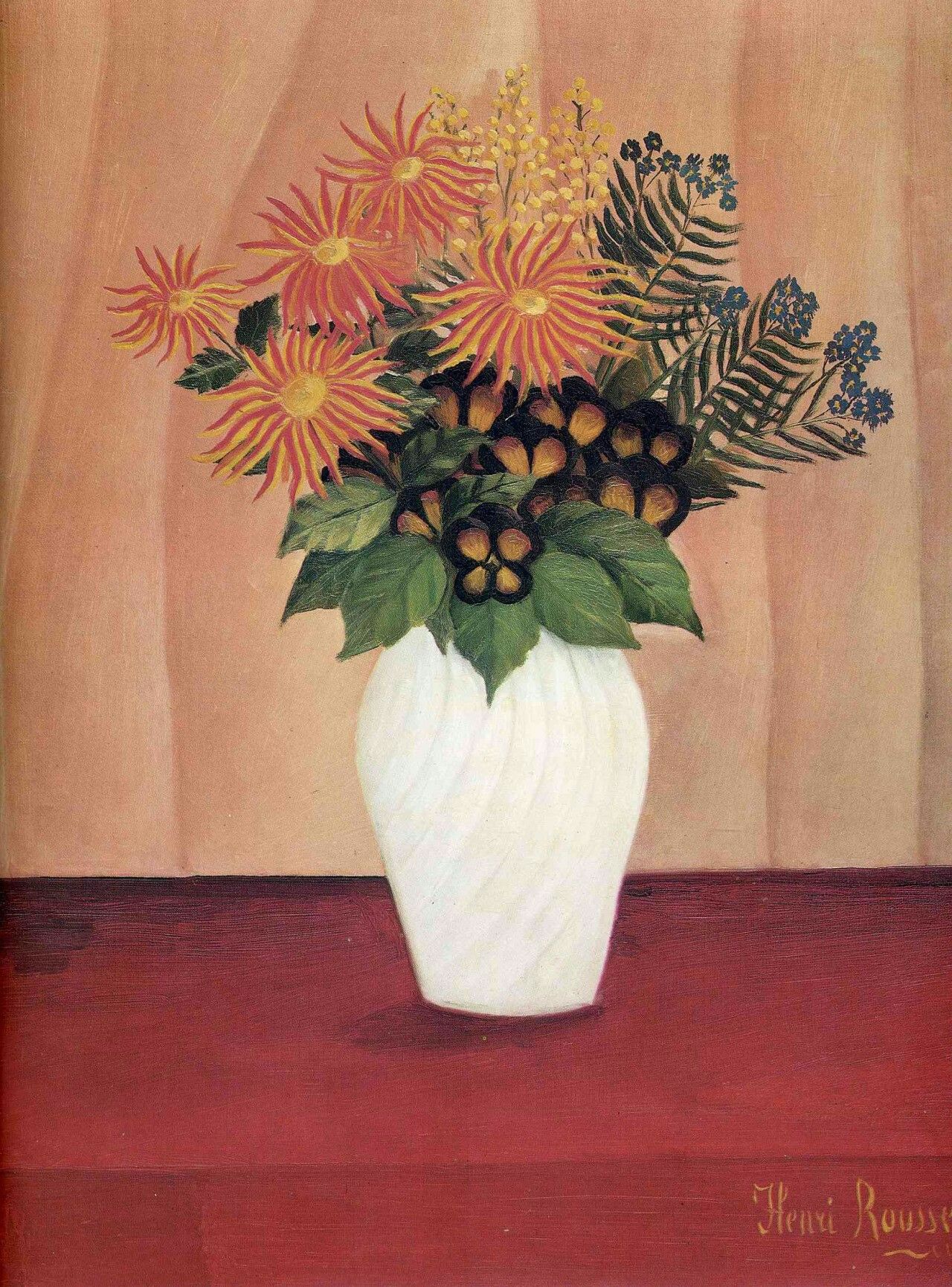
Bouquet of Flowers is the only flower still life in our range by this painter and one of his last works. Against a dark ground, in a plain vase, stands a dense bouquet made up of flowers of several kinds. The original is held by the Tate gallery in London under inventory number N04727; the gallery dates it c. 1909–1910. Here it is made as a hand-painted reproduction in oil, on canvas, in eight sizes from 50 x 61 cm to 150 x 180 cm or to your own measurement. Before dispatch we send you a photograph of the finished canvas for approval.
What is on the canvas?
The upright canvas is filled by a single object: a vase of flowers set on a flat surface against a dark, even wall. The blooms are painted one by one and each as sharply as the next, including those at the back, so the bouquet has no depth but opens like a surface turned towards the viewer. The leaves are hard and clearly outlined, with no soft transitions. The ground has neither a window nor a table edge to say where the scene stands. That emptiness is deliberate: without it the bouquet would be merely a still life, and with it the flowers look cut out of their setting and placed in front of us.
Why are the flowers painted like a jungle?
Because the method is the same. Anyone who knows the painter’s forests recognises it at once: layer upon layer, every leaf separately, nothing lost in shadow and nothing blurred by distance. In a jungle it builds a wall of foliage; here it builds a bouquet in a vase. The difference is only one of scale. That is why a still life by Rousseau does not look like a school exercise but like another assembled world, gathered this time into a vase on a table. The same handling on a large canvas is in The Equatorial Jungle.
When was the canvas painted?
This needs care, because the year 1910 is often quoted on its own. The Tate gallery does not date the work to a single year: its record gives c. 1909–1910. That places the canvas in the last years of the painter’s work, but it does not mean it was certainly finished in the year he died. Where the record leaves a span, we leave it too — a date that sounds firmer than the record would be more precise only in appearance.
Why does this particular canvas matter?
Among the jungles, the city scenes and the portraits, a still life by Rousseau is rare, so this canvas shows something the large works do not: that his manner does not depend on the subject. The same flat laying-on of colour, the same outline instead of modelling and the same absence of aerial perspective work on a bouquet exactly as they work on a forest. To see another flower painting by him, look at Flowers in a Vase.
What does the painting mean?
A still life usually speaks of transience: a bloom that will wither, a fruit that will spoil. That is missing here. The bouquet is in full flower, nothing wilts and nothing falls, and the dark ground reads not as shadow but as empty space. What remains is the appearance of the flowers, painted with all the attention the painter otherwise gave his forests. The meaning it allows is therefore closer to calm than to warning, and each viewer completes it alone. A related quiet motif without figures is Meadowland.
How did the painting reach the Tate?
The canvas is today in the Tate gallery in London, recorded under the number N04727. It entered the collection in 1933 as the bequest of C. Frank Stoop, and that is what the record of its path states. What happened to the canvas between its making and that bequest is not broken down in the record we read, so we do not describe it; we would rather leave a gap than fill it with a guess.
What does naive art mean in this work?
Naive art is the name for painting by self-taught artists who trained in no academic studio and kept to none of its rules on perspective, shading and anatomy. On this canvas it shows in two things: in the bouquet that has no depth, and in the ground that is not space but surface. Everything else is considered — the spacing of the blooms, the relation of vase to bouquet, the weight of the dark ground. The label naive art therefore does not mean ignorance, but a style recognisable at first glance. There is more on the painter’s path in our article about the painter.
How is your canvas made here?
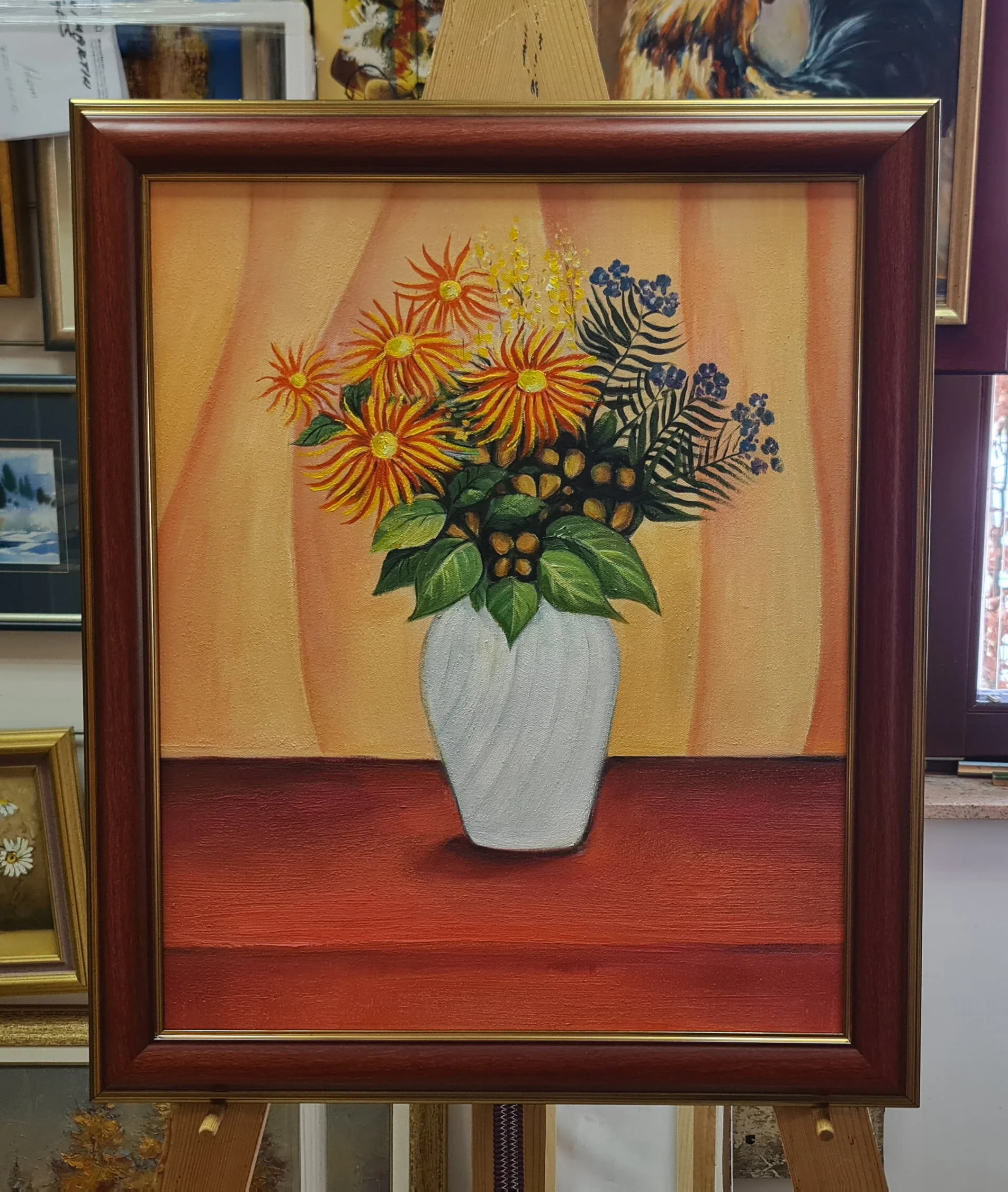
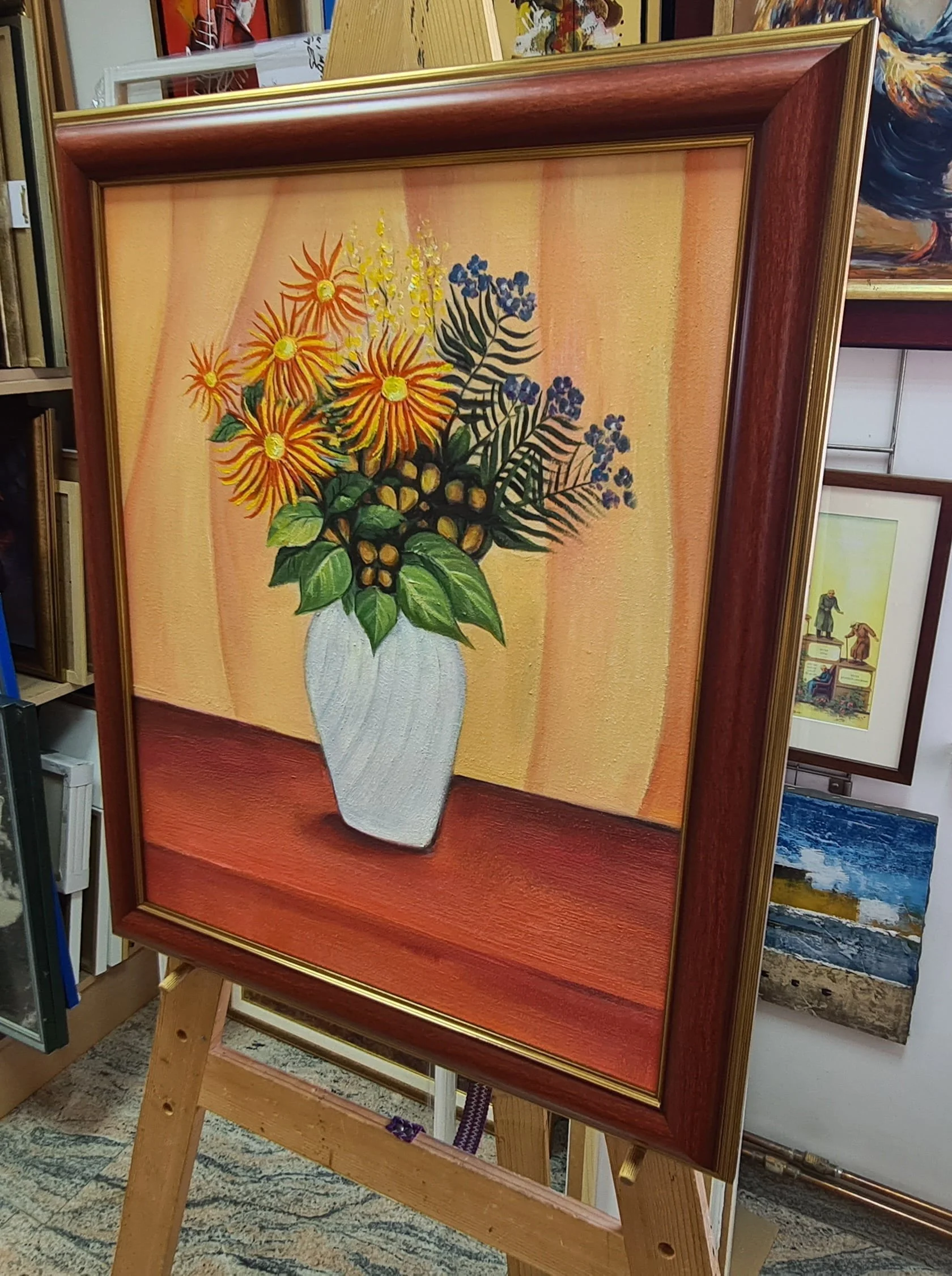
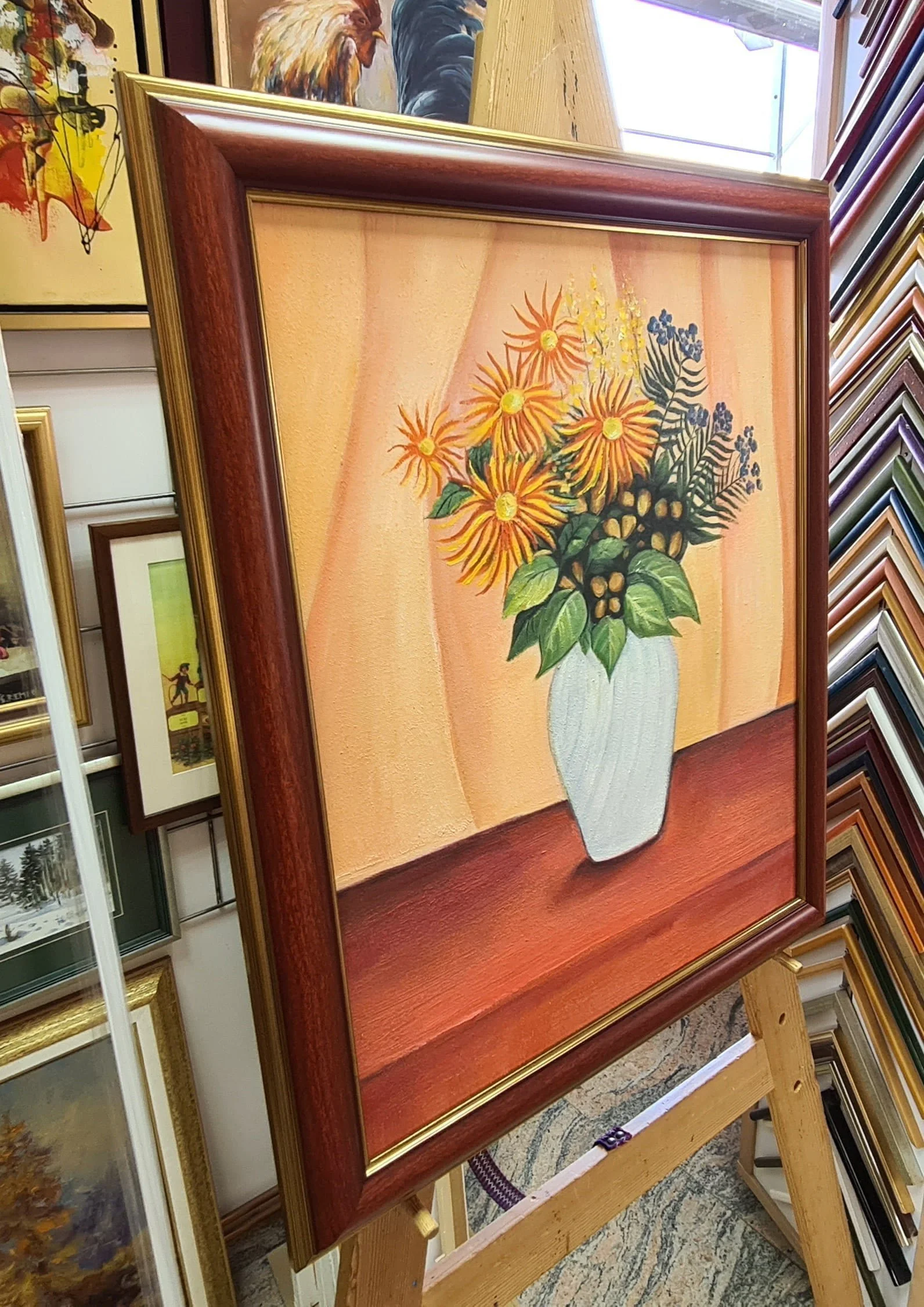
Your canvas is begun only after your order, in our workshop in Slovenia. The oil is built up in layers, from the dark ground towards the flowers, so that the palest petals arrive last. The photographs on this page are of our own version, not of the original: in the first the finished canvas stands on the workshop easel in a dark red frame with a gold inner edge; the second shows it from the side among other commissions, so the depth of the frame and the lay of the paint are both visible. The third is a close view in which the paint stands on the surface rather than being printed, seen best along the edges of the petals, and the fourth is a macro of the flower heads in which the individual brush strokes and the weave of the canvas can both be made out. The full range by this painter is in the Henri Rousseau gallery.
Which size for which wall?
Eight sizes: 50 x 61, 60 x 75, 70 x 90, 80 x 100, 90 x 110, 110 x 140, 130 x 160 and 150 x 180 cm. Being an upright format with a single object, it works on a narrow wall too, between a door and a corner, in a dining room above a sideboard, or in a hallway. For a living room the usual choice is 90 x 110 cm or larger. Below 60 x 75 cm the separate blooms begin to merge and the bouquet loses what rewards close looking. The 50 x 61 cm size is notable because it matches the original almost exactly. Above a sideboard the picture should take about two thirds of the width of the furniture.
How do I order a custom size, a stretcher and a frame?
Custom sizes go through the painting made by order page, where you enter width and height. Proportions matter here: the bouquet fills almost the whole height, and widening the canvas creates empty dark ground around the vase that the original does not have. For non-standard measurements we suggest keeping the ratio of the original and changing only the scale. The canvas is always stretched on a wooden frame. A frame is not included in the price and is chosen separately; in the photographs the canvas is framed because it was ordered that way, and unframed it is ready to hang on arrival.
How is it delivered and what do we guarantee?
We deliver to Slovenia, Croatia, Italy, Austria, Hungary and Germany. The canvas travels rolled in a hard tube or stretched on its frame, depending on the size, always in protective wrapping. We guarantee that every work is painted by hand and that you will see a photograph of the finished piece before dispatch; if something there is not as you wish, we correct it before the work leaves the workshop. A flower motif is a frequent choice for a dining room and as a gift.
Frequently asked questions
Where is the original?
In the Tate gallery in London, under inventory number N04727. The record gives oil paint on canvas and a support measuring 610 x 495 mm.
What year is the painting from?
The gallery dates it c. 1909–1910, not to a single year. Giving one year would be more precise only in appearance.
What do the photographs on this page show?
Our own version, not the original: the framed canvas on the easel, the side view, a close view of the surface and a macro of the brushwork.
Is this a print?
No. Every canvas is painted by hand in oils, to order. In the third and fourth photographs the paint can be seen standing on the surface rather than printed.
Which size should I choose?
For a living room 90 x 110 cm or larger, for a narrow wall or hallway 60 x 75 cm. The upright format asks for height, not width.
Can I have a size that is not on the list?
Yes, a made-to-order size carries no surcharge for a non-standard format. We recommend keeping the proportions of the original.
Which size is closest to the original?
The 50 x 61 cm size. The original measures 49.5 x 61 cm and is among the smaller canvases by this painter.
Is the frame included?
No. In the photographs the canvas is framed because it was ordered that way; the frame is chosen separately.
What does the painting say in one sentence?
That a painter known for invented forests gave the same care to a bouquet of flowers on a table.
Is the original for sale?
No. The work is in the public collection of the London gallery and is not for sale; we give no value, having no source for one.
Is it suitable as a gift?
A flower motif is a rewarding choice for a gift. If you would rather leave the choice to the recipient, there is a gift voucher.
- Subject: a dense bouquet of flowers in a vase against a dark, empty ground
- Original: c. 1909–1910, oil paint on canvas, 49.5 x 61 cm, Tate gallery in London, inv. N04727, bequeathed by C. Frank Stoop 1933
- Our version: hand-painted oil, eight sizes from 50 x 61 to 150 x 180 cm or made to measure, photograph for approval before dispatch
- Worth knowing: the gallery does not date the work to one year but to c. 1909–1910