







































Description
| Title: | The Merry Jesters |
| Other titles: | Joyeux farceurs (the French title) |
| Painter: | Henri Rousseau (1844–1910) |
| Year of creation: | 1906, as the museum dates it |
| Original size: | 113.3 cm x 145.7 cm |
| Original technique: | oil on canvas |
| Painting style: | naive art (primitivism), Paris after Impressionism |
| Located at: | Philadelphia Museum of Art (inv. 1950-134-176) |
| Our reproduction: | hand-painted oil on canvas, eight sizes or a size made to order |
The Merry Jesters – Henri Rousseau
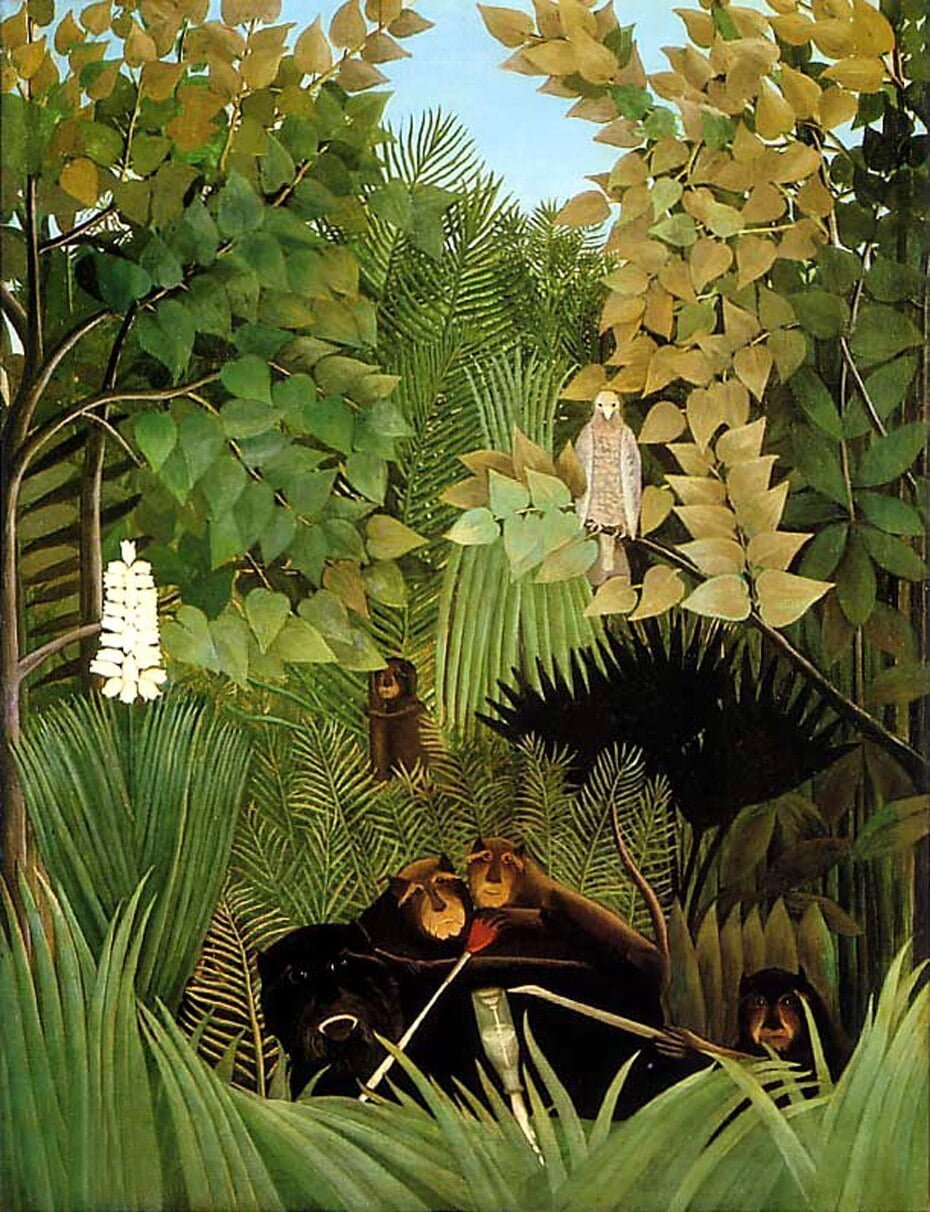
The Merry Jesters is a jungle scene with no danger in it. Monkeys are at home among dense growth, a bird is with them, and nothing is hunting and nothing is fleeing. The original is held by the Philadelphia Museum of Art under inventory number 1950-134-176; the museum dates it 1906 and gives a height of 145.7 cm and a width of 113.3 cm. Here it is made as a hand-painted reproduction in oil, on canvas, in eight sizes from 50 x 65 cm to 150 x 190 cm or to your own measurement. Before dispatch we send you a photograph of the finished canvas for approval.
What is on the canvas?
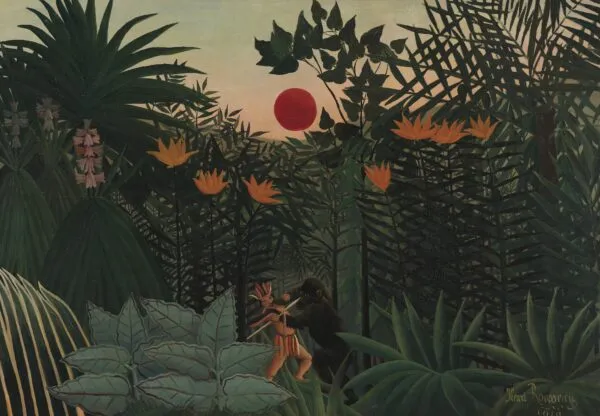
The scene is a jungle, and in it are monkeys and a bird. That is not our description but what the work is recorded as showing: jungle, monkeys, a bird, and nothing further. We are that exact because with this painter it is tempting to describe more than can be checked. What can be seen and also described without guessing is the method: the foliage is painted leaf by leaf, each with its own hard outline, and what is behind is painted as sharply as what is in front. So the scene has none of the depth you would expect and reads instead as a dense wall with the animals set into it. The same method on a wider canvas is The Equatorial Jungle.
Who are the jesters of the title?
The title calls them jesters; on the canvas they are monkeys. With this painter that difference matters: the title assigns the scene a mood the animals themselves do not show. A monkey painted with a hard outline and no expression cannot look merry, so the merriment arrives from the title and the viewer then finds it in the picture. That is why this is one of those works where the title is part of the painting rather than a label on it. Set the title aside and what remains is calm, almost silent. A related gathering of animals and growth is Tropical Forest with Monkeys.
When was the canvas painted?
The museum dates it to 1906, with a single year — no span and no hedge. That is worth saying, because institutions date many works by this painter more cautiously, with a range or with a circa. Here the record is unambiguous, so we give it as it stands. The year places the canvas in the period when the painter had already returned to the jungle and was making these scenes one after another.
Why is the foliage not a background?
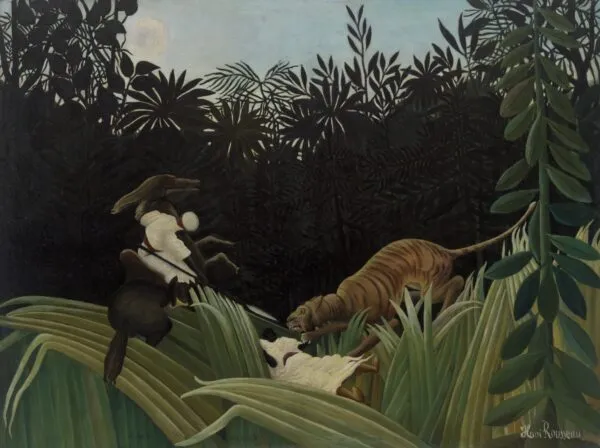
Because it is not painted as one. In an ordinary picture whatever lies behind is softened, darkened or broken up so the eye knows what is near and what is far. None of that happens here: a leaf in the back layer is as sharp as a leaf in the front, and the colours do not retreat with distance. The consequence is that the growth occupies the whole surface and the animals do not stand in front of it but inside it. That is also why the scene can be looked at for a long time without the eye settling anywhere: there is no single point the picture leads to. A more dramatic version of the same construction is The Hungry Lion Throws Itself on the Antelope.
What does the painting mean?
Because nothing happens, the scene does not narrate, and that is the easiest thing to read as its subject. The jungle here is a place where it is possible simply to be, not a place of hunting. Some viewers find in it the joke the title promises; others find something stranger — a world ordered too evenly to be real, in which the animals are closer to ornament than to inhabitants. Both can be argued and the painting takes no side. There is more on the painter’s path in our article about the painter.
How did the painting reach the museum?
The museum records that it entered the collection in 1950 as part of the Louise and Walter Arensberg Collection. That is the only fact about the canvas’s path that the institution publishes: no list of earlier owners, no sale history. So we give nothing else. What the museum does publish besides it is the painter, the title, the year, the medium, the measurements, the department of European Painting and the inventory number 1950-134-176. All of it is in its record on the museum’s page for the work.
What does naive art mean in this work?
Naive art is the name for painting by self-taught artists who trained in no academic studio and kept to none of its rules on perspective, shading and anatomy. In this canvas it shows above all in the absence of aerial perspective: the growth does not lose itself towards the back. Rousseau was a customs clerk who began to paint seriously only in his forties. The label naive art therefore does not mean ignorance but a style you recognise at first glance, and it is that style which a reproduction of this work has to carry.
How is your canvas made here?
Your canvas is begun only after your order, in our workshop in Slovenia. The oil is built up in layers, from the back layers of foliage towards the front ones and last of all towards the animals. Because every leaf is painted separately and nothing is blurred, at the larger sizes this is several weeks of work, and it is here that hand painting shows most. We do not print and we use no mechanical application; a hand-painted canvas differs from a print by touch alone, because the body of the paint is visible and can be felt. The canvas is stretched on a wooden frame, ready to hang. The full range by this painter is in the Henri Rousseau gallery.
Which size for which wall?
Eight sizes: 50 x 65, 60 x 75, 70 x 90, 80 x 100, 90 x 120, 113 x 146, 130 x 170 and 150 x 190 cm. Being an upright canvas with a dense pattern, it needs height and some quiet wall around it: between a door and a corner, beside a staircase, or in a hallway. For a living room the usual choice is 90 x 120 cm or larger. Below 60 x 75 cm the leaves begin to merge into a green plane and the scene loses the very thing that makes it work. The 113 x 146 cm size is the measurement of the original, rounded to the whole centimetre.
How do I order a custom size, a stretcher and a frame?
Custom sizes go through the painting made by order page, where you enter width and height. Proportions matter here: the scene is upright and dense from edge to edge, so widening it brings in growth at the sides that the source does not have, while shortening it loses the top layer of foliage. For non-standard measurements we therefore suggest keeping the ratio and changing only the scale. The canvas is always stretched on a wooden frame. A frame is not included in the price and is chosen separately.
How is it delivered and what do we guarantee?
We deliver to Slovenia, Croatia, Italy, Austria, Hungary and Germany. The canvas travels rolled in a hard tube or stretched on its frame, depending on the size, always in protective wrapping. We guarantee that every work is painted by hand and that you will see a photograph of the finished piece before dispatch; if something there is not as you wish, we correct it before the work leaves the workshop. Production time depends on the size and is confirmed when you order.
Frequently asked questions
Which museum holds the original today?
The Philadelphia Museum of Art, under inventory number 1950-134-176. The museum gives oil on canvas, 145.7 cm high and 113.3 cm wide.
What year is the painting from?
The museum dates it to 1906, with a single year, no span and no circa.
What is actually depicted?
A jungle, monkeys and a bird. The museum publishes no description for this object, so we claim no more than that.
Which size is closest to the original?
The 113 x 146 cm size. The museum gives 113.3 cm of width and 145.7 cm of height for the original.
Is this a print?
No. Every canvas is painted by hand in oils, to order. The body of the paint is visible and can be felt, which a print cannot imitate.
Which size should I choose?
For a living room 90 x 120 cm or larger, for a narrower wall 70 x 90 cm. The upright format asks for height, not width.
Can I have a size that is not on the list?
Yes, a made-to-order size carries no surcharge for a non-standard format. We recommend keeping the proportions.
How did the work reach the museum?
In 1950, as part of the Louise and Walter Arensberg Collection. The museum publishes no other detail of the canvas’s path.
Can the original be seen?
The museum is open to the public, but its record states the work is not currently in the permanent display. Check with the museum before a visit.
How is the painting delivered?
Rolled in a tube or stretched on its frame, with tracked shipping. Production time is confirmed when you order.
Is it suitable as a gift?
The scene is calm and colourful, which makes it a rewarding choice for a gift. If you would rather leave the choice to the recipient, there is a gift voucher.
- Subject: monkeys and a bird in dense jungle, with no hunt and no event
- Original: 1906, oil on canvas, 145.7 x 113.3 cm (height x width), Philadelphia Museum of Art, inv. 1950-134-176
- Our version: hand-painted oil, eight sizes from 50 x 65 to 150 x 190 cm or made to measure
- Worth knowing: the merriment comes from the title, not from the animals’ faces