



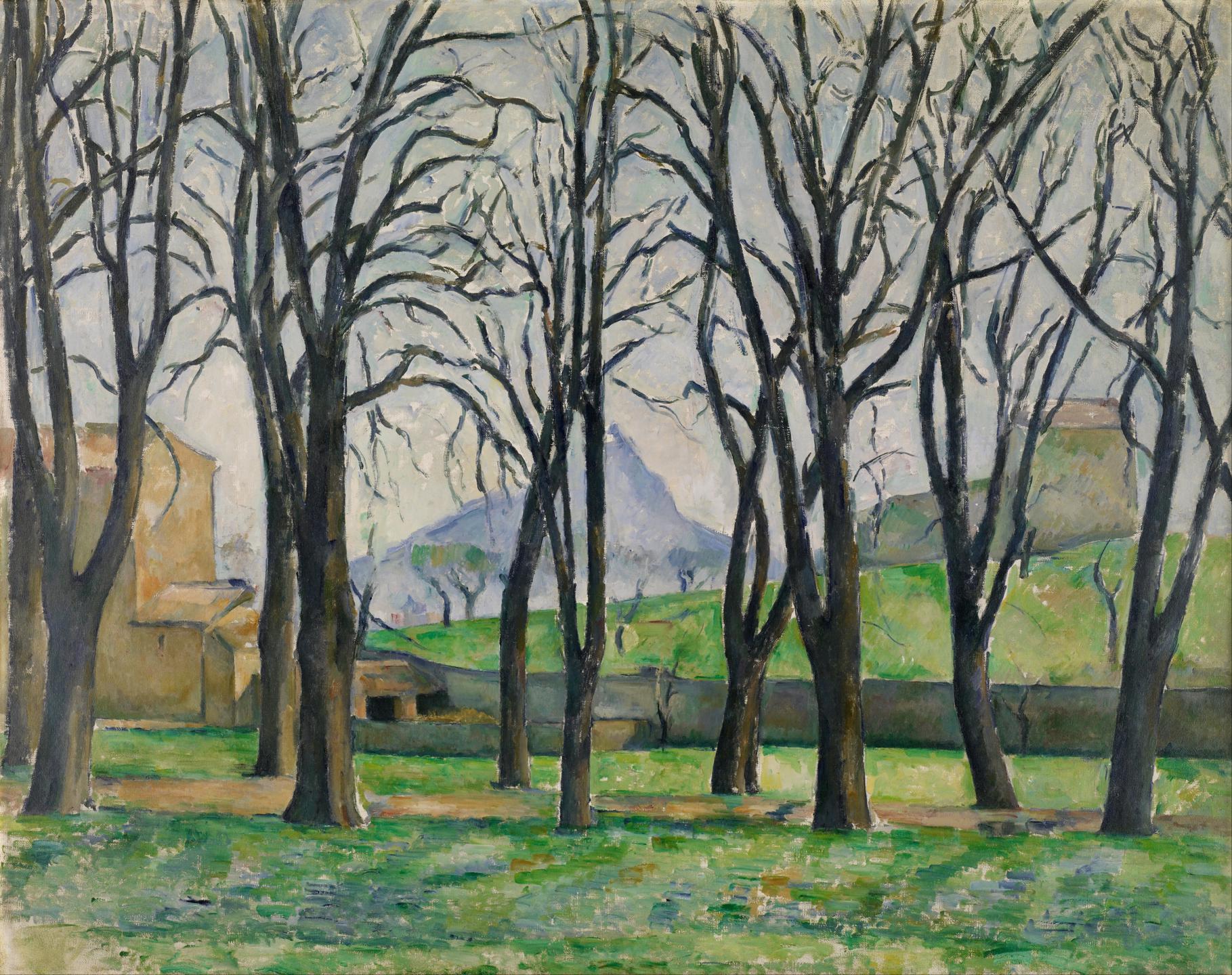
Paul Cézanne did not look for new subjects – he returned to the same places until he had taken them apart into planes of colour. Three recur across his whole life: the family estate Jas de Bouffan near Aix, the seaside village of L’Estaque outside Marseille, and the abandoned Bibémus quarry. All three are among our hand-painted reproductions on canvas.
Jas de Bouffan – the estate he painted for forty years
Jas de Bouffan is a country estate northwest of Aix-en-Provence, bought in 1859 by the painter’s father, the banker Louis-Auguste Cézanne. For Cézanne it was both home and an open-air studio: he painted the house, the chestnut avenue and the pond with its fountain – the same scene through every season and every light. The estate stayed in the family until 1899, when it was sold after his mother’s death, and with it he lost a motif he had painted for almost forty years. We carry both the view of the estate and the version with the pond.
L’Estaque – the bay that made the modern landscape
Cézanne first withdrew to the fishing village of L’Estaque, west of Marseille, in 1870. From there he looked down on the bay: red roofs, factory chimneys, then a band of blue water and the mountains beyond. That arrangement – horizontal bands stacked one above another, with no classical depth perspective – later became the starting point of the cubist landscape. The Bay of Marseille, Seen from L’Estaque exists in several versions; one is at the Art Institute of Chicago, another at the Metropolitan Museum of Art.
Bibémus – a quarry that was already geometry
East of Aix lies the Bibémus quarry, where ochre sandstone was cut for centuries. When Cézanne rented a cabin at its edge around 1895 he found a landscape already broken into planes: rectangular blocks, hard edges, ochre and orange against the green of the pines. He painted the rock faces, rocks and branches, and also Mont Sainte-Victoire Seen from Bibémus, a canvas now in the Baltimore Museum of Art.
The Great Pine and Lake Annecy
Among the place motifs, The Great Pine stands out – a single tree whose branches run across the whole upper edge of the canvas. In 1896 Cézanne spent the summer beside Lake Annecy in Savoy; the canvas he made there is held by the Courtauld in London and counts among his most tightly built landscapes.
And The Card Players?
The Card Players is not a landscape but a figure series of five canvases, so we treat it separately. Who painted The Card Players, how many versions exist and which one set the record price are covered in our guide to the most famous paintings of Paul Cézanne; we carry the New York version and the Courtauld version.
Frequently asked questions about Cézanne’s places
What is Jas de Bouffan?
A country estate near Aix-en-Provence, bought in 1859 by the painter’s father. Cézanne painted its house, chestnut avenue and pond for almost forty years, until the estate was sold in 1899.
Where is L’Estaque and why does it matter?
A fishing village west of Marseille. From there Cézanne painted the bay in horizontal bands – roofs, water, mountains – abandoning classical depth perspective, which fed directly into cubism.
What did Cézanne paint at Bibémus?
An abandoned ochre sandstone quarry east of Aix: rock faces, branches, and the view of Mont Sainte-Victoire. He rented a cabin there around 1895.
Who painted The Card Players?
Paul Cézanne, in a series of five canvases made in the early 1890s. The versions differ in the number of figures; one hangs at the Metropolitan Museum of Art and another at the Courtauld in London.
Leave a Reply