Description
| Title: | The Dream |
| Other titles: | Le Rêve · Il sogno · Der Traum |
| Painter: | Henri Rousseau (1844–1910) |
| Year painted: | 1910 |
| Original size: | 298.5 cm x 204.5 cm |
| Original technique: | oil on canvas |
| Painting style: | naive art (primitivism), Paris after Impressionism |
| Located at: | Museum of Modern Art, New York (inv. 252.1954) |
| Our reproduction: | hand-painted oil on canvas, eleven sizes or a size made to order |
The Dream – Henri Rousseau
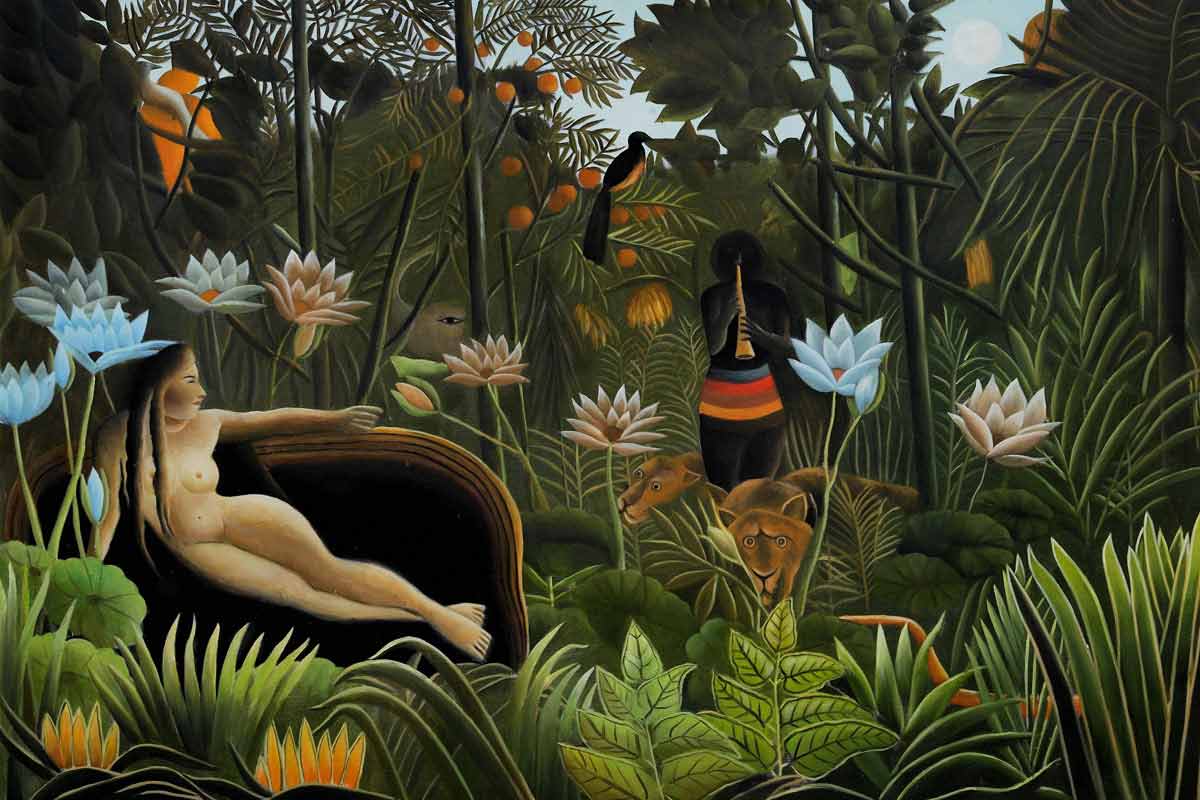
The Dream is Henri Rousseau’s last large jungle canvas, painted in 1910, the year he died. On a wide canvas a naked woman lies on an upholstered sofa in the middle of tropical growth, and around her the animals emerge quietly from the leaves. The original is held by the Museum of Modern Art in New York under inventory number 252.1954, a gift of Nelson A. Rockefeller. Here it is made as a hand-painted reproduction in oil, on canvas, in eleven sizes from 50 x 35 cm to 299 x 207 cm or to your own measurement. Before dispatch we send you a photograph of the finished canvas for approval.
What is on the canvas?
The scene is wide and filled with growth to the edge. At the left a naked woman lies on a sofa, one arm stretched towards the thicket, her gaze turned to the viewer. Two lions emerge from the leaves, with birds, a snake and an elephant, each sharply painted and in its place, as though arranged rather than caught in movement. Behind the woman stands a barely perceptible figure playing a horn, which the New York record singles out precisely because it is so easy to miss at first glance. A round moon hangs above. Rousseau painted all of it in flat areas, without soft shadows, so that every leaf can be counted.
Why is there a sofa in the middle of a jungle?
Almost everyone asks this in front of the canvas. The New York record answers directly: although Rousseau visited natural history museums and botanical gardens to study tropical plants, much of this composition was his own invention — among them the reclining nude woman and the barely visible horn player behind her. The sofa is therefore neither a mistake nor a joke. It is the sign that the scene is not a landscape but a dream, where things from two entirely different worlds share one space without either giving way. The painter did not hide that, and it is why the work holds.
Did Rousseau ever see a jungle?
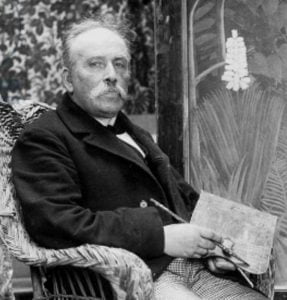
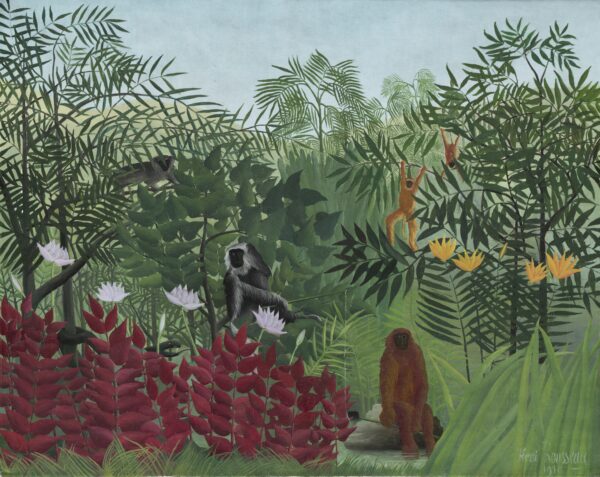
He never saw one. The painter never left France; he studied the plants in Paris hothouses and natural history collections. The leaves are therefore recognisable, but their relations are not those of a real tropical forest. It is this contradiction — precise in detail, impossible as a whole — that holds these scenes together. The same method, without a human figure and without beasts, can be seen in The Equatorial Jungle, painted a year earlier.
Why does this particular canvas matter?
The Dream is the largest and last big jungle canvas Rousseau painted, dating from 1910, the year he died. In it he gathered all he had developed in these scenes over twenty years: layers of foliage, sharply outlined animals, a light falling from nowhere in particular. And he added something that had not been there before — a human figure that neither flees nor fights in the scene, but rests. To see the early, dramatic version of the same motif, look at Tiger in a Tropical Storm, where a storm stands in place of the sofa. To see another resting figure, this time asleep under a full moon in the desert, look at The Sleeping Gypsy.
What does the painting mean?
The title says this is a dream, and with that the question only opens. The woman on the sofa may be the one dreaming, and the jungle is her dream; or she may herself be part of someone else’s dream, and the sofa is the only piece of reality in the scene. The work does not choose, and offers no key. That is why it stays in mind longer than a scene that spelled its meaning out. Only the mood is certain: quiet, watchful, with no danger that has just occurred.
How did the painting reach New York?
The canvas is today in the Museum of Modern Art in New York, recorded under the number 252.1954. It entered the collection in 1954 as a gift of Nelson A. Rockefeller, and that is what the record of its path states. What happened to the canvas between 1910 and that gift is not broken down in the record we read, so we do not describe it; we would rather leave a gap than fill it with a guess.
What does naive art mean in this work?
Naive art is the name for painting by self-taught artists who trained in no academic studio and kept to none of its rules on perspective, shading and anatomy. On this canvas it shows above all in the perspective that is not there: space does not recede, it stands in layers one behind another. The New York record quotes the present-day painter Mark Bradford, who described exactly this manner as an amazingly flat, perspectiveless way of painting imaginary jungles — and names it as an influence on his own work. The label naive art therefore does not mean ignorance, but a style later painters took seriously. There is more on the painter’s path in our article about the painter.
How is your canvas made here?
Your canvas is begun only after your order, in our workshop in Slovenia. The oil is built up in layers, from the growth at the back towards the front, so that the animals and the figure on the sofa arrive last, in the same order as in the original. We do not print and use no machine application; a hand-painted canvas differs from a print on touch alone, and no two versions are quite alike. The canvas is stretched on a wooden frame, ready to hang. Before packing we photograph the work and send you that photograph for approval; only then does it travel. The full range by this painter is in the Henri Rousseau gallery.
Which size for which wall?
Eleven sizes: 50 x 35, 60 x 40, 70 x 50, 80 x 60, 100 x 70, 120 x 80, 150 x 100, 180 x 125, 200 x 140, 250 x 170 and 299 x 207 cm. This wide landscape format asks for width: above a sofa or a sideboard, or along a wide wall, it carries as it cannot in a narrow space. For a living room the usual choice is 150 x 100 cm or larger. Below 80 x 60 cm the animals merge into the leaves and the scene loses what rewards close looking. The 299 x 207 cm size is notable because it matches the original almost exactly. Above a sofa the picture should take about two thirds of the furniture’s width.
How do I order a custom size, a stretcher and a frame?
Custom sizes go through the painting made by order page, where you enter width and height. Proportions matter here: the scene is built across its width, and narrowing the canvas pushes the sofa and the animals behind it together. For non-standard measurements we suggest keeping the ratio of the original and changing only the scale. The canvas is always stretched on a wooden frame. A frame is not included in the price and is chosen separately; unframed, the work is ready to hang on arrival.
How is it delivered and what do we guarantee?
We deliver to Slovenia, Croatia, Italy, Austria, Hungary and Germany. The canvas travels rolled in a tube or stretched on its frame, always in protective wrapping. We guarantee that every work is painted by hand and that you will see a photograph of the finished piece before dispatch; if something there is not as you wish, we correct it before the work leaves the workshop. For the largest sizes we agree access to the room beforehand, because a canvas in one piece needs a way through to the wall.
Frequently asked questions
Where is the original?
In the Museum of Modern Art in New York, under inventory number 252.1954. The record gives 1910, oil on canvas, and a size of 204.5 x 298.5 cm.
Who is the woman on the sofa?
The record does not name or interpret her; it states only that the reclining nude woman was Rousseau’s invention and not a scene he had seen.
What is the figure behind her doing?
Playing a horn. The figure stands deep in the leaves and is easy to miss at first glance; the New York record mentions it for that very reason.
Is this a print?
No. Every canvas is painted by hand in oils, to order. The body of the paint is visible and can be felt, which a print cannot imitate.
Which size should I choose?
For a living room 150 x 100 cm or larger, for a smaller room 100 x 70 cm. The landscape format asks for width, not height.
Can I have a size that is not on the list?
Yes, a made-to-order size carries no surcharge for a non-standard format. We recommend keeping the proportions of the original.
Which size is closest to the original?
The 299 x 207 cm size. The original measures 298.5 x 204.5 cm and is the largest canvas the painter made.
How is the painting delivered?
Rolled in a tube or stretched on its frame, with tracked shipping. Production time depends on size and is confirmed when you order.
What does the painting say in one sentence?
That a sofa from a Paris apartment can be set down in the middle of an invented jungle, and the scene does not break apart but becomes a dream.
Is the original for sale?
No. The work is in the public collection of the New York museum and is not for sale; we give no value, having no source for one.
Is it suitable as a gift?
A large, quiet scene is a rewarding choice for a gift. If you would rather leave the choice to the recipient, there is a gift voucher.
- Subject: a naked woman on a sofa amid tropical growth, lions, birds and a snake in the leaves, a moon above the scene
- Original: 1910, oil on canvas, 298.5 x 204.5 cm, Museum of Modern Art in New York, inv. 252.1954, gift of Nelson A. Rockefeller
- Our version: hand-painted oil, eleven sizes from 50 x 35 to 299 x 207 cm or made to measure, photograph for approval before dispatch
- Worth knowing: the painter’s largest and last big jungle canvas, painted in the year of his death