







































Description
| Title: | Child with Puppet (To Celebrate the Baby) |
| Other titles: | Pour fêter le bébé! (title in the museum record) · Zur Feier des Kindes! |
| Painter: | Henri Rousseau (1844–1910) |
| Year painted: | 1903, signed lower right «Henri Rousseau» |
| Original size: | 81 cm x 100 cm |
| Original technique: | oil on canvas |
| Painting style: | naive art (primitivism), Paris after Impressionism |
| Located at: | Kunst Museum Winterthur (inv. KV 1103) |
| Our reproduction: | hand-painted oil on canvas, eight sizes or a size made to order |
Child with Puppet (Pour fêter le bébé!) – Henri Rousseau
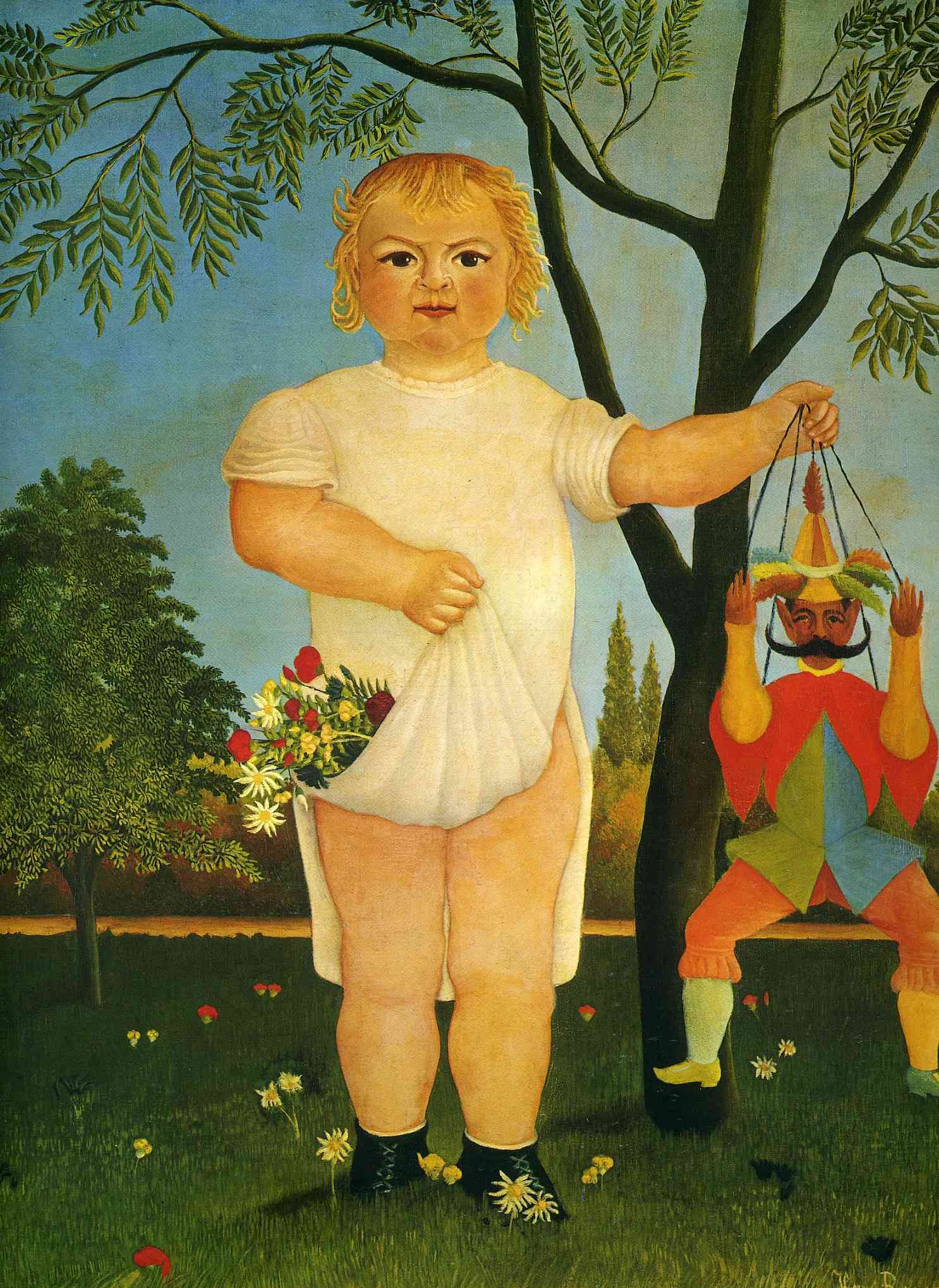
Child with Puppet (To Celebrate the Baby) is an upright canvas by Henri Rousseau from 1903 and the only portrait of a child in our range by this painter. A child in a white smock stands in the middle of a meadow, a puppet in one hand and a flower in the other. The original is held by the Kunst Museum Winterthur in Switzerland under inventory number KV 1103, and the work is signed lower right. Here it is made as a hand-painted reproduction in oil, on canvas, in eight sizes from 40 x 50 cm to 150 x 180 cm or to your own measurement. Before dispatch we send you a photograph of the finished canvas for approval.
What is on the canvas?
The child stands at the front, turned straight towards the viewer, and fills almost the whole height. One hand holds a puppet, the other a flower; both are painted as carefully as the face. The smock is white and wide, with no folds to show the body beneath. Behind the figure is a meadow strewn with small flowers, each painted separately, and a low horizon with no buildings. The sky is pale and empty. Because no shadow sets the child on the ground, the figure seems to stand in front of the meadow rather than on it.
Why does the child not look like a child?
This is the question almost everyone asks in front of the canvas. The head is out of proportion and the face is serious, almost adult: this is not the image of an infant but of a small person with a strong, withheld expression. Rousseau did not paint by the rules of academic anatomy and made no attempt to soften the figure. That disproportion is what holds the work together — the child looks back, so the scene is not sweet but direct.
How is the space built?
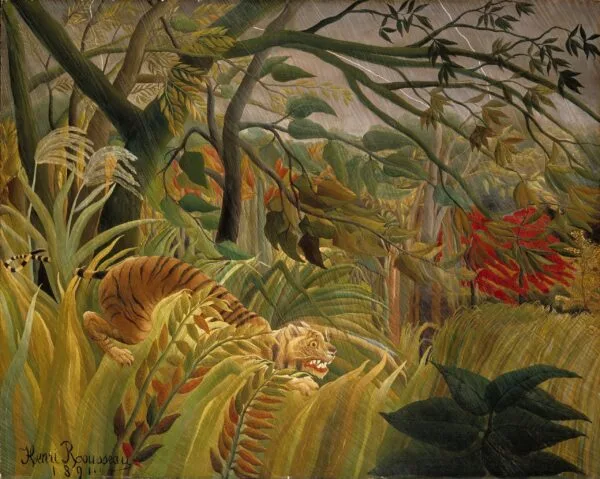
There is no space in the usual sense. The meadow is a flat area strewn with flowers of equal size from the bottom edge to the horizon, so it does not recede. There is no aerial perspective and no shadow. Depth is carried by size alone: the child is large, the flowers are small, and from that difference the viewer infers distance. The same method, carried into dense growth, can be seen in The Equatorial Jungle, where a wall of leaves stands in place of the meadow.
Why does this particular canvas matter?
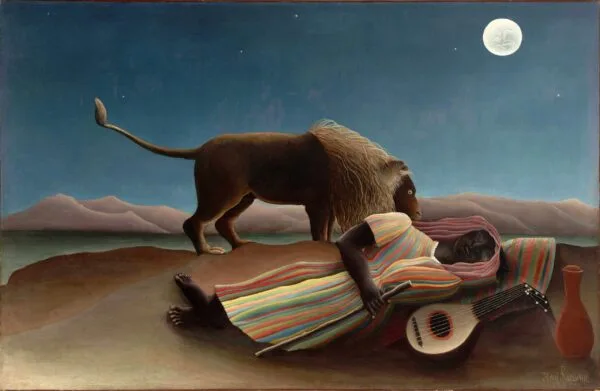
Among the jungles and the city scenes this is one of the few works by Rousseau to put a person at the front, and the only child portrait in our range by this painter. It dates from 1903, between the early forest scenes and the late large canvases, and shows that the painter applied the same manner — flat colour, outline instead of modelling — whatever the subject. Another figure in empty space, this time adult and reclining, is The Dream, and a sleeping figure under a full moon, in the middle of the desert, is The Sleeping Gypsy.
What does the painting mean?
The French title is an exclamation: to celebrate the baby. The scene is therefore a celebration, though nobody in it is celebrating — no guests, no table, no second person. What remains is the child with a toy and a flower, set straight in front of the viewer as in an official photograph. That gap between title and scene is what makes the work unusual and what keeps it in mind. If you see tenderness in it you are right; if you see seriousness, you are right as well.
How did the painting reach Winterthur?
The canvas is today in the Kunst Museum Winterthur, recorded under the number KV 1103. It entered the collection in 1970 as a gift of the heirs of Olga Reinhart-Schwarzenbach, and that is what the museum record states. What happened to the canvas between 1903 and that gift is not broken down in the record we read, so we do not describe it; we would rather leave a gap than fill it with a guess.
What does naive art mean in this work?
Naive art is the name for painting by self-taught artists who trained in no academic studio and kept to none of its rules on perspective, shading and anatomy. On this canvas it shows at once: in the proportion of head to body, in the meadow without depth, and in the missing shadow. Everything else is considered — the central placing of the figure, the even flowers, the clean boundary between smock and background. The label naive art therefore does not mean ignorance, but a style recognisable at first glance. There is more on the painter’s path in our article about the painter.
How is your canvas made here?
Your canvas is begun only after your order, in our workshop in Slovenia. The oil is built up in layers, from the sky and the meadow towards the figure, so that the smock, the puppet and the flower arrive last, in the same order as in the original. We do not print and use no machine application; a hand-painted canvas differs from a print on touch alone, and no two versions are quite alike. The canvas is stretched on a wooden frame, ready to hang. Before packing we photograph the work and send you that photograph for approval; only then does it travel. The full range by this painter is in the Henri Rousseau gallery.
Which size for which wall?
Eight sizes: 40 x 50, 50 x 60, 60 x 75, 70 x 90, 81 x 100, 100 x 120, 120 x 150 and 150 x 180 cm. Being an upright format with a single large figure, it works on a narrow wall too, between a door and a corner, or in a child’s room. For a living room the usual choice is 100 x 120 cm or larger. Below 50 x 60 cm the small flowers of the meadow merge into one green area and the scene loses half its precision. The 81 x 100 cm size is notable because it matches the original exactly. Above a sofa the picture should take about two thirds of the furniture’s width.
How do I order a custom size, a stretcher and a frame?
Custom sizes go through the painting made by order page, where you enter width and height. Proportions matter here: the figure fills almost the whole height, and widening the canvas creates empty meadow around the child that the original does not have. For non-standard measurements we suggest keeping the ratio of the original and changing only the scale. The canvas is always stretched on a wooden frame. A frame is not included in the price and is chosen separately; unframed, the work is ready to hang on arrival.
How is it delivered and what do we guarantee?
We deliver to Slovenia, Croatia, Italy, Austria, Hungary and Germany. The canvas travels rolled in a tube or stretched on its frame, always in protective wrapping. We guarantee that every work is painted by hand and that you will see a photograph of the finished piece before dispatch; if something there is not as you wish, we correct it before the work leaves the workshop. This motif is a frequent choice for a child’s room and as a gift for a birth.
Frequently asked questions
Where is the original?
In the Kunst Museum Winterthur in Switzerland, under inventory number KV 1103. The record gives 1903, oil on canvas, and a size of 100 x 81 cm.
Is the work signed?
Yes. The museum record gives a signature lower right, «Henri Rousseau».
Why is the child’s head so large?
Because the painter did not work to academic anatomy. The disproportion belongs to his manner and is not a fault to be corrected.
Is this a print?
No. Every canvas is painted by hand in oils, to order. The body of the paint is visible and can be felt, which a print cannot imitate.
Which size should I choose?
For a living room 100 x 120 cm or larger, for a child’s room or a narrow wall 60 x 75 cm. The upright format asks for height, not width.
Can I have a size that is not on the list?
Yes, a made-to-order size carries no surcharge for a non-standard format. We recommend keeping the proportions of the original.
Which size is closest to the original?
The 81 x 100 cm size, which matches the original exactly as the museum record gives it.
How is the painting delivered?
Rolled in a tube or stretched on its frame, with tracked shipping. Production time depends on size and is confirmed when you order.
What does the painting say in one sentence?
That a celebration can be entirely silent: one child, one toy and one flower on an empty meadow, with no guests.
Is the original for sale?
No. The work is in the public collection of the museum in Winterthur and is not for sale; we give no value, having no source for one.
Is it suitable as a gift?
As a gift for a birth or for a child’s room this is a rewarding choice. If you would rather leave the choice to the recipient, there is a gift voucher.
- Subject: a child in a white smock with a puppet and a flower, a meadow of small flowers, a low horizon and an empty sky
- Original: 1903, oil on canvas, 81 x 100 cm, signed lower right, Kunst Museum Winterthur, inv. KV 1103, gift of the heirs of Olga Reinhart-Schwarzenbach
- Our version: hand-painted oil, eight sizes from 40 x 50 to 150 x 180 cm or made to measure, photograph for approval before dispatch
- Worth knowing: the 81 x 100 cm size matches the size of the original exactly