


Description
| Title: | Rendezvous in the Forest |
| Other titles: | Rendezvous in the Forest (the museum’s title) |
| Painter: | Henri Rousseau |
| Year painted: | 1889 |
| Original size: | 92 cm x 73 cm (height x width); with frame 107.9 x 89.5 cm |
| Original technique: | oil on canvas |
| Painting style: | naive art (primitivism) |
| Held at: | National Gallery of Art, Washington, USA (inv. 1972.9.20) |
| Our reproduction: | hand-painted oil on canvas, eight sizes or a size made to order |
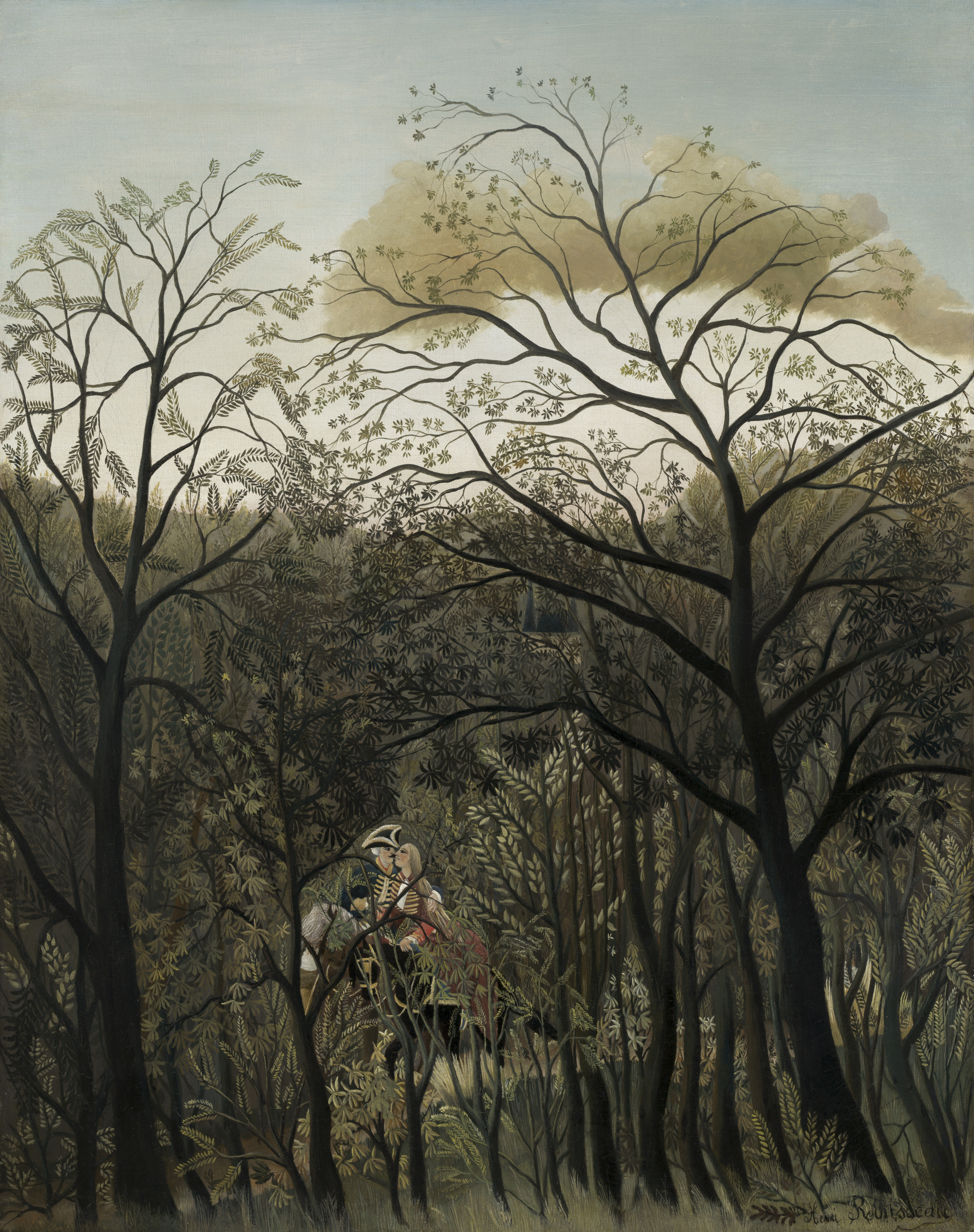
Rendezvous in the Forest is a painting by Henri Rousseau, oil on canvas, dated 1889 by the National Gallery of Art in Washington, which holds it under inventory number 1972.9.20. The original is 92 cm high and 73 cm wide. What you see: a dense wood of thin trees under a pale sky with an ochre cloud, and low down among the leaves two riders leaning towards each other to kiss.
Rendezvous in the Forest
What is on the canvas?
The canvas is upright. Across the upper half spread thin, dark trees whose branches and small leaves form a net against a pale grey-blue sky, where a large ochre-brown cloud hangs. The lower two thirds are filled with dense undergrowth of olive, brown and grey-green leaves, drawn one leaf at a time. Far off, between the branches, a dark building with pointed roofs can just be made out. Below the centre, half hidden in the leaves, two riders meet and kiss: the man, in a tricorn hat over white hair, a blue coat with gold braid and a red collar, rides a grey horse whose lowered head shows at the left; the woman, with long fair hair, in a red jacket with gold braid and a reddish skirt, sits on a dark horse. The signature, Henri Rousseau, is at the lower right.
Who are the riders in the wood?
The museum’s record does not name them and tells no story about them, so we tell none either. The title speaks only of a rendezvous, and the canvas shows what that means: two riders meeting in the middle of a wood and leaning together, so small and so screened by branches that the eye finds them only after a moment. Their clothes, the tricorn and the braided coats, belong to a time before the painter’s own, and the wood around them is painted with the same precision as everything else. A very different encounter in a wood is Mauvaise surprise.
Who owned the painting before the museum?
The museum’s record gives an unusual beginning: in 1889 the painter gave it to his baker in Paris. The museum’s open data add that it was sold at the Hôtel Drouot auction house in Paris in December 1926, under the title Composition. It then belonged to Bela Hein in Paris, who sold it in June 1931 to Marie N. Harriman and W. Averell Harriman in New York; from the W. Averell Harriman Foundation it came to the museum in 1972 as a gift in memory of Marie N. Harriman. It has been exhibited, among other places, at the Museum of Modern Art in New York in 1942, at the Louvre and MoMA in 1984–1985, and in Henri Rousseau: Jungles in Paris in 2005–2006. Another scene from the edge of Paris is The Banks of the Bièvre near Bicêtre.
How large is the original, and what does that mean on a wall?
The original is 92 cm high and 73 cm wide; with its frame the museum gives 107.9 x 89.5 cm. Eight sizes are available: 56 x 70, 70 x 85, 79 x 100, 87 x 110, 100 x 120, 127 x 160, 143 x 180 and 160 x 200 cm. The nearest to the original are 70 x 85 and 79 x 100 cm. The riders are less than ten centimetres tall on the original, so the larger sizes help the eye find them from across the room. Custom sizes are ordered through the made-to-order painting page. Tall trees above small figures also appear in Jardin du Luxembourg.
How is a hand-painted reproduction made?
We paint your canvas painting by hand in oils after you order it, at the size you choose. From a high-resolution image of the original, the painter lays in the sky and the cloud first, then the trunks and branches, one leaf at a time, and paints the riders last so that they stay clear in the middle of the undergrowth. A hand-painted canvas always differs slightly from the next, and that difference is exactly what a print cannot give you. It is stretched on a wooden frame, ready to hang. A late painting by Rousseau, from 1910, is The Waterfall, and the whole collection is in the Henri Rousseau gallery.
Frequently asked questions
Where is the original kept?
At the National Gallery of Art in Washington, inventory number 1972.9.20.
When was it painted?
In 1889, the date the museum gives; the signature at the lower right carries no year.
Who did Rousseau give the painting to?
According to the museum’s record, to his baker in Paris, in 1889. The record does not name the baker.
Is this a print?
No. It is painted by hand in oils, and the layers of paint can be seen and felt.
Is the painting suitable as a gift?
Yes, especially for a couple or an anniversary: it is two lovers meeting in a wood. If you would rather the recipient chose, there is a gift voucher.
- Subject: two riders kissing in the middle of a dense wood of thin trees under a pale sky.
- Original: oil on canvas, 92 x 73 cm (height x width), National Gallery of Art, Washington, inv. 1972.9.20; 1889.
- Our version: hand-painted oil, eight sizes from 56 x 70 to 160 x 200 cm, or a size made to order.
- Of note: according to the museum’s record, the painter gave it to his baker in Paris in 1889.