


Description
| Title: | The Sleeping Gypsy |
| Other titles: | La Bohémienne endormie · La zingara addormentata |
| Painter: | Henri Rousseau (1844–1910) |
| Year painted: | 1897 |
| Original size: | 200.7 cm x 129.5 cm |
| Original technique: | oil on canvas |
| Painting style: | naive art (primitivism), Paris after Impressionism |
| Located at: | Museum of Modern Art, New York (inv. 646.1939) |
| Our reproduction: | hand-painted oil on canvas, eight sizes or a size made to order |
The Sleeping Gypsy – Henri Rousseau
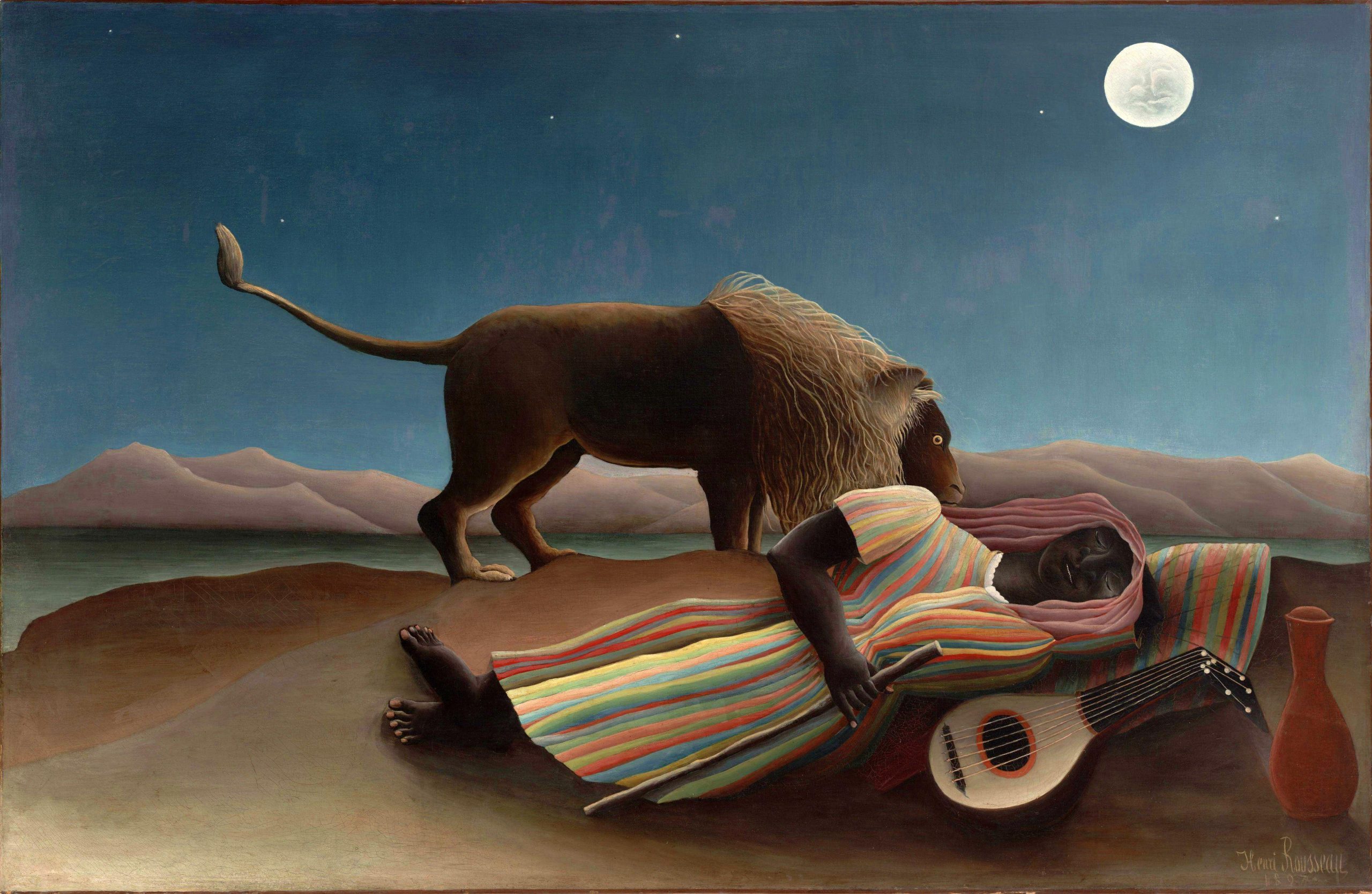
This is one of Rousseau’s most recognisable canvases, painted in 1897. A sleeping figure lies on the sand in a striped robe, a mandolin and a jar beside her, and a lion stands over her. The original is held by the Museum of Modern Art in New York under inventory number 646.1939, a gift of Mrs Simon Guggenheim. Here it is made as a hand-painted reproduction in oil, on canvas, in eight sizes from 80 x 50 cm to 201 x 130 cm or to your own measurement. Before dispatch we send you a photograph of the finished canvas for approval.
What is on the canvas?
The scene is wide and almost empty. The sleeping figure lies on the sand, wrapped in a striped robe, one arm stretched along the body. Beside her are only two objects: a mandolin and a clay jar. A lion stands over her, its mane turned towards the viewer, its head lowered to the sleeping body. The sky is dark blue with a large round moon in it, and the horizon is an almost straight line without obstacle. Nowhere does a shadow fall from the lion onto the sand. That absence of shadow is the strangest detail in the scene: the lion stands in the light and yet throws no shadow at all.
Why does the lion not attack?
Because the scene is not an event but a moment before or after one. The lion shows no teeth and is not gathering to spring; its head is lowered as though scenting. The sleeping figure does not wake and knows nothing of it. That restraint is why the work stays in mind longer than a scene of attack would: the viewer decides whether anything is going to happen. The opposite, louder pole of the same meeting with a beast is The Hungry Lion Throws Itself on the Antelope, where the decision has already been made.
How is the space built?
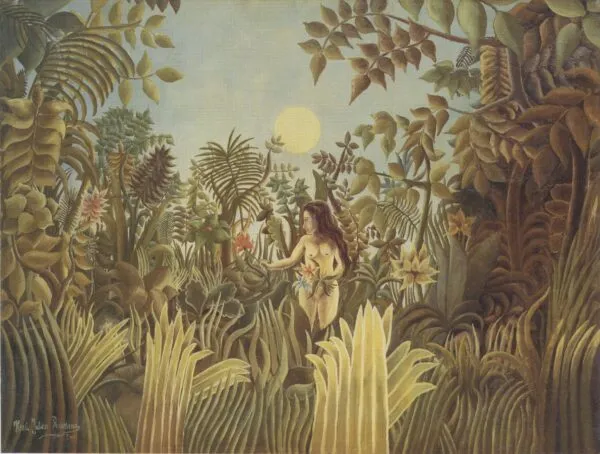
Nothing here is painted from nature. The desert is a flat area, not a landscape; the sand carries no tracks, furrows or stones to give it depth. The lion is assembled from captive animals and from illustrations, and the robe is a pattern rather than a cloth. There is no aerial perspective: the horizon is as sharp as the objects in front, so the scene reads as a surface with bodies set on it. Depth is carried by the size of the figures alone. The same method, carried into dense growth, can be seen in The Equatorial Jungle.
Why does this particular canvas matter?
It was painted in 1897, in the middle of the painter’s path, between the early forest scenes and the late large canvases. It differs from both in how little is on it: one figure, one animal, two objects and the moon. Rousseau showed here that his manner needs no dense backdrop to work — an empty space and two bodies in it are enough. The late, opposite solution, with the canvas filled to the edge, is The Dream.
What does the painting mean?
The title says who is sleeping but not what is happening. The lion may be a danger the sleeping figure does not suspect; it may be part of her dream; it may be both at once. The work does not choose between these readings. The silence the two stand in is the only certainty, and that is why the scene later interested painters looking for images of dreaming. If you see calm in it you are right; if you see a threat, you are right as well.
How did the painting reach New York?
The canvas is today in the Museum of Modern Art in New York, recorded under the number 646.1939. It entered the collection in December 1939 as a gift of Mrs Simon Guggenheim, and that is what the record of its path states. What happened to the canvas between 1897 and that gift is not broken down in the record we read, so we do not describe it; we would rather leave a gap than fill it with a guess.
What does naive art mean in this work?
Naive art is the name for painting by self-taught artists who trained in no academic studio and kept to none of its rules on perspective, shading and anatomy. On this canvas it shows in three things: the perspective that is not there, the shadow that is missing, and the lion, painted as a sign of a lion rather than an animal in motion. Everything else is considered — the balance of emptiness and bodies, the placing of the moon, the turned head of the beast. The label naive art therefore does not mean ignorance, but a style recognisable at first glance. There is more on the painter’s path in our article about the painter.
How is your canvas made here?
Your canvas is begun only after your order, in our workshop in Slovenia. The oil is built up in layers, from the sky and the sand towards the figures, so that the lion and the sleeping figure arrive last, in the same order as in the original. We do not print and use no machine application; a hand-painted canvas differs from a print on touch alone, and no two versions are quite alike. The canvas is stretched on a wooden frame, ready to hang. Before packing we photograph the work and send you that photograph for approval; only then does it travel. The full range by this painter is in the Henri Rousseau gallery.
Which size for which wall?
Eight sizes: 80 x 50, 90 x 60, 100 x 65, 120 x 80, 140 x 90, 160 x 100, 180 x 120 and 201 x 130 cm. Being a very wide landscape canvas it asks for wall length: above a sofa, above a bed or in a hallway it carries as it cannot on a narrow wall. For a living room the usual choice is 160 x 100 cm or larger. Below 100 x 65 cm the mandolin and the jar begin to disappear, and with them the scene loses two of its four objects. The 201 x 130 cm size is notable because it matches the original, rounded to whole centimetres. Above a sofa the picture should take about two thirds of the furniture’s width.
How do I order a custom size, a stretcher and a frame?
Custom sizes go through the painting made by order page, where you enter width and height. Proportions matter here: the scene lives on the emptiness between the figures and the edge, and narrowing the canvas brings the lion and the sleeping figure too close together. For non-standard measurements we suggest keeping the ratio of the original and changing only the scale. The canvas is always stretched on a wooden frame. A frame is not included in the price and is chosen separately; unframed, the work is ready to hang on arrival.
How is it delivered and what do we guarantee?
We deliver to Slovenia, Croatia, Italy, Austria, Hungary and Germany. The canvas travels rolled in a tube or stretched on its frame, always in protective wrapping. We guarantee that every work is painted by hand and that you will see a photograph of the finished piece before dispatch; if something there is not as you wish, we correct it before the work leaves the workshop. For the longest sizes we agree access to the room beforehand, because a canvas in one piece needs a way through to the wall.
Frequently asked questions
Where is the original?
In the Museum of Modern Art in New York, under inventory number 646.1939. The record gives 1897, oil on canvas, and a size of 129.5 x 200.7 cm.
Does the lion attack?
No attack is painted on the canvas. The lion stands over the sleeping figure with its head lowered; what will happen, the work does not say.
Why is there no shadow on the sand?
Because the painter did not paint one. That omission is what gives the scene the unreality for which it was later read as a space of dreaming.
Is this a print?
No. Every canvas is painted by hand in oils, to order. The body of the paint is visible and can be felt, which a print cannot imitate.
Which size should I choose?
For a living room 160 x 100 cm or larger, for a smaller room 120 x 80 cm. The landscape format asks for wall length, not height.
Can I have a size that is not on the list?
Yes, a made-to-order size carries no surcharge for a non-standard format. We recommend keeping the proportions of the original.
Which size is closest to the original?
The 201 x 130 cm size, which matches the original rounded to whole centimetres. The original measures 200.7 x 129.5 cm.
How is the painting delivered?
Rolled in a tube or stretched on its frame, with tracked shipping. Production time depends on size and is confirmed when you order.
What does the painting say in one sentence?
That two bodies and a moon in an empty space can say more than a whole scene, because they leave the ending to the viewer.
Is the original for sale?
No. The work is in the public collection of the New York museum and is not for sale; we give no value, having no source for one.
Is it suitable as a gift?
A quiet, instantly recognisable scene is a rewarding choice for a gift. If you would rather leave the choice to the recipient, there is a gift voucher.
- Subject: a sleeping figure in a striped robe on sand, a mandolin and a jar beside her, a lion above and a large moon
- Original: 1897, oil on canvas, 200.7 x 129.5 cm, Museum of Modern Art in New York, inv. 646.1939, gift of Mrs Simon Guggenheim
- Our version: hand-painted oil, eight sizes from 80 x 50 to 201 x 130 cm or made to measure, photograph for approval before dispatch
- Worth knowing: not one shadow falls on the sand — that omission is what gives the scene its unreality