




Description
| Title: | Tropical Landscape: An American Indian Struggling with a Gorilla |
| Other titles: | Tropical Landscape – An American Indian Struggling with an Ape (former title); Paysage tropical : lutte de l’Indien et du gorille (French title) |
| Painter: | Henri Rousseau |
| Year painted: | 1910 |
| Original size: | 113.67 cm x 162.56 cm (height x width) |
| Original technique: | oil on canvas |
| Painting style: | naive art (primitivism) |
| Held at: | Virginia Museum of Fine Arts, Richmond, USA (acc. 84.3) |
| Our reproduction: | hand-painted oil on canvas, eight sizes or a size made to order |
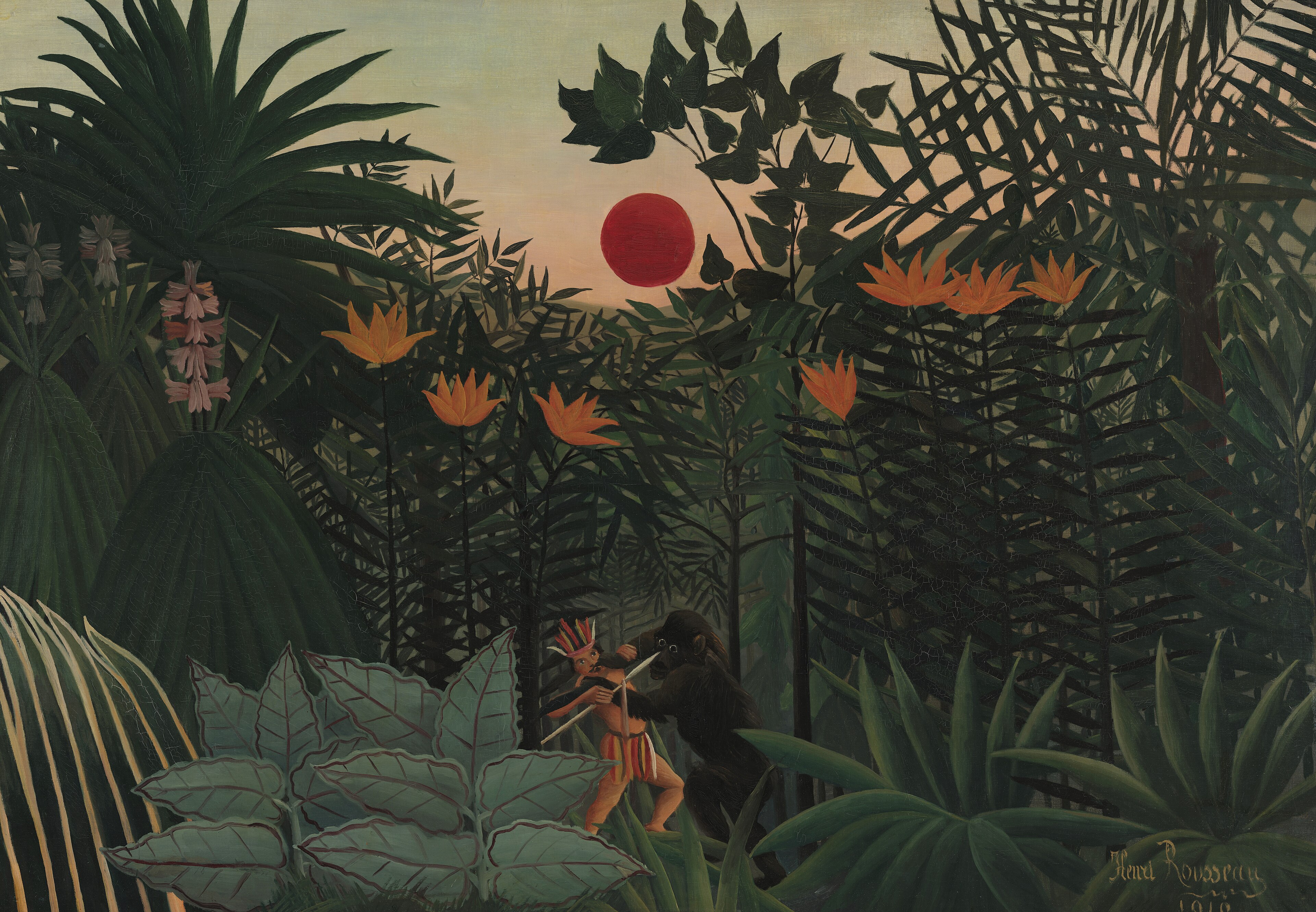
Tropical Landscape: An American Indian Struggling with a Gorilla is a painting by Henri Rousseau, oil on canvas, signed and dated 1910 by the painter at the lower right. The original is 113.67 cm high and 162.56 cm wide and is held by the Virginia Museum of Fine Arts in Richmond under object number 84.3, in the Collection of Mr. and Mrs. Paul Mellon. What you see: a dark jungle, a red sun in a pink sky, orange flowers, and, small at the lower centre, a struggle between a man in a feathered headdress and a gorilla.
Tropical Landscape: An American Indian Struggling with a Gorilla
What is on the canvas?
The canvas is wide and almost entirely dark green. A red sun hangs high in the centre against a pink sky, and around it rise palm fronds, spiky orange flowers and, at the left, a pink flower spike. A large pale grey-green leaf closes the view at the front left. Low in the centre, small against the vegetation, a man in a feathered headdress and a striped loincloth, holding a long spear, struggles with a black gorilla that has seized him. The museum describes the landscape as a progression of flat planes arranged like theatre scenery, with the two unlikely opponents framed at its centre. The signature Henri Rousseau, with the year 1910, is at the lower right. Another struggle in the jungle that we offer is Virgin Forest at Sunset.
Did Rousseau ever see a jungle?
No. The museum describes him as self-taught, making his living as a toll collector while aspiring to be accepted by the art establishment; his naive, artificial style appealed to enthusiasts of the avant-garde when he showed at the Salon des Indépendants. The National Gallery in London adds that he never left France and that his jungles are imaginary, put together from house plants and tropical species at the Jardin des Plantes in Paris. The first of them is the painting we offer as Tiger in a Tropical Storm.
How does the museum read the scene today?
The museum does not soften it. It writes that Rousseau exploits racist stereotypes about indigenous people that were all too common in the European popular imagination of his time: the fight between man and beast against a background of untamed nature reflects a view of distant tropical lands as “uncivilised”, a view that had long served as a pretext for colonial invasion. The same text adds that this prejudice coexisted in Rousseau’s mind with a sincere fascination with, and curiosity about, non-European cultures, which he saw as poetic and exotic. We give the museum’s reading because it belongs to the story of the painting; the title is the museum’s, which has already changed it once: it used to read “with an Ape”.
How large is the original, and what does that mean on a wall?
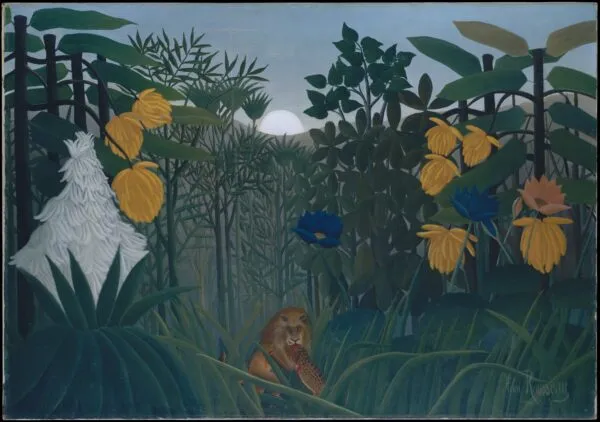
The original is 113.67 cm high and 162.56 cm wide. Eight sizes are available: 75 x 50, 90 x 65, 100 x 70, 110 x 80, 130 x 90, 170 x 120, 200 x 140 and 210 x 150 cm. The nearest to the original is 170 x 120 cm, 7.4 cm wider and 6.3 cm taller; 100 x 70 and 200 x 140 cm keep its proportion almost exactly. The struggle takes up only a small part of the canvas: on the original the figures are about 23 centimetres tall, so larger sizes show them more clearly while smaller ones bring out the jungle as a whole. A painting this dark wants a pale wall and good light, above a sofa or in a dining room, for instance. Custom sizes are ordered through the made-to-order painting page. Another large jungle is The Repast of the Lion.
How is a hand-painted reproduction made?
Every canvas painting is made by hand in oils when you order it, in the size you choose. From a high-resolution image of the original, the painter builds up the dark layers of foliage one after another so that they stay distinct, and the red sun and orange flowers keep their force against the dark ground. A hand-painted canvas always differs a little from another, and that difference is the trace of the brush a print does not have. It is stretched on a wooden frame, ready to hang. Also from 1910 is Tropical Forest with Monkeys, and the whole collection is in the Henri Rousseau gallery.
Frequently asked questions
Where is the original kept?
At the Virginia Museum of Fine Arts in Richmond, object number 84.3, in the Collection of Mr. and Mrs. Paul Mellon. When we read the museum’s record, the work was not on view, so check with the museum before a visit.
Why was the title changed?
The museum records a former title in which the gorilla was an ape, and now uses the title with the gorilla. We give both forms in the table as the record gives them.
When was it painted?
In 1910: Rousseau signed and dated it at the lower right, and the museum gives the same year.
Is this a print?
No. It is painted by hand in oils, and the layers of paint can be seen and felt.
Is the painting suitable as a gift?
It can be, but bear in mind that it shows a violent struggle and that the museum’s own text discusses the racist stereotypes in it. If you are unsure, a gift voucher leaves the choice to the recipient.
- Subject: a dark jungle under a red sun, orange flowers, and a small struggle between a man in a feathered headdress and a gorilla.
- Original: oil on canvas, 113.67 x 162.56 cm (height x width), Virginia Museum of Fine Arts, Richmond, acc. 84.3; 1910.
- Our version: hand-painted oil, eight sizes from 75 x 50 to 210 x 150 cm, or a size made to order.
- Of note: the museum’s own text names the racist stereotypes in the scene and sets them beside Rousseau’s curiosity about non-European cultures.