


Description
| Title: | The Football Players |
| Other titles: | Nogometaši, Die Fußballspieler, I giocatori di football |
| Painter: | Henri Rousseau (1844–1910) |
| Year of creation: | 1908, as the museum dates it |
| Original size: | 81.1 cm x 100.3 cm |
| Original technique: | oil on canvas |
| Painting style: | naive art (primitivism), Paris after Impressionism |
| Located at: | Solomon R. Guggenheim Museum, New York |
| Our reproduction: | hand-painted oil on canvas, eight sizes or a size made to order |
The Football Players – Henri Rousseau
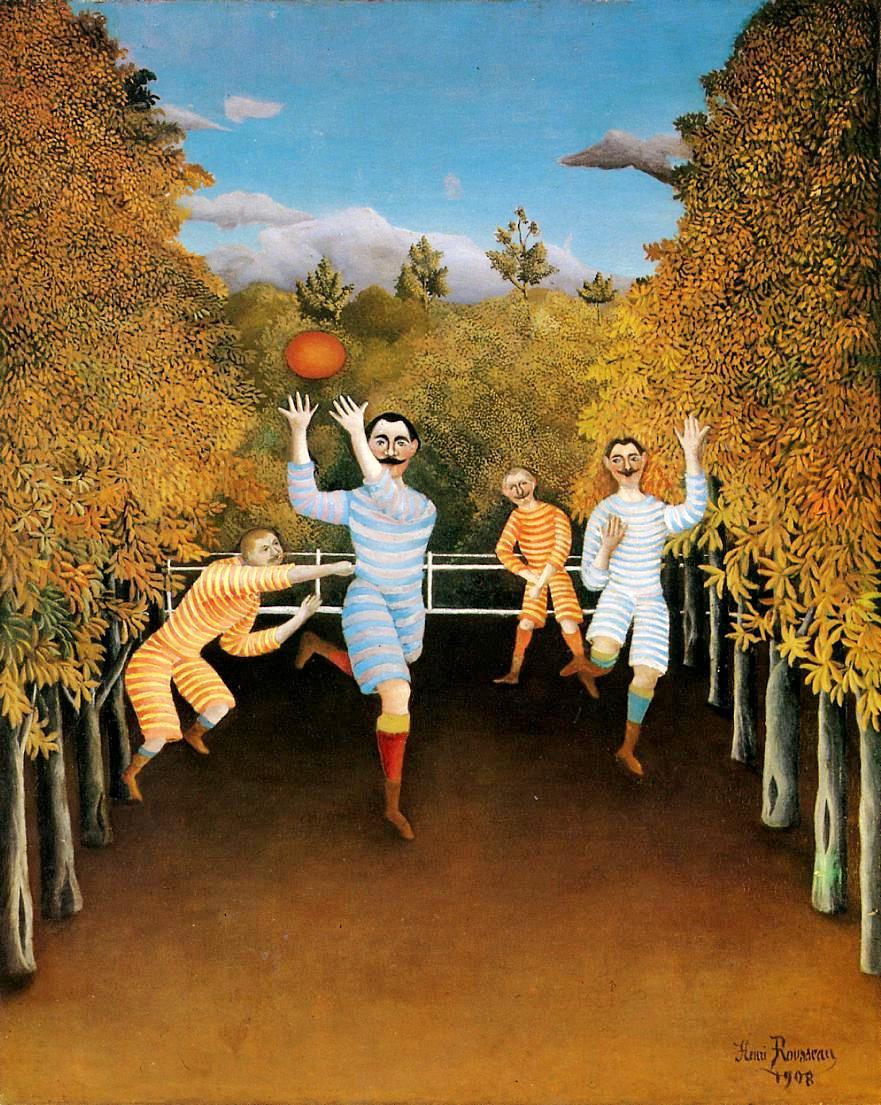
The Football Players is one of the few works by this painter with a sporting subject, and one of the strangest figure compositions he made. Four men in striped kit chase a ball in a clearing between autumn avenues of trees. The Solomon R. Guggenheim Museum in New York holds the canvas, dates it 1908 and gives its measurements as 100.3 cm high by 81.1 cm wide. Here it is made as a hand-painted reproduction in oil, on canvas, in eight sizes from 50 x 60 cm to 150 x 190 cm or to your own measurement. Before dispatch we send you a photograph of the finished canvas for approval.
What is on the canvas?
Four moustached men in striped kit move across a narrow band of grass between two avenues of trees. The movements are stiff and oddly symmetrical, as though a moment had been caught and then frozen: legs are in the air while the bodies hold a balance no real game would allow. The trees behind stand in an even rhythm, their foliage painted dot beside dot in red and yellow, so that autumn is not the colour of the background but a pattern laid across it. There is no shadow under the feet, no mud and no spectators. That emptiness is what turns a sporting picture into something closer to a rite: the game reads as an arrangement rather than an event. A comparably still arrangement of figures is A Carnival Evening.
Is this football or rugby?
The title under which the work is established, and under which we list it, says football. The museum’s own text calls the game rugby, and sees in the four men the enthusiasts of a sport that was new at the time. The kit supports that reading: the broad-striped jerseys, the headgear and the way the ball is carried in the hands belong to rugby rather than to football. We do not change the title – the work is established under it, and changing it would only make it harder to find – but we do say what the record of the institution that holds the painting states. For a viewer this is not a quibble: if you look for football in the scene, something will seem not to fit, and that observation is the correct one.
When was the canvas painted?
The museum dates it to 1908, with a single year rather than a span. That places it late in the painter’s work: Rousseau had retired and was painting full time, two years before his death. The canvas belongs among his last major works, though the jungle scenes of the same years usually overshadow it. Because the museum gives one year, we give one year, and do not guess at months or at the order of that year’s pictures.
Why does the scene read like a stage?
Rousseau set the figures on a shallow plane of grass that rises like a theatre stage, with the avenues on either side working as wings. There is almost no depth: the trees do not diminish towards the background as they would in real space, so the scene reads as a surface with figures set into it. As in his forests, every leaf is painted separately and nothing is lost in shadow. Only the subject differs. Anyone who knows his jungles will recognise the method, moved to a lawn and to four men. The museum holds a second Rousseau of the same kind, Artillerymen, and its own text reads the two together as attempts to picture modern life.
What does the painting mean?
The picture does not narrate a match. Nobody is winning, the ball is not in play in any way that reads as a move, and no two opponents face each other. What remains is a pattern: four bodies, two colours, two avenues. Some viewers read humour in it, others a quiet solemnity, because the men look like participants in a rite we do not understand. Both can be argued. Rousseau adds neither mockery nor explanation, and it is that restraint which keeps the painting strange more than a century later.
Why is there no accession number on this page?
Because the museum does not publish one. The record the museum makes available gives the painter, the title, the year, the medium, the measurements and the name of the institution – but no accession number. A number that appears inside the filename of the museum’s photograph is not a catalogue field, and we do not state it as a fact. We would rather say what the institution has not published than put something on the page that looks like evidence nobody has confirmed. What the museum publishes we give in full; its record is at the museum’s page for the work.
What does naive art mean in this work?
Naive art is the name for painting by self-taught artists who trained in no academic studio and kept to none of its rules on perspective, shading and anatomy. Rousseau was a customs clerk who began to paint seriously only in his forties – his shortcoming in the eyes of the critics of the day, and what drew the painters and writers around him. In this canvas the naivety shows in the stiff bodies, in the flat colour and in an avenue with no aerial perspective. It does not mean ignorance, but a style you recognise at first glance. There is more on the painter’s path in our article about the painter.
How is your canvas made here?
Your canvas is begun only after your order, in our workshop in Slovenia. The oil is built up in layers, from the background towards the figures, so that the stripes on the jerseys and the faces arrive last. Because the composition is strictly symmetrical, the proportions are held at every size, so the central axis stays where it belongs. We do not print and we use no mechanical application; a hand-painted canvas differs from a print by touch alone, because the body of the paint is visible and can be felt. The canvas is stretched on a wooden frame, ready to hang. The full range by this painter is in the Henri Rousseau gallery, and a related figure subject is Jardin du Luxembourg.
Which size for which wall?
Eight sizes: 50 x 60, 60 x 75, 70 x 90, 80 x 100, 90 x 110, 110 x 140, 130 x 160 and 150 x 190 cm. Being an upright canvas with four figures, it needs height and some quiet wall around it: above a sideboard, beside a staircase, or in a row with other figure subjects. For a living room the usual choice is 90 x 110 cm or larger. Below 60 x 75 cm the stripes on the jerseys and the dots in the foliage begin to merge, and what rewards close looking is lost. The 80 x 100 cm size is the closest to the measurements the museum gives for the original.
How do I order a custom size, a stretcher and a frame?
Custom sizes go through the painting made by order page, where you enter width and height. Proportions matter here: the figures stand in a row across the middle, and widening the scene brings in grass and trees at the sides that the source does not have. For non-standard measurements we suggest keeping the ratio and changing only the scale. The canvas is always stretched on a wooden frame. A frame is not included in the price and is chosen separately.
How is it delivered and what do we guarantee?
We deliver to Slovenia, Croatia, Italy, Austria, Hungary and Germany. The canvas travels rolled in a hard tube or stretched on its frame, depending on the size, always in protective wrapping. We guarantee that every work is painted by hand and that you will see a photograph of the finished piece before dispatch; if something there is not as you wish, we correct it before the work leaves the workshop. Production time depends on size and is confirmed when you order.
Frequently asked questions
Where is the original?
In the Solomon R. Guggenheim Museum in New York. The museum gives oil on canvas, 100.3 cm high and 81.1 cm wide.
Why is no accession number given?
Because the museum does not publish one. A number inside the filename of its photograph is not a catalogue field, so we do not quote it.
What year is the painting from?
The museum dates it to 1908, with a single year. That is two years before the painter’s death.
Which sport is actually shown?
The museum’s text says rugby; the title of the work says football. The kit on the canvas supports the museum.
Is this a print?
No. Every canvas is painted by hand in oils, to order. The body of the paint is visible and can be felt, which a print cannot imitate.
Which size should I choose?
For a living room 90 x 110 cm or larger, for a narrow wall 70 x 90 cm. The upright format asks for height, not width.
Can I have a size that is not on the list?
Yes, a made-to-order size carries no surcharge for a non-standard format. We recommend keeping the proportions.
Which size is closest to the original?
The 80 x 100 cm size. By the museum’s measurements the original is 81.1 cm wide and 100.3 cm high.
How is the painting delivered?
Rolled in a tube or stretched on its frame, with tracked shipping. Production time is confirmed when you order.
Is the original for sale?
No. The work is in the public collection of the New York museum and is not for sale; we give no value, having no source for one.
Is it suitable as a gift?
A sporting subject is a rewarding choice for a gift. If you would rather leave the choice to the recipient, there is a gift voucher.
- Subject: four players in striped kit in a clearing between autumn avenues of trees
- Original: 1908, oil on canvas, 100.3 x 81.1 cm (height x width), Solomon R. Guggenheim Museum, New York
- Our version: hand-painted oil, eight sizes from 50 x 60 to 150 x 190 cm or made to measure
- Worth knowing: the museum’s own text calls the game rugby, while the title of the work says football