


Description
| Title: | The Waterfall |
| Other titles: | The Waterfall (the museum’s title) |
| Painter: | Henri Rousseau |
| Year painted: | 1910 |
| Original size: | 116.2 cm x 150.2 cm (height x width) |
| Original technique: | oil on canvas |
| Painting style: | naive art (primitivism) |
| Held at: | Art Institute of Chicago, Chicago, USA |
| Our reproduction: | hand-painted oil on canvas, ten sizes or a size made to order |
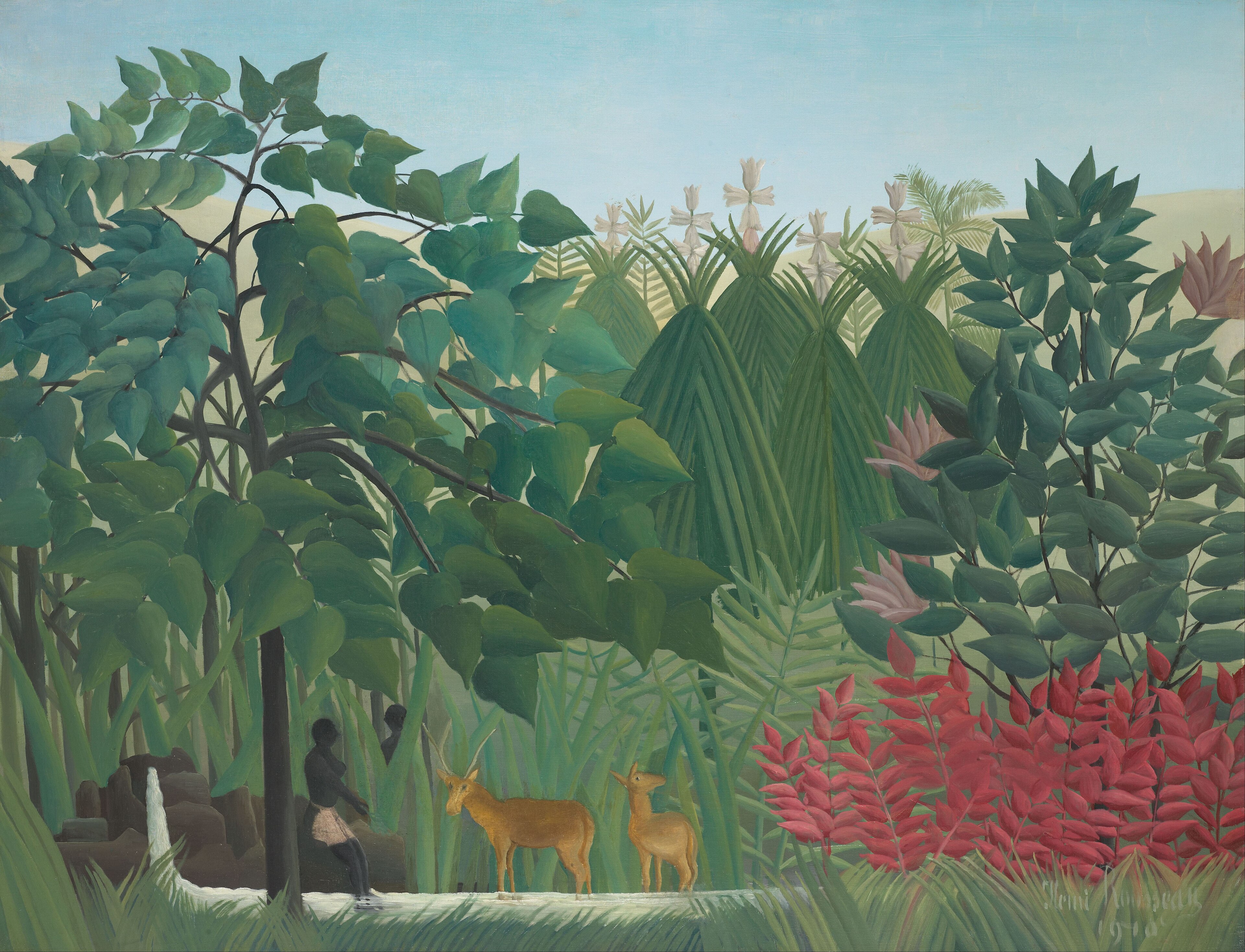
The Waterfall is a painting by Henri Rousseau, oil on canvas, dated 1910 by the Art Institute of Chicago. What you see: a dense jungle of big leaves, a red shrub and flowering palms, and below it a small waterfall, two dark-skinned figures and two deer by a stream. We paint it by hand in oils, in ten sizes or to measure, and send you a photograph of the finished painting before dispatch.
The Waterfall
What is on the canvas?
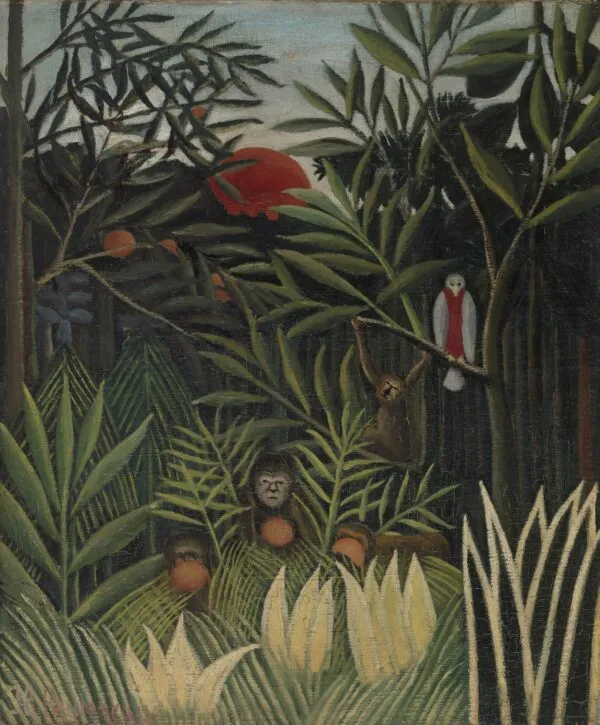
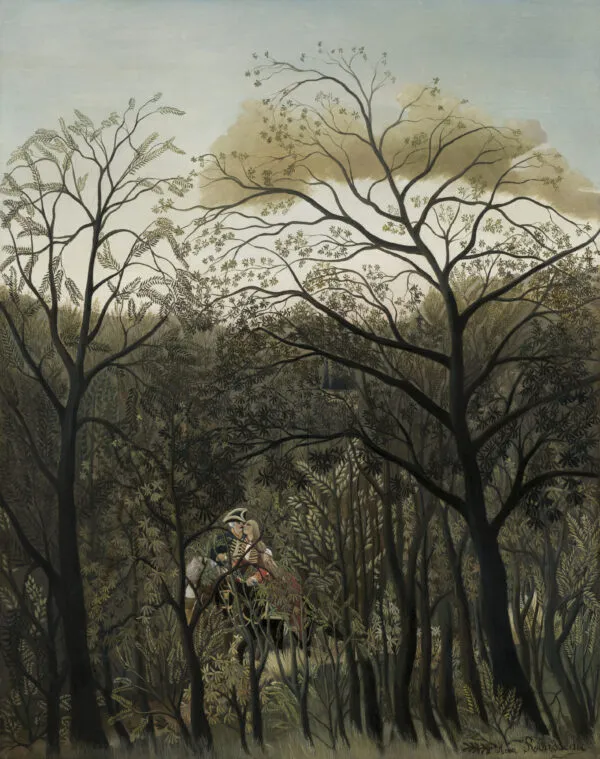
At the left a tree with large heart-shaped leaves in greens and blue-greens rises over the scene. In the middle stand tall tufts of narrow leaves topped with pale pink flowers, and at the right a shrub of red leaves glows beside a few pink blossoms. At the lower left a small white waterfall drops between rocks into a stream; a dark-skinned figure sits by the tree and a second stands behind. In the middle two brown deer stand by the water, one with long horns. Above opens a pale blue sky over sandy hills. The signature and year, Henri Rousseau 1910, are at the lower right. Another Rousseau jungle is Tropical Forest with Monkeys.
What does the painting mean?
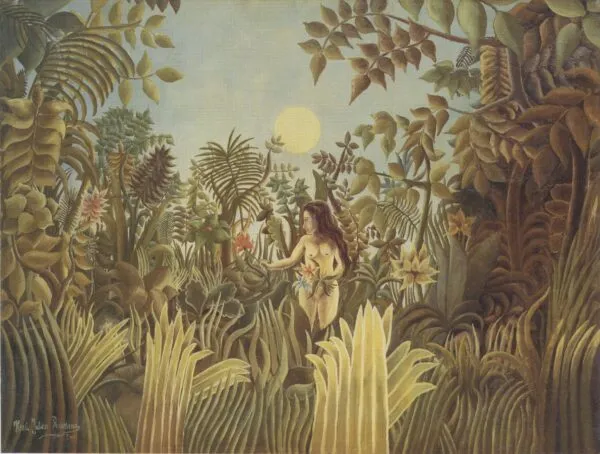
The Art Institute of Chicago writes that The Waterfall is among the very last compositions Rousseau painted, and typical of the large jungle scenes for which he became famous. Rousseau never set foot outside France: he learned about the plants and animals of faraway places in the botanical gardens and zoos of Paris and from popular books. Here, the museum says, he created a secluded corner with two figures and a pair of deer at a stream; the deer seem not to notice us, or to have just noticed us. The scene is imaginary and speaks of a European longing of the time for peace far from the modern world. Another Rousseau jungle scene is The Equatorial Jungle.
Which size suits which room?
The original is 116.2 cm high and 150.2 cm wide, a large painting; 90 x 70 cm keeps its proportion most exactly. Ten sizes are available: 70 x 55, 80 x 61, 90 x 70, 100 x 80, 120 x 90, 130 x 105, 150 x 120, 200 x 160, 223 x 179 and 270 x 200 cm; 150 x 120 cm is close to the size of the original. Because the painting lives on its dense leaves and small figures, we recommend 130 x 105 cm or larger for a living room; the smaller sizes suit a study or a hallway. Above a sofa the painting usually takes about two thirds of the width of the furniture; above a bed it should stay narrower than the headboard. Custom sizes are ordered through the made-to-order painting page, where you enter the width and height; we suggest keeping the proportion of the original and changing only the scale. A jungle by the same painter is also The Snake Charmer.
How is the painting made, and does it come framed?
Your canvas is begun only after you order it, and is painted by hand in oils in our workshop in Slovenia, at the size you choose. The painter lays in the sky and the hills first, then the layers of leaves from back to front, then the big-leaved tree and the red shrub, and last the waterfall, the deer and the figures. We do not print, and no machine application is used, so no two versions are exactly alike. The canvas is stretched on a wooden frame and arrives ready to hang; a picture frame is not included in the price and is chosen separately. Before packing we photograph the finished painting and send you the photograph for approval; only then does it travel. A fight in the jungle by the same painter is Fight between a Tiger and a Buffalo. The whole collection is in the Henri Rousseau gallery.
How is it delivered, and what do we guarantee?
We deliver to Slovenia, Croatia, Italy, Austria, Hungary and Germany. Depending on its size, the canvas travels rolled in a rigid tube or stretched on its frame, always in protective wrapping and as a tracked parcel. The making time depends on the size and is confirmed when you order. We guarantee that every painting is painted by hand and that you see a photograph of the finished work before dispatch; if anything in it is not as you wish, we correct it before it leaves the workshop.
Frequently asked questions
Where is the original kept?
At the Art Institute of Chicago in Chicago, USA.
When was it painted?
In 1910; Rousseau signed and dated it at the lower right.
Is a frame included?
No. The canvas is stretched on a wooden frame and ready to hang without a picture frame; a frame can be chosen separately.
Is this a print?
No. It is painted by hand in oils, and the layers of paint can be seen and felt.
Is the painting suitable as a gift?
Yes, especially for someone who loves greenery, nature and calm scenes. If you would rather the recipient chose, there is a gift voucher.
- Subject: a dense jungle of big leaves and a red shrub; a small waterfall, two figures and two deer by a stream.
- Original: oil on canvas, 116.2 x 150.2 cm, Art Institute of Chicago; 1910.
- Our version: hand-painted oil, ten sizes from 70 x 55 to 270 x 200 cm or to measure, unframed, photograph before dispatch.
- Of note: according to the museum, The Waterfall is among the very last compositions Rousseau painted.