


Description
| Title: | Tropical Forest with Monkeys |
| Other titles: | Forêt tropicale avec singes (French title) |
| Painter: | Henri Rousseau |
| Year painted: | 1910 |
| Original size: | 129.5 cm x 162.5 cm (height x width) |
| Original technique: | oil on canvas |
| Painting style: | naive art (primitivism) |
| Held at: | National Gallery of Art, Washington, USA (acc. 1982.76.7) |
| Our reproduction: | hand-painted oil on canvas, nine sizes or a size made to order |
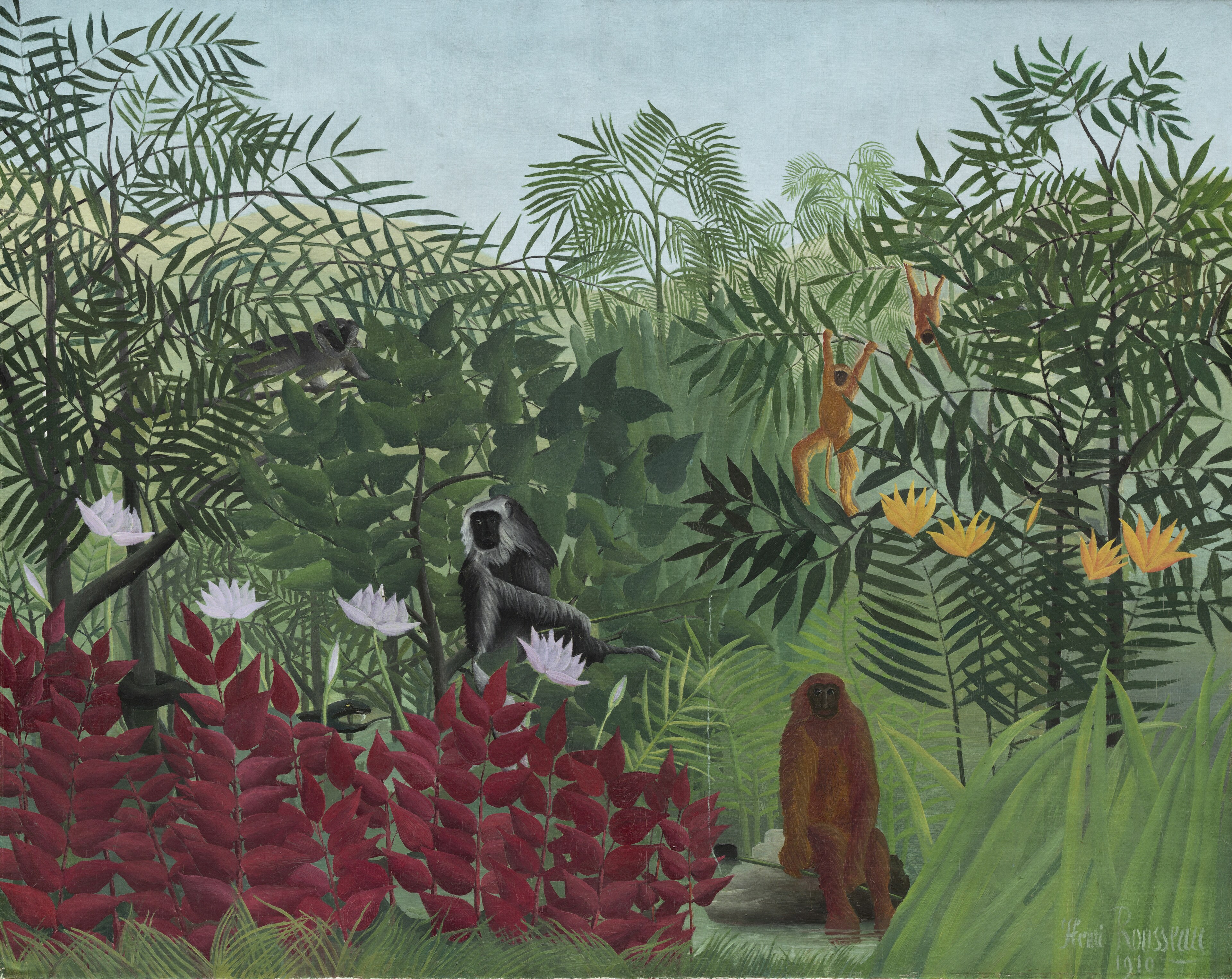
Tropical Forest with Monkeys is a painting by Henri Rousseau, oil on canvas, signed and dated 1910 by the painter at the lower right. The original measures 129.5 cm high and 162.5 cm wide and is held by the National Gallery of Art in Washington under accession number 1982.76.7, as part of the John Hay Whitney Collection. What you see: monkeys in a light green forest, a bed of dark red leaves at the front left, white flowers on thin stems and yellow-orange blossoms on the right.
Tropical Forest with Monkeys
What is on the canvas?
The canvas is a little wider than it is high and, for one of Rousseau’s forests, unusually light: a pale blue-green sky, a soft green hill at the upper left and layer upon layer of feathery fronds. The strongest colour is a bank of dark red leaves across the lower left, with white flowers rising above it on thin stems. At the centre a dark grey monkey with a white ruff sits on a branch, holding a long thin rod. Two orange monkeys hang from branches at the upper right, one by both arms, and a grey animal lies stretched along a branch at the upper left. At the lower right a large brown monkey sits on a rock by the water, facing the viewer. Look closer at the left and a dark snake is coiled round a trunk among the red leaves. The signature Henri Rousseau and the year 1910 stand at the lower right.
Did Rousseau ever see a jungle?
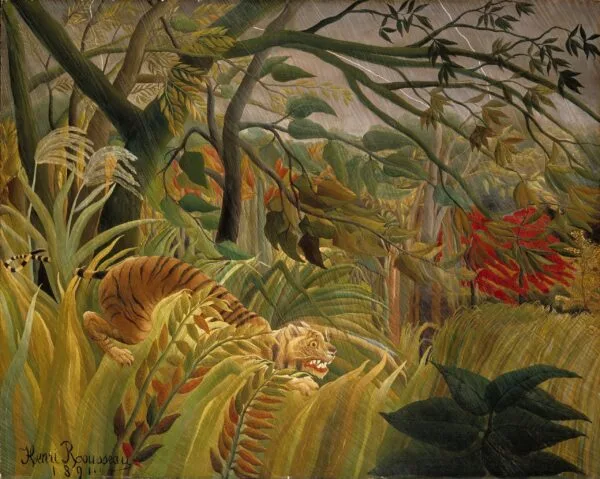
He did not. According to the National Gallery in London, whose Surprised! was the first of his twenty or so jungle paintings, Rousseau never left France, whatever he said about serving with the army in Mexico, and his jungles are entirely imaginary. The same museum names his models: house plants and tropical species seen at the Jardin des Plantes in Paris, a garden that also kept a zoo. Read this forest the same way, as an arrangement of studied plants and animals rather than a view. We offer the London painting as Tiger in a Tropical Storm.
Who owned the painting before the National Gallery of Art?
The museum publishes a short chain of owners, and we repeat it as written. The first owner named is Paul von Mendelssohn Bartholdy of Berlin, then his wife, Elsa Gräfin Kesselstadt, of Berlin and later Vaduz. In 1950 the painting was on consignment with Walter Feilchenfeldt in Switzerland, who sold it that year to John Hay Whitney of Manhasset, New York. In 1982 it was deeded to the John Hay Whitney Charitable Trust and given the same year to the National Gallery of Art. The places are where the owners lived, as the record gives them, not a route the canvas is known to have taken. Monkeys also fill Monkeys and Parrot in the Virgin Forest.
How large is the original, and what does that mean on a wall?
The original is 129.5 cm high and 162.5 cm wide, close to a proportion of five to four. Nine sizes are available: 70 x 55, 75 x 60, 85 x 68, 100 x 80, 110 x 90, 120 x 100, 160 x 127, 180 x 143 and 200 x 160 cm. The nearest to the original is 160 x 127 cm, 2.5 cm narrower and 2.5 cm lower; 75 x 60, 85 x 68, 100 x 80 and 200 x 160 cm keep the five-to-four proportion exactly. Because the canvas is so light, it holds its own on a pale wall and in a room with little daylight, where a darker jungle can feel heavy. The monkeys are small against the foliage, so from 100 x 80 cm upwards the white ruff and the thin rod stay easy to read. Custom sizes are ordered through the made-to-order painting page. A cooler jungle at dusk is The Repast of the Lion.
How is a hand-painted reproduction made?
We paint each canvas painting by hand in oils once it is ordered, in whichever size you choose. The painter builds the surface in layers from a high-resolution image of the original, so that single fronds, the monkeys’ fur and the red veins of the leaves stay distinct at every size. A hand-painted canvas always differs a little from any other; those are the marks of a brush where a print would repeat itself exactly. Before it leaves us it is stretched over a wooden frame, ready to hang. The forest scenes we offer also include The Equatorial Jungle, and the whole collection is in the Henri Rousseau gallery.
Frequently asked questions
Where is the original kept?
At the National Gallery of Art in Washington, accession number 1982.76.7, in the John Hay Whitney Collection. The museum’s page is linked in the table above.
When was it painted?
In 1910: Rousseau signed and dated it at the lower right, and the museum gives the same year. It was also the year of his death.
What are the original’s measurements in centimetres?
129.5 cm high and 162.5 cm wide, oil on canvas; framed, the museum gives 152.4 x 182.25 cm.
Is this a print?
No. Every canvas is painted by hand in oils, and the raised brushstrokes show it.
Is the painting suitable as a gift?
Yes. It shows no hunt, only animals among the leaves, and its colours are light, so it settles easily into a living room or a child’s room. If you would rather let the recipient choose, there is the gift voucher.
- Subject: monkeys in a light green forest, dark red leaves at the front, white and yellow-orange flowers, and a snake half hidden at the left.
- Original: oil on canvas, 129.5 x 162.5 cm (height x width), National Gallery of Art, Washington, acc. 1982.76.7; 1910.
- Our version: hand-painted oil, nine sizes from 70 x 55 to 200 x 160 cm, or a size made to order.
- Of note: Rousseau signed and dated the canvas in 1910, the year of his death.