


Description
| Title: | Boy on the Rocks |
| Other titles: | L’Enfant aux rochers (French) |
| Painter: | Henri Rousseau (1844–1910) |
| Year painted: | 1895–1897, as the museum dates it |
| Original size: | 55.4 cm x 45.7 cm (height x width) |
| Original technique: | oil on linen |
| Painting style: | naive art (primitivism), Post-Impressionist period |
| Held at: | National Gallery of Art, Washington (acc. 1963.10.63) |
| Our reproduction: | hand-painted oil on canvas, eight sizes or a size made to order |
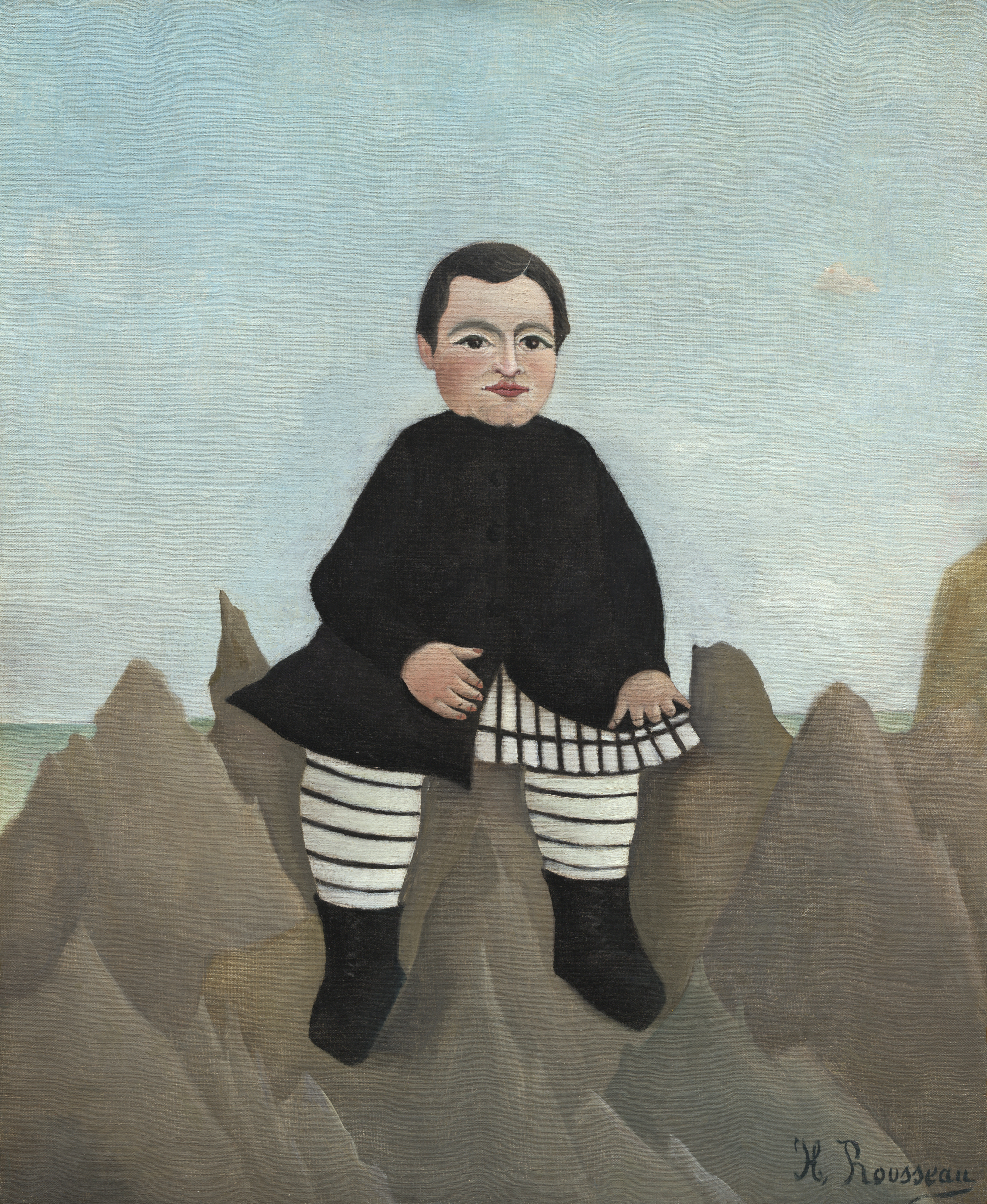
Boy on the Rocks is a painting by Henri Rousseau, oil on linen, made between 1895 and 1897. The original measures 55.4 cm high and 45.7 cm wide, and is held by the National Gallery of Art in Washington. What you see: a boy in a black coat and black-and-white striped stockings sits on the points of grey rocks, with a narrow band of sea at the left edge.
Boy on the Rocks, 1895–1897
What is on the canvas?
The canvas is upright and almost entirely filled by a single figure. The boy sits astride the tops of grey-brown rocks that rise like a row of sharp triangular points. He is not standing on the ground and not sitting on a flat surface; his body rests on the points themselves, and his legs hang down over the rock. The effect is of a boy placed on the rocks rather than one who climbed them. The lower two thirds of the painting belong to the rocks and the upper third to the sky, with no transition between them to lead the eye from one into the other.
What is he wearing, and why does it show?
The boy wears a buttoned black coat with a wide lower hem, and across his lap a striped cloth opens out in horizontal black and white bands. The same stripes continue down the stockings that cover both legs to the ankle, where they end in black boots. That rhythm of stripes is the strongest pattern on the canvas: without it the dark figure would be one unbroken black shape, whereas now the legs read as two bands that carry the eye down towards the rocks. Rousseau left the black of the coat almost without shadow, so the stripes do not describe the form of the body; they lie on it like a pattern on a flat surface.
Why does the face not look like a child’s?
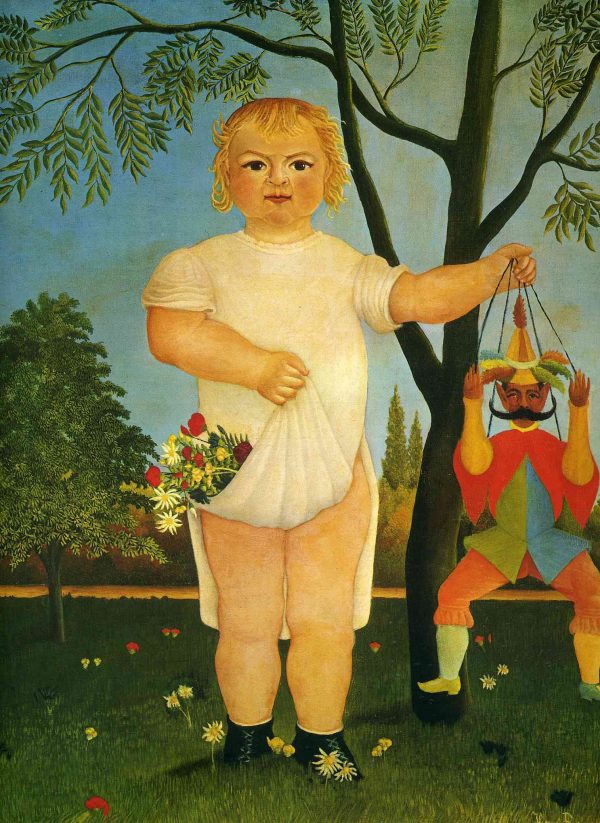
The head is large in relation to the body, the face pale and round, the hair dark and smoothly combed. The eyes are dark and wide open, the mouth small and red. The expression is not a child’s: the figure has the seriousness of an adult portrait, which is familiar in Rousseau’s work, for example in Child with Puppet (To Celebrate the Baby). It is the mismatch between the large head and the small body that gives the painting its strange tension: the proportions belong to a child and the gaze does not.
What is around him?
The rocks are painted as a row of even points, without cracks and without detail, in grey and brownish tones with soft transitions. At the left edge a narrow band of greenish blue sea opens between them, the only sign that we are on a coast. The sky is pale blue-grey and empty; at the upper right a single small pink cloud drifts. Which stretch of coast this is cannot be said, because the museum names none. A comparably composed outdoor portrait is The Past and the Present, and, among his figure scenes, The Football Players.
When was the painting made?
The museum does not date the work to a single year but gives a span between 1895 and 1897. The support is recorded by the museum as linen rather than ordinary canvas; the difference is in the fibre, and we keep it here as the museum wrote it. In the lower right corner there is a signature, which the museum reads as H. Rousseau.
How did the painting reach the museum?
The museum publishes a short chain, and it has a gap the museum does not fill. The first recorded event is the auction at the Hôtel Drouot in Paris on 29 April 1927, where the work was lot 74. There it was bought by the New York collector Chester Dale, who lived from 1883 to 1962. In 1963 it came to the National Gallery of Art with his bequest, and it has carried the accession number 1963.10.63 and the collection name Chester Dale Collection ever since. For the first thirty years, from the painting’s making to that sale, the museum names no owner at all, so we make no claim about where the canvas was.
What does naive art mean for this work?
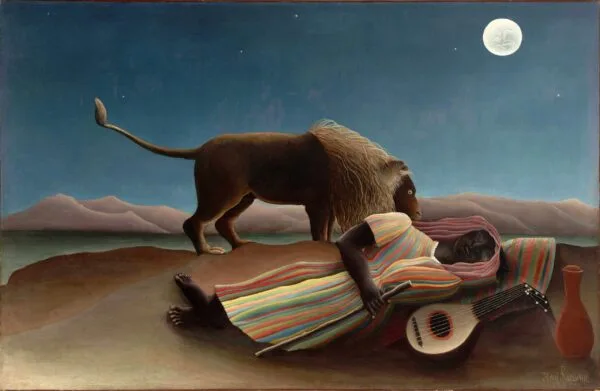
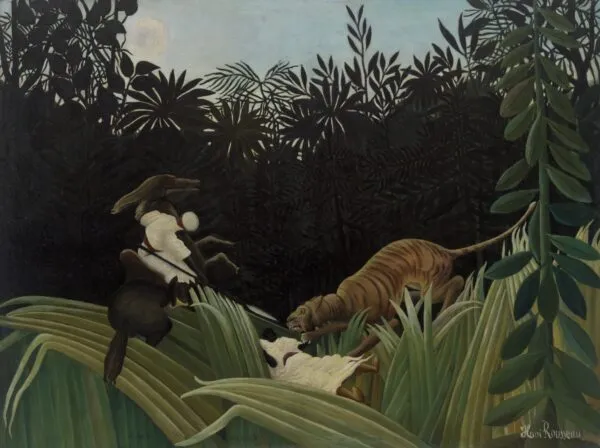
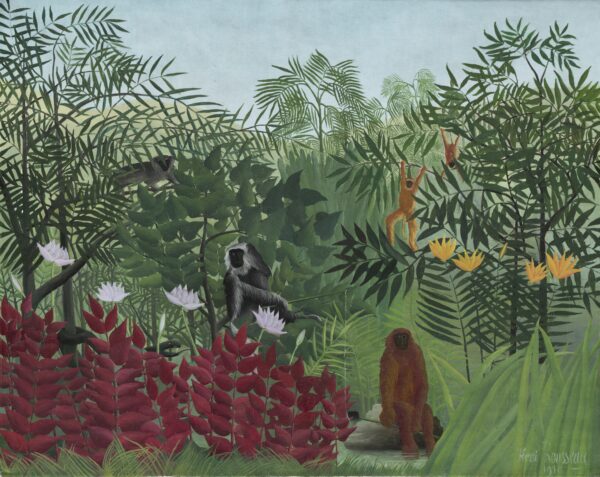
Naive art is the name given to the painting of self-taught artists who did not train in academic studios and did not follow their rules on perspective, shading and anatomy. In this canvas that shows in three places at once: the head is too large for the body, the rocks have no weight and do not recede into depth, and the sea lies at the edge as a strip rather than as a horizontal plane. Rousseau did not hide these departures but left them in plain view, and that is why the scene reads less as a mistake than as the record of someone who saw this way. The same handling on a larger canvas can be seen in The Equatorial Jungle.
How do we make your canvas?
We make this artwork as a hand-painted oil reproduction on canvas, to order, in the size you choose. The original is painted on linen; our reproduction is made in oil on artists’ canvas, which means the same process of laying on colour, though not necessarily the same fibre in the support. The painter begins with the rocks and the sky and builds the figure last, because it is precisely the relation between head and body that has to be right. We do not print; a hand-painted canvas is distinguishable from a print by touch alone, since the body of the paint is visible and can be felt. The full collection of canvases by this painter is in the Henri Rousseau gallery.
Which size suits which wall?
Eight sizes are available: 58 x 70, 70 x 85, 80 x 100, 90 x 110, 100 x 120, 132 x 160, 149 x 180 and 160 x 200 cm. Because this is an upright canvas with a single figure, it needs height and some quiet wall beside it: between a door and a corner, beside a staircase, or in a hallway. For a living room the usual choice is 90 x 110 cm or larger. The original is a small painting, smaller than every size we offer, so even at our smallest the face comes out larger than it is on the original; the adult expression the picture depends on reads at every size. The closest to the original’s proportions is 132 x 160 cm.
How do I order a custom size, stretcher and frame?
Custom sizes are ordered through the made-to-order painting page, where you enter the width and height you want. With this subject the ratio of the sides matters: the figure is placed exactly in the centre and reaches almost from the lower to the upper edge, so widening it at the sides produces rock that is not in the source, while shortening it loses the sky above the head. For non-standard measurements we therefore suggest keeping the ratio and adjusting only the size. The canvas is always stretched on a wooden stretcher. A frame is not included in the price and is chosen separately.
How is it delivered and what do we guarantee?
We deliver to Slovenia, Croatia, Italy, Austria, Hungary and Germany. The canvas travels rolled in a hard tube or stretched on its stretcher, depending on the size, always with protective wrapping. We guarantee that every painting of ours is painted by hand and that you will see a photograph of the finished work before it is dispatched; if anything in that photograph is not as you wanted, we correct the painting before it leaves the workshop. The production time depends on the size and is confirmed when you order.
Frequently asked questions
Where is the original kept today?
At the National Gallery of Art in Washington, under accession number 1963.10.63, in the Chester Dale Collection. The museum record is available on the gallery’s page.
Why does the museum give two years instead of one?
Because it does not date the work to a single year but to a span between 1895 and 1897. We claim no narrower date, because the museum gives none, and the record does not say where in that span the canvas was painted.
How large is the original?
The museum gives 55.4 cm in height and 45.7 cm in width, oil on linen. Framed it measures 84.1 x 74.3 cm (height x width).
Which size is closest to the original?
None of them by size: the original is smaller than our smallest. By the ratio of the sides the closest is 132 x 160 cm.
Is this a print?
No. Every canvas is painted by hand, in oils, to order. The body of the paint is visible and can be felt, which a print cannot imitate.
Which size should I choose?
For a living room 90 x 110 cm or larger, for a narrower wall 70 x 85 cm. An upright format needs height rather than width.
Can I have a size that is not on the list?
Yes, we make custom sizes with no surcharge for a non-standard measurement. We recommend keeping the ratio of the sides.
What is known about the work before 1927?
Nothing, according to the museum record. The first recorded event is the auction of April 1927; for the years before it the museum names no owner, and we do not try to fill that in.
Is the original signed?
Yes. The museum records a signature in the lower right corner reading H. Rousseau.
Can the original be seen?
The gallery is open to the public, but it is not guaranteed that this particular canvas is on display. Check with the museum before visiting whether it is hanging.
Is the painting suitable as a gift?
Yes. The scene is quiet and unusual, which makes it a rewarding choice for someone who likes portraits unlike any others. If you would rather leave the choice to them, there is a gift voucher.
- Subject: a boy on rocky points, in a black coat and striped stockings, with the sea at the left edge and a single cloud in the sky.
- Original: 1895–1897, oil on linen, 55.4 x 45.7 cm (height x width), National Gallery of Art, Washington, acc. 1963.10.63
- Our version: hand-painted oil, eight sizes from 58 x 70 to 160 x 200 cm, or a size made to order
- Of note: it is the mismatch between the large head and the small body that gives the painting its unease: the proportions belong to a child and the gaze does not.