


Description
| Title: | Virgin Forest at Sunset |
| Other titles: | Forêt vierge au soleil couchant · Urwaldlandschaft mit untergehender Sonne · Jungle with Setting Sun |
| Painter: | Henri Rousseau (1844–1910) |
| Year of creation: | about 1910 |
| Original size: | 113.6 cm x 162.3 cm (height x width) |
| Original technique: | oil on canvas |
| Painting style: | naive art (primitivism), Paris after Impressionism |
| Located at: | Kunstmuseum Basel, Switzerland (inv. 2225) |
| Our reproduction: | hand-painted oil on canvas, eight sizes or a size made to order |
Virgin Forest at Sunset – Henri Rousseau
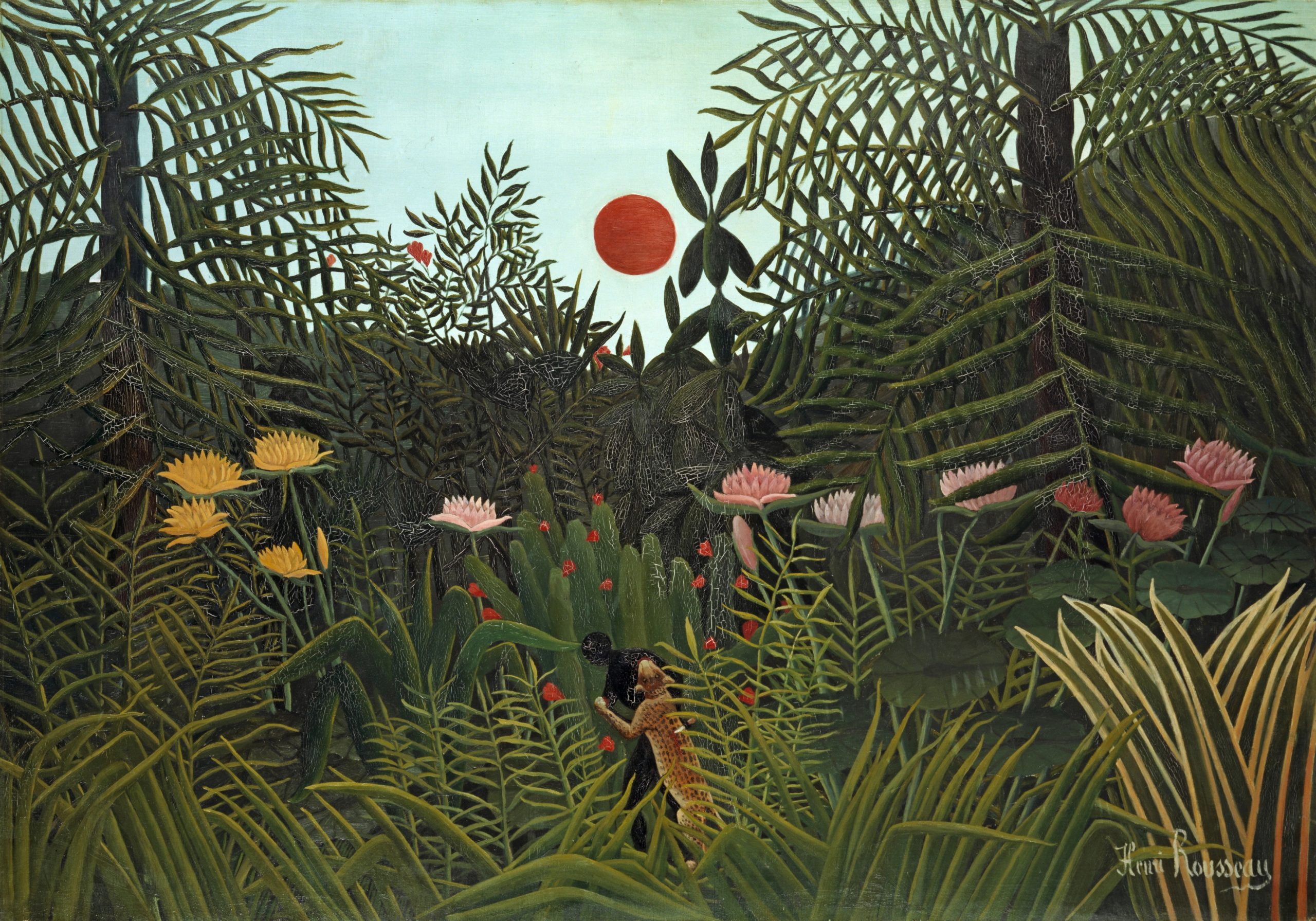
Virgin Forest at Sunset is one of the last jungle scenes by Henri Rousseau, painted about 1910, and one of his most violent. A man has fallen to the ground, a jaguar has taken hold of him, and around the two of them stands a dense wall of vegetation with the setting sun behind it. The original is held by the Kunstmuseum Basel in Switzerland under inventory number 2225. Here it is made as a hand-painted reproduction in oil, on canvas, in eight sizes from 70 x 60 cm to 200 x 140 cm or to your own measurement. Before dispatch we send you a photograph of the finished canvas for approval.
What is on the canvas?
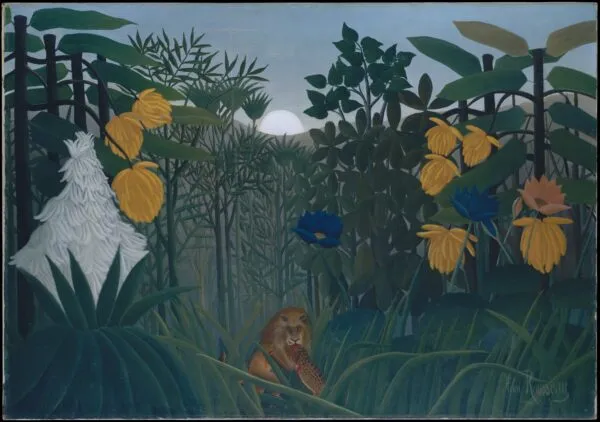
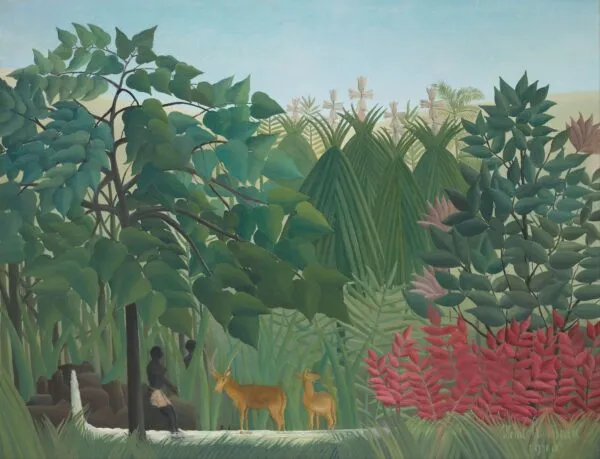
The man lies on his back along the lower edge of the scene, the jaguar is over him, and both are almost entirely enclosed by vegetation. The grasses and leaves follow one rule: each painted separately, hard-outlined, with no shadow tying them together. So the two bodies do not happen in a space; they are set into a pattern. Behind, through a narrow opening in the growth, a low sun is visible, and that band of orange is the only place where the scene opens into any distance. It is this construction that makes the scene feel closed in: there is no way out, no horizon at the sides, and the viewer is placed near enough to be standing in the grass. The same method on a larger canvas is The Hungry Lion Throws Itself on the Antelope.
Why is the painting called Virgin Forest at Sunset?
Because it renders in English the title the owning museum gives first. In the Kunstmuseum Basel’s collection the work is listed under its French title, Forêt vierge au soleil couchant, and our title is that name in English. The museum also gives a German and an English title, Urwaldlandschaft mit untergehender Sonne and Jungle with Setting Sun; all of them describe the same canvas. The title does not name the event in the scene but what surrounds it: a wall of virgin forest and, through a gap in it, the low sun.
When was it painted, and how big is the original?
The museum dates the canvas to about 1910; its description places it in the group of Rousseau’s last jungle pictures, made in the year of his death. The original is 113.6 cm high and 162.3 cm wide, painted in oil on canvas, and signed lower right in white paint: Henri Rousseau. The museum also says where these jungles came from: not from travel in the tropics, but from visits to the 1889 World’s Fair in Paris and the Jardin des Plantes, and from reading popular magazines.
Why is this scene different from his other jungles?
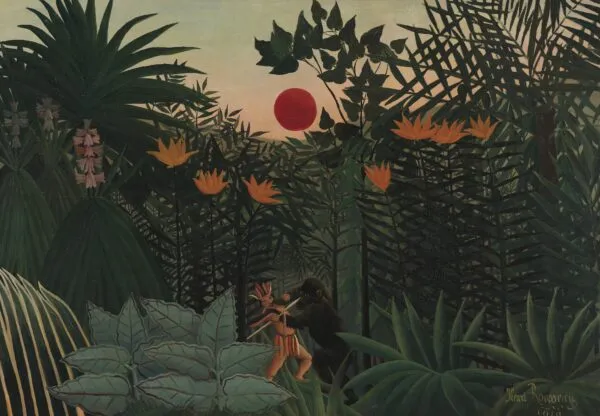
In most of his jungles what is attacked is an animal. Here it is a person, and that puts the viewer in a different position: the scene is no longer a natural-history tableau but something that could happen to them. The vegetation comes from the same vocabulary as everywhere else in his work – layers of leaves, hard outlines, no aerial perspective – but here it is pressed to the edges of the canvas so that barely any room is left for the event. That is why the scene reads as a detail rather than as a view. A more open and quieter look at the same world is The Equatorial Jungle.
What does the painting mean?
The scene can be read two ways, and the painting does not choose between them. The first is simple: nature is dangerous and a person in it is not the master. The second is less comfortable: he never saw the jungle he painted, but assembled it from a glasshouse, from books and from invention, so the scene is not a report from a distant country but a picture of how Paris then imagined such places. A viewer today sees both at once, and that is why the painting is still uneasy to look at. Something of the same tension is in Woman Walking in an Exotic Forest.
Where is the original, and how did it get there?
In the Kunstmuseum Basel, Switzerland, under inventory number 2225; the collection records it as a purchase. The museum’s record traces the painting back to at least 1914, in the collection of Paul von Mendelssohn-Bartholdy and his first wife Charlotte. After his death in 1935 it belonged to his second wife Elsa, later Countess von Kesselstatt, until 1948. That year the museum bought it through Christoph Bernoulli of Basel, in a sale arranged by Walter Feilchenfeldt of Zurich.
What does naive art mean in this work?
Naive art is the name for painting by self-taught artists who trained in no academic studio and kept to none of its rules on perspective, shading and anatomy. In this canvas it shows in vegetation without depth, in flat colour, and in bodies painted as signs rather than as studies. Rousseau was a customs clerk who began to paint seriously only in his forties. The label naive art therefore does not mean ignorance, but a style you recognise at first glance. There is more on the painter’s path in our article about the painter.
How is your canvas made here?
Your canvas is begun only after your order, in our workshop in Slovenia. The oil is built up in layers, from the sky and the sun towards the vegetation and last of all towards the two bodies, so that the hard outlines are made at the end. Because the growth is painted leaf by leaf, at the larger sizes this is several weeks of work. We do not print and we use no mechanical application; a hand-painted canvas differs from a print by touch alone, because the body of the paint is visible and can be felt. The canvas is stretched on a wooden frame, ready to hang. The full range by this painter is in the Henri Rousseau gallery.
Which size for which wall?
Eight sizes: 70 x 60, 90 x 65, 100 x 70, 120 x 90, 140 x 100, 163 x 116, 180 x 130 and 200 x 140 cm. Being a landscape canvas with a dense pattern, it needs a wide wall and some distance: above a sofa, above a sideboard, or in a corridor where you can step back. For a living room the usual choice is 140 x 100 cm or larger. Below 100 x 70 cm the leaves begin to merge and the scene loses the very thing that makes it work. The 163 x 116 cm size is the closest to the original: it is 0.7 cm wider and 2.4 cm higher than the canvas in Basel.
How do I order a custom size, a stretcher and a frame?
Custom sizes go through the painting made by order page, where you enter width and height. Proportions matter here: the scene is wide, and bringing it closer to a square loses the vegetation at the sides and with it the sense of enclosure that this work depends on. For non-standard measurements we suggest keeping the ratio and changing only the scale. The canvas is always stretched on a wooden frame. A frame is not included in the price and is chosen separately.
How is it delivered and what do we guarantee?
We deliver to Slovenia, Croatia, Italy, Austria, Hungary and Germany. The canvas travels rolled in a hard tube or stretched on its frame, depending on the size, always in protective wrapping. We guarantee that every work is painted by hand and that you will see a photograph of the finished piece before dispatch; if something there is not as you wish, we correct it before the work leaves the workshop. Production time depends on the size and is confirmed when you order.
Frequently asked questions
Which museum holds the original today?
The Kunstmuseum Basel in Switzerland, under inventory number 2225. It has been in the museum’s collection since 1948.
Is the year it was painted exact?
The museum gives about 1910, not an exact date; its description places the work in the year of Rousseau’s death.
Is the original signed?
Yes, lower right, in white paint: Henri Rousseau. That is how the museum’s record gives it.
What other titles is the work catalogued under?
The museum lists it under the French title Forêt vierge au soleil couchant, and in German and English as Urwaldlandschaft mit untergehender Sonne and Jungle with Setting Sun. It is the same canvas.
Is this a print?
No. Every canvas is painted by hand in oils, to order. The body of the paint is visible and can be felt, which a print cannot imitate.
Which size should I choose?
For a living room 140 x 100 cm or larger, for a narrower wall 100 x 70 cm. The landscape format asks for width, not height.
Can I have a size that is not on the list?
Yes, a made-to-order size carries no surcharge for a non-standard format. We recommend keeping the proportions.
Which size is closest to the original?
The 163 x 116 cm size. The original measures 113.6 x 162.3 cm (height x width), so this size is 2.4 cm higher and 0.7 cm wider.
How is the painting delivered?
Rolled in a tube or stretched on its frame, with tracked shipping. Production time is confirmed when you order.
Is the original for sale?
No. The work is in a public museum collection and is not for sale; we give no value, having no source for one.
Is it suitable as a gift?
The scene is harsh and not for every wall, so we suggest choosing it as a gift with care. If you would rather leave the choice to the recipient, there is a gift voucher.
- Subject: a man attacked by a jaguar in dense jungle, with a setting sun behind
- Original: Kunstmuseum Basel, Switzerland, inv. 2225; about 1910, oil on canvas, 113.6 x 162.3 cm
- Our version: hand-painted oil, eight sizes from 70 x 60 to 200 x 140 cm or made to measure
- What we say plainly: the title is the museum’s own, and the year and size come from its record