


Description
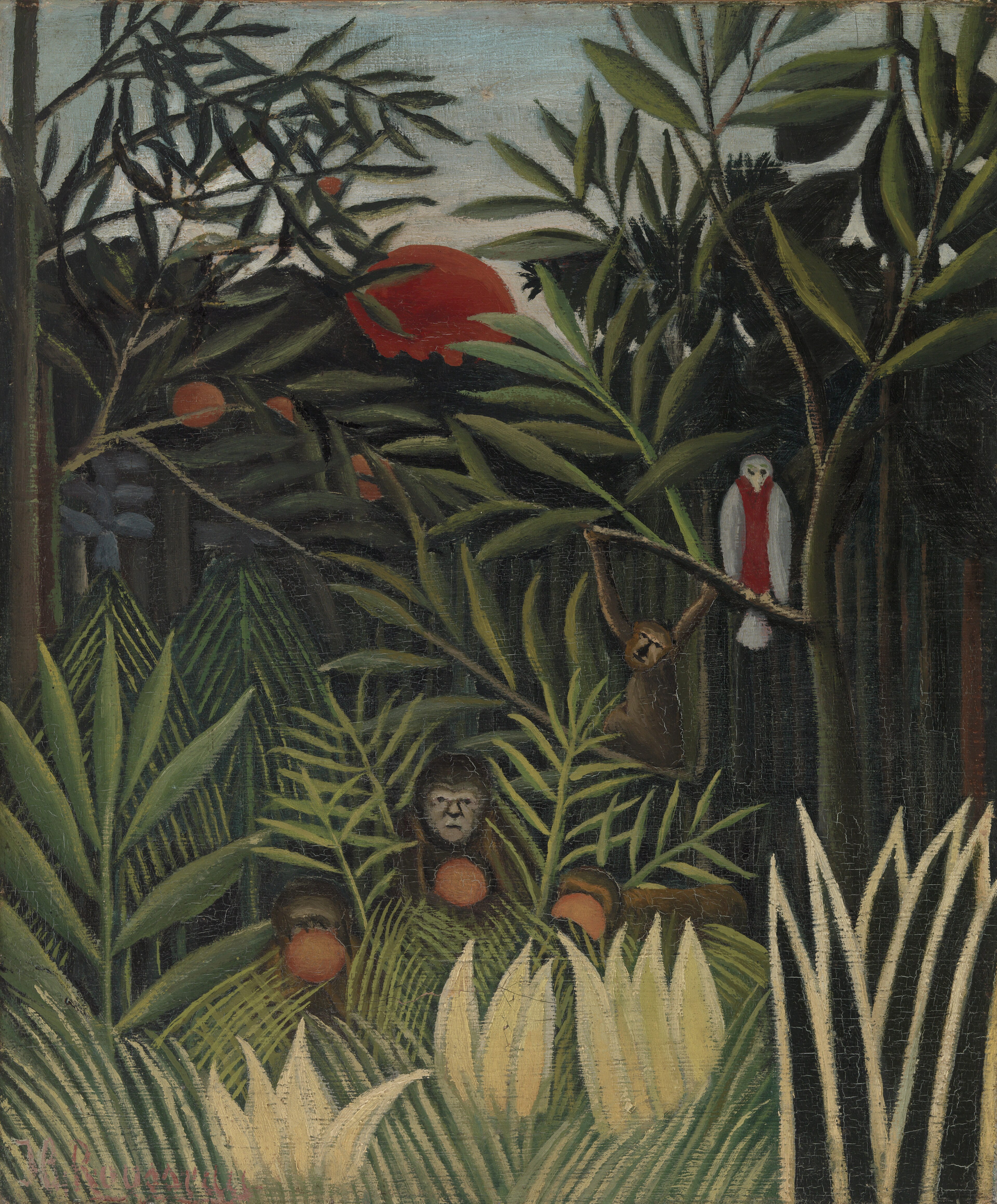
| Title: | Monkeys and Parrot in the Virgin Forest |
| Other titles: | Singes et perroquet dans la forêt vierge (French title in the museum’s record) |
| Painter: | Henri Rousseau |
| Year painted: | about 1906–1909 |
| Original size: | 56.2 cm x 47.3 cm (height x width) |
| Original technique: | oil on canvas |
| Painting style: | naive art (primitivism) |
| Held at: | Barnes Foundation, Philadelphia, USA (inv. BF397) |
| Our reproduction: | hand-painted oil on canvas, ten sizes or a size made to order |
Monkeys and Parrot in the Virgin Forest is a painting by Henri Rousseau, oil on canvas, dated by the Barnes Foundation to about 1906–1909. The original is 56.2 cm high and 47.3 cm wide and is held by the Barnes Foundation in Philadelphia under inventory number BF397. What you see: a white parrot with a red breast on a branch, a monkey hanging from a branch, three more monkeys with orange fruit peering out of the undergrowth, and a red sun behind dark trees.
Monkeys and Parrot in the Virgin Forest
What is on the canvas?
The canvas is upright and small, and the forest fills it to the edges. A thin strip of pale sky shows at the top; below it is a red disc, half hidden by dark treetops, which the museum reads as the sun. Orange fruits hang from the branches at the upper left. On the right a white parrot with a red breast sits on a branch, and just to its left a brown monkey hangs from the same branch by both arms. Lower down three more monkeys peer out of the foliage, each with an orange fruit: the one on the left raises it to its mouth, the pale-faced one in the middle looks straight at the viewer, and a third lies half hidden on the right. Cream-coloured pointed leaves close off the bottom edge, and the signature, H. Rousseau, is at the lower left.
Did Rousseau ever see a jungle?
No. The Barnes Foundation’s own text says so directly: Rousseau worked as a Paris tax collector, taught himself to paint in his spare hours and never travelled to an actual jungle. What he did visit, regularly, was the Jardin des Plantes, the Paris museum of natural history, which had an aviary of exotic birds and a monkey house, the very two kinds of animal on this canvas. The same museum also holds his Mauvaise surprise, a forest scene of a very different kind.
Why is the foreground so bright?
The museum’s description gives the answer: the foreground is lit as if by the lantern of a visitor who has just come upon the scene, the animals peer out from a shadowy web of oversized tropical plants, and in the last hours of the tropical night a deep red sun looms in the sky. That is the museum’s reading and we pass it on as such; the painting itself shows only light leaves in front and dark ones behind. The same collection also holds the larger canvas Woman Walking in an Exotic Forest.
How large is the original, and what does that mean on a wall?
The original is 56.2 cm high and 47.3 cm wide, so every size we offer is larger than the painting itself. Ten sizes are available: 57 x 69, 65 x 80, 75 x 90, 89 x 107, 100 x 120, 110 x 130, 130 x 150, 172 x 200, 180 x 220 and 205 x 255 cm. The smallest, 57 x 69 cm, is about 10 cm wider and 13 cm taller than the original; 110 x 130 cm comes closest to its proportion. At the original’s scale the monkeys’ faces are only a few centimetres across, so a larger size makes them readable from across a room. An upright format like this fits beside a door or in a narrow alcove. Custom sizes are ordered through the made-to-order painting page. The virgin forest again, this time with a low sun, a man and a jaguar, is in Virgin Forest at Sunset.
How is a hand-painted reproduction made?
Your canvas painting is made by hand in oils after you order it, in the size you select. Working layer by layer from a high-resolution image of the original, the painter sets down the red sun, the parrot’s white feathers and the orange fruits so that they keep their weight at every size. Two hand-painted canvases are never exactly alike, and that is the difference between a brushstroke and a print. The canvas is stretched on a wooden frame and ready for the wall. Another jungle from the Henri Rousseau gallery is Tiger in a Tropical Storm.
Frequently asked questions
Where is the original kept?
At the Barnes Foundation in Philadelphia, inventory number BF397. Whether it is on display on a particular day is best checked with the museum.
When was it painted?
The museum dates it to about 1906–1909, a span rather than a single year, and we give it the same way.
What are the original’s measurements in centimetres?
56.2 cm high and 47.3 cm wide, oil on canvas.
Is this a print?
No. The paint is applied by hand, in oils, and you can see and feel the brushwork.
Is the painting suitable as a gift?
Yes: a small, bright upright canvas with animals and fruit and no hunt. If you would rather the recipient chose, give a gift voucher.
- Subject: a white parrot with a red breast, four monkeys, three of them with orange fruit, and a red sun behind dark trees.
- Original: oil on canvas, 56.2 x 47.3 cm (height x width), Barnes Foundation, Philadelphia, inv. BF397; about 1906–1909.
- Our version: hand-painted oil, ten sizes from 57 x 69 to 205 x 255 cm, or a size made to order.
- Of note: the museum reads the bright foreground as the lantern light of a visitor who has just come upon the scene.