


Description
| Title: | Eve in the Garden of Eden |
| Other titles: | エデンの園のエヴァ (the museum’s Japanese title) |
| Painter: | Henri Rousseau |
| Year painted: | about 1906–1910 |
| Original size: | 46.5 cm x 61.4 cm (height x width) |
| Original technique: | oil on canvas |
| Painting style: | naive art (primitivism) |
| Held at: | Pola Museum of Art, Hakone, Japan (collection no. 002-0004) |
| Our reproduction: | hand-painted oil on canvas, ten sizes or a size made to order |
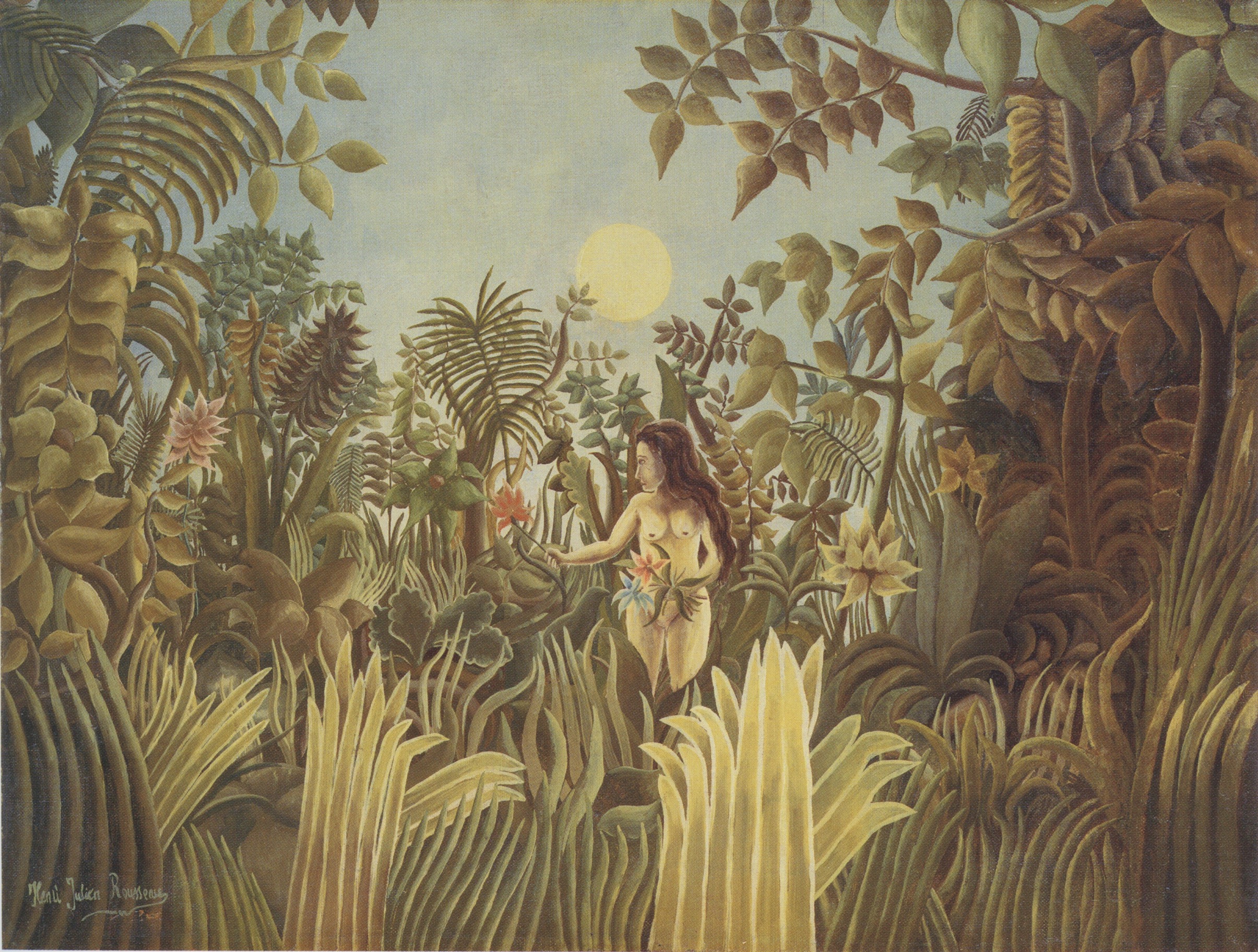
Eve in the Garden of Eden is a painting by Henri Rousseau, oil on canvas, dated by the Pola Museum of Art to about 1906–1910. The original is 46.5 cm high and 61.4 cm wide and belongs to the Pola Museum of Art in Hakone, Japan, which lists it in its online collection under 002-0004. What you see: a nude woman with long hair among tall grasses in dense, warm-toned vegetation, picking a red flower with one hand and holding a small bunch of flowers in the other, under a large pale moon.
Eve in the Garden of Eden
What is on the canvas?
The canvas is wide and warm: olive, ochre and brown leaves fill it almost to the top, and pale blue sky shows only in the middle. High in the centre hangs a large pale yellow disc. Eve stands just below the centre among tall pale grasses, turned to the left, her long reddish-brown hair falling down her back to the waist. With her right hand she reaches for a red flower on a stem, and in her left she holds a small bunch of pink, blue and pale flowers in front of her body. Fern fronds, broad leaves and a few pale star-shaped blossoms crowd around her, and on the right a dark trunk rises out of the thicket. The signature at the lower left reads Henri Julien Rousseau.
Is this the Eve of the Bible?
Only partly. The text on the museum’s Japanese page, taken from its 2010 exhibition catalogue, reads her less as the inhabitant of the biblical paradise than as a personification of the virgin forest, the forêt vierge: a wild woman who lures the curious gaze of the civilised viewer into a labyrinth of fantasy. The same text counts about six surviving paintings by Rousseau with a nude figure in the jungle, each woman in a world of her own, and notes that two of them are named Eve. Another Eve among the works we offer is Eve and the Serpent; the catalogue text also cites The Snake Charmer.
Did Rousseau ever see a jungle?
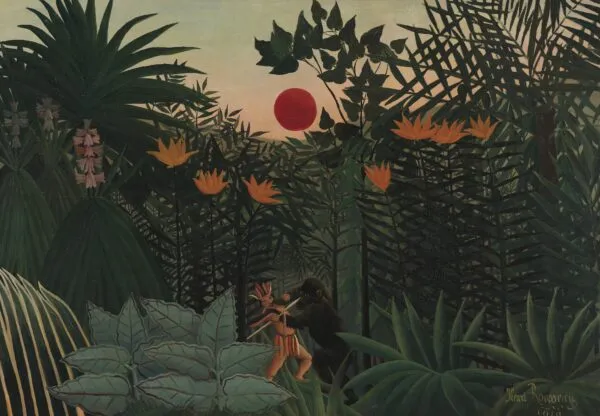
No. The National Gallery in London, whose Surprised! began his series of jungles, puts it plainly: the jungles are imaginary and Rousseau never left France; the plants are house plants and tropical species from the Jardin des Plantes in Paris. The Pola Museum’s text counts well over ten kinds of strange plant tangled together in this one thicket, which is that very method at work: studied plants, assembled into a forest that exists nowhere. We offer the London painting as Tiger in a Tropical Storm.
How large is the original, and what does that mean on a wall?
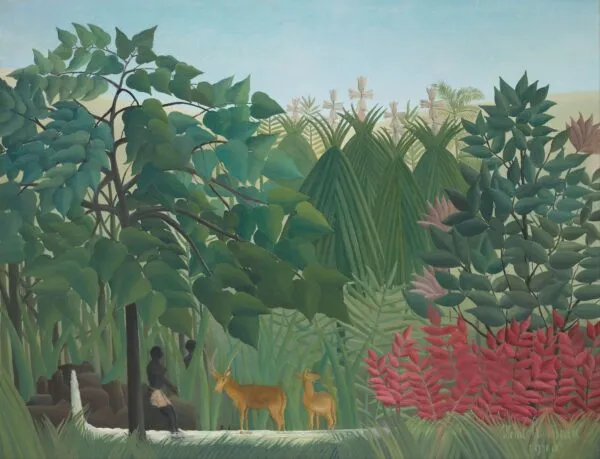
The original is 46.5 cm high and 61.4 cm wide, smaller than every size we offer. Ten sizes are available: 70 x 55, 80 x 61, 90 x 70, 110 x 80, 120 x 90, 140 x 110, 170 x 130, 200 x 150, 240 x 180 and 300 x 221 cm. The smallest, 70 x 55 cm, is about 9 cm wider and 8.5 cm taller than the original; 80 x 61 cm keeps its proportion most closely. Eve is small within the thicket, about a third of the canvas height, so larger sizes make the flowers in her hands and her face easier to read. The warm, muted palette suits a bedroom or a reading corner. Custom sizes are ordered through the made-to-order painting page. Another woman alone among exotic plants appears in Woman Walking in an Exotic Forest.
How is a hand-painted reproduction made?
Your canvas painting is made by hand in oils after you order, in the size you choose. Following a high-resolution image of the original layer by layer, the painter separates the many kinds of leaf by shape and tone so that the thicket does not dissolve into one brown mass, and keeps the moon and Eve’s skin as the lightest areas. Handwork means that no two canvases come out quite the same, which is the difference between a painting and a print. The canvas is stretched on a wooden frame and prepared for hanging. The whole collection is in the Henri Rousseau gallery.
Frequently asked questions
Where is the original kept?
At the Pola Museum of Art in Hakone, Japan, which lists it in its online collection under 002-0004. Whether it is on display is best checked with the museum.
Is the disc in the sky the sun or the moon?
The museum’s text calls it a huge full moon that floods the whole painting with clear light, and we follow that reading.
When was it painted?
The museum dates it to about 1906–1910, a span rather than one year, so we no longer give a single year.
Is this a print?
No. It is painted by hand in oils, and the layers of paint can be seen and felt.
Is the painting suitable as a gift?
It can be, for someone who loves Rousseau’s jungles; bear in mind that Eve is nude. If you are unsure, a gift voucher leaves the choice to the recipient.
- Subject: a nude Eve picking a flower in a dense, warm-toned thicket under a large pale moon.
- Original: oil on canvas, 46.5 x 61.4 cm (height x width), Pola Museum of Art, Hakone, 002-0004; about 1906–1910.
- Our version: hand-painted oil, ten sizes from 70 x 55 to 300 x 221 cm, or a size made to order.
- Of note: the museum reads this Eve less as the Eve of paradise than as the virgin forest in human form.