









Description
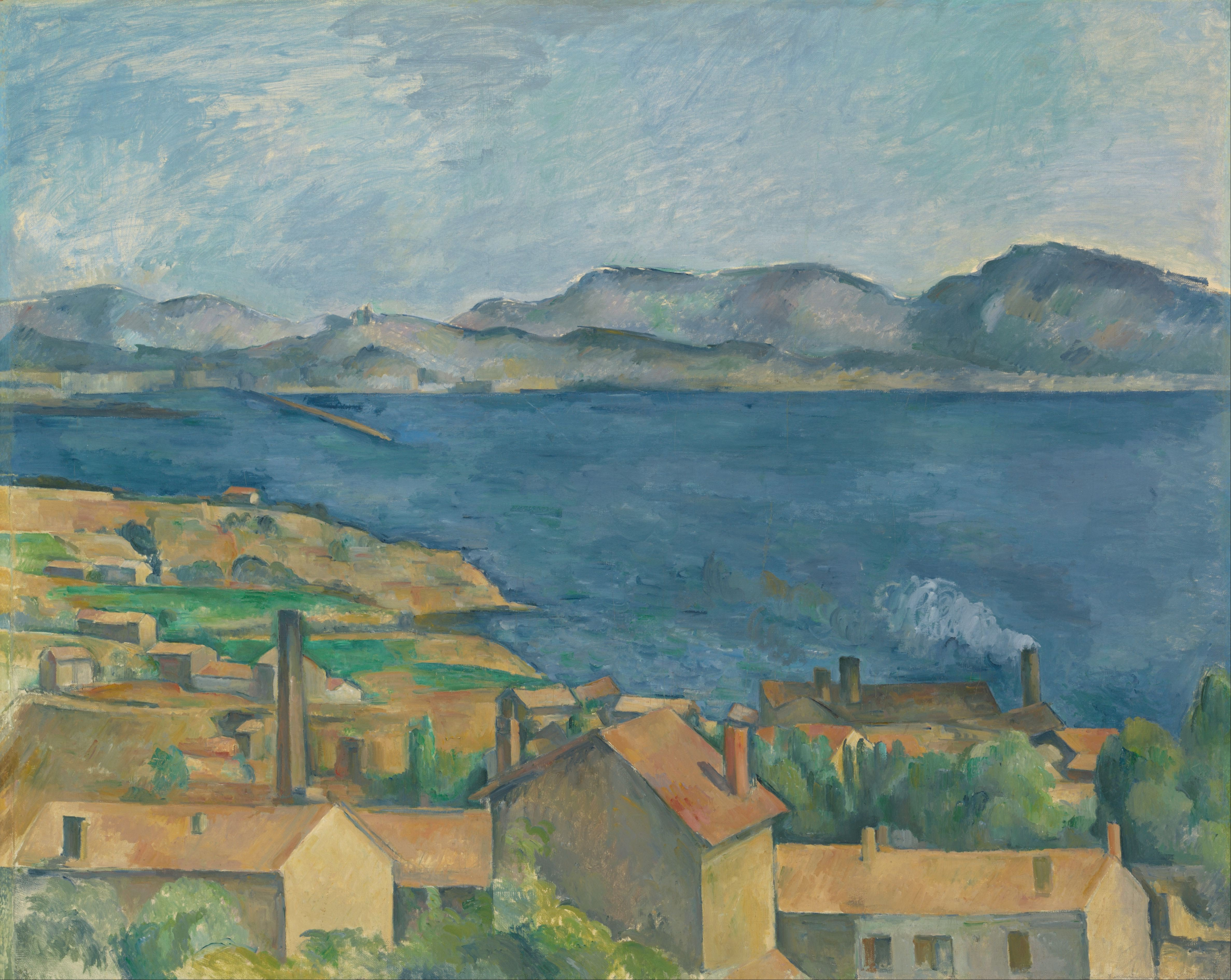
The Bay of Marseille, Seen from L’Estaque – the village, the sea and a factory chimney
In the lower third of the canvas the ochre and red roofs of the village press together, and among them rises a tall narrow factory chimney. Above the roofs the deep blue plane of the bay opens out, so still that it reads as a wall rather than as water. Behind it low mountains run in grey-blue and violet, and above them a pale sky. This hand-painted painting on canvas reproduces Cézanne’s work of about 1885, which measures 80.2 × 100.6 centimetres in the original and is held by the Art Institute of Chicago under the inventory number 1933.1116.
L’Estaque
The catalogue raisonné names two locales for this canvas: L’Estaque and Marseille. L’Estaque was then a fishing and industrial settlement on the north-western edge of the bay of Marseille, and today it is part of the city itself. The painter returned there for years and painted the bay from above, from the slope over the roofs. It is that fixed standpoint which gives all those canvases the same three-part build: roofs below, water in the middle, mountains above – three horizontal bands laid one over another with no transition between them.
A blue that stands upright
The most unusual thing on this canvas is the sea. It is painted as one unified, almost unbroken blue surface, without waves, without reflections and without tracks of light to open it into depth. So it does not recede but stands upright inside the work, a wall of colour between the roofs and the mountains. The roofs below, by contrast, are broken into dozens of small ochre and red faces, and the mountains above are one stroke after another. The work is therefore made of three completely different ways of laying on paint, meeting without an edge.
The first loan exhibition of MoMA in New York
In November 1929 this canvas was in New York, in the exhibition titled The museum’s first loan exhibition: Cézanne, Gauguin, Seurat, van Gogh – the first loan exhibition of the Museum of Modern Art, which opened on 8 November and closed on 7 December. The work ran as number 18, under the title Landscape at Estaque, lent by the Art Institute of Chicago. Eighteen years earlier, in October and November 1911, it had been in Amsterdam in the international exhibition of the Moderne Kunstkring at the Stedelijk Museum, then as part of the Hoogendijk collection.
Vollard, Amsterdam, Chicago
The first known owner was the dealer Ambroise Vollard in Paris. After him the canvas went to the Dutch collector Cornelis Hoogendijk in Amsterdam, in 1920 to Paul Rosenberg in Paris, and then to Mr and Mrs Martin A. Ryerson in Chicago. In 1933 it passed to the Art Institute of Chicago, which records it under the name of their collection; the first two digits of the inventory number 1933.1116 are the year of that passage.
The year 1933 in Chicago
In the same year it entered the museum the canvas was also exhibited: from 1 June to 1 November 1933 in A Century of Progress at the Art Institute of Chicago as number 309, and again in 1934 in the continuation of the same event. The show accompanied the world’s fair held in the city that year. The work therefore came before the public at once, not after years in storage.
The chimney the catalogue counts among the motifs
Among the keywords for this canvas the catalogue lists, besides the bay, the sea, the mountains and the houses, a smoke-stack. It is not a detail you have to search for: the chimney stands almost at the centre of the lower half and is the tallest vertical among the roofs. In a landscape we otherwise read as a Mediterranean view there is therefore an industrial plant – and the catalogue records it as a motif of equal standing, not as an intrusion.
This is a wide, calm canvas with a strong blue that works in a room like a window. The choice runs to fifteen sizes, from 50 × 40 to 180 × 143 centimetres; intermediates we stretch to measure, and how it will look in the chosen frame is shown by our 3D application. Among the Provençal landscapes are also Mont Sainte-Victoire Seen from Bibémus, Mont Sainte-Victoire and Château Noir and Poplars.
- Subject: The Bay of Marseille, Seen from L’Estaque, Paul Cézanne, about 1885, Art Institute of Chicago
- Technique: hand-painted painting, oil on canvas, reproduction
- Sizes: 15 dimensions, custom size on request
- Of note: in November 1929 the canvas hung in the first loan exhibition of the Museum of Modern Art in New York as number 18