





Description
The Bibémus Quarry – the canvas that left the museum and came back
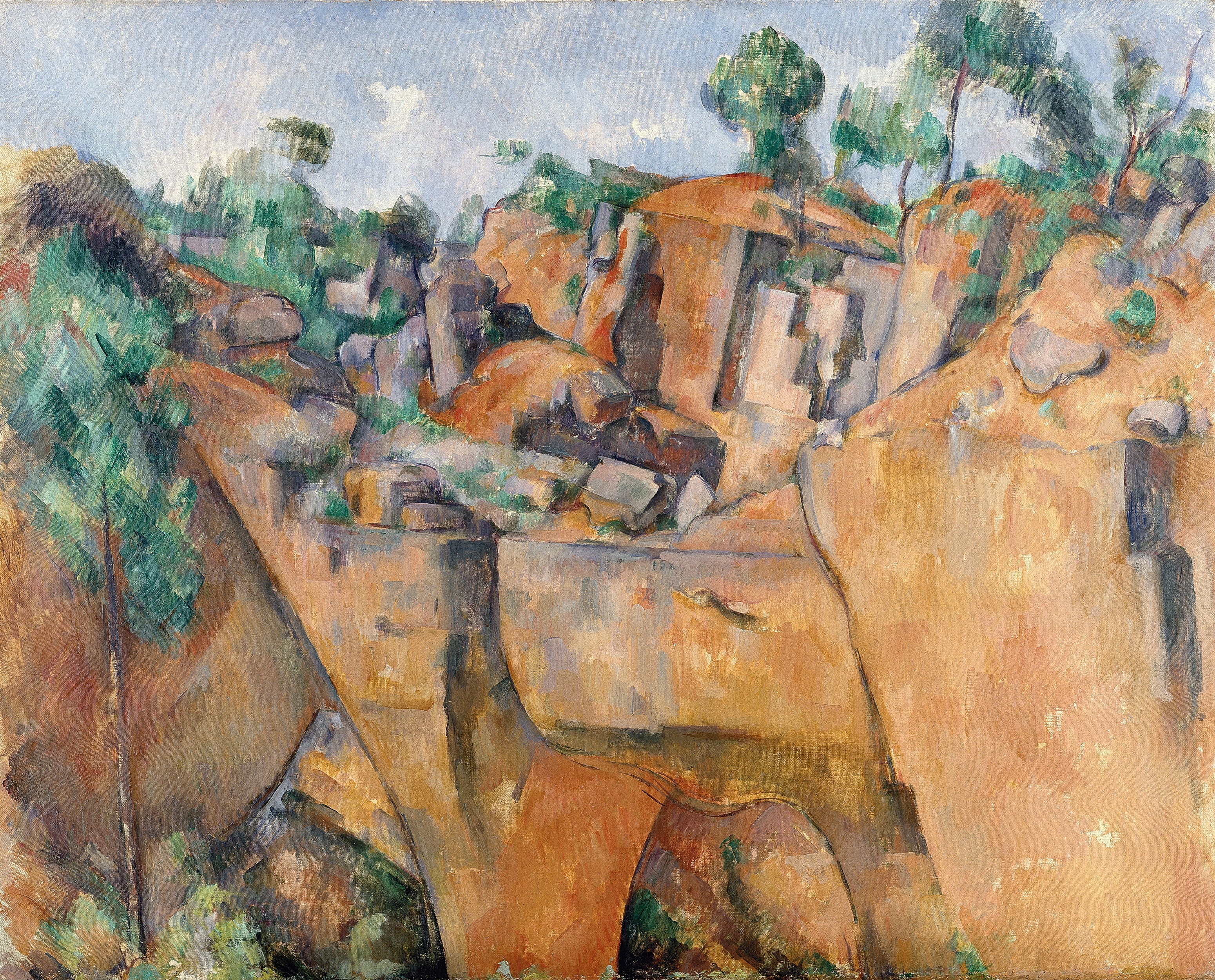
The canvas is filled almost entirely with stone. The steep red-orange walls of the quarry are cut into flat faces that rise one above another like masonry; among them and above them stand dark green pines and low scrub. At the top only a narrow band of blue sky remains. There is no horizon – the eye does not get out of the pit. This hand-painted painting on canvas reproduces Cézanne’s work of about 1895, which measures 65 × 81 centimetres in the original and is held by the Museum Folkwang in Essen under the number G 342.
Gone, and back in 1964
The provenance of this canvas ends unusually: with the same museum it had once already begun with. The work belonged to Karl Ernst Osthaus in Hagen and then to the Museum Folkwang in Hagen. Later we find it with Siegfried Kramarsky in New York, in 1964 with Walter Feilchenfeldt in Zurich, and in the same year the Museum Folkwang takes it again – this time in Essen. The museum therefore had the canvas, lost it, and bought it back decades later, in a different city from the first time. Why it left is not stated in the record consulted, and we will not supply it; what is stated is the route and the year of the return.
From Vollard to a baron and back
Before Hagen the canvas belonged to the dealer Ambroise Vollard in Paris, then to Baron Denys Cochin, also in Paris, and on 20 October 1904 to Vollard again. The dealer appears twice in this chain, which means he sold the work once and bought it back later – exactly as the museum would do afterwards. Only from Vollard did the canvas go to Germany, to Osthaus, who was among the first German collectors of modern French painting.
Six canvases with the same place in the title
The Bibémus quarry does not appear once in the catalogue raisonné but several times. Under the title La Carrière de Bibémus four different canvases are recorded: this one, 65 × 81 centimetres, in Essen; one of 92 × 73 centimetres at the Barnes Foundation in Philadelphia; one of 65 × 54 centimetres in a private collection; and one of 65 × 54 centimetres at the Nelson-Atkins Museum of Art in Kansas City. Beside these the catalogue lists Dans la carrière de Bibémus and a work titled simply Bibémus at the Barnes Foundation. It is precisely because of this abundance that with this motif the only reliable mark of recognition is the museum’s inventory number, and not the ratio of the sides.
Stone painted as masonry
The paint is laid on in broad flat faces that do not blend into one another: each wall of the quarry is built from a few strokes set side by side, and it is for this reason that the rock reads as masonry rather than as natural fracture. Red and orange stand here almost equal with the green; between them there is no transitional colour but a direct meeting, and that gives the work its hardness. The pines are painted not as crowns but as dark masses closing the gaps between the walls. Because there is neither sky nor horizon apart from the narrow band at the top, the whole depth of the work plays out within a few metres of the viewer.
Hagen, Paris, New York
In July 1912 the canvas was exhibited at the Museum Folkwang in Hagen as number 114. In March and April 1939 it was in Paris at the Grand Palais in the fiftieth exhibition of the Société des artistes indépendants, held for the centenary of the painter’s birth – and there it appeared hors catalogue, outside the catalogue. In 1948 Wildenstein showed it in New York under the title Six Masters of Post-Impressionism as number 10, lent by Kramarsky; in 1952 it was at the Art Institute of Chicago as number 107 and then at the Metropolitan, and in 1958 at the Metropolitan again.
What Vollard entered beside number 3987
In Vollard’s stockbook this canvas carries the number 3987, and beside it a description of exactly seven words: huile; rocher rouge avec quelques arbres verts – oil; red rock with a few green trees. Next to it stand the measurement 64 × 79 centimetres and the price of 200 francs. The description is spare but exact: there really is nothing else on the canvas. The catalogue itself gives this work a single heading among the natural motifs, rocks.
This is a canvas of strong warm colour and closed construction, and so it works on a wall that lacks weight – opposite a window, say, or in a room with pale furniture. Fifteen measurements are available, from 50 × 40 to 180 × 145 centimetres, in-between sizes made to measure, and the effect of the chosen frame is shown in advance by our 3D application. From the same country come Mont Sainte-Victoire Seen from Bibémus, Mont Sainte-Victoire and Château Noir and The Bay of Marseille, Seen from L’Estaque.
- Subject: The Bibémus Quarry, Paul Cézanne, about 1895, Museum Folkwang, Essen
- Technique: hand-painted painting, oil on canvas, reproduction
- Sizes: 15 dimensions, custom size on request
- Of note: the Museum Folkwang owned the canvas already in Hagen, then no longer had it, and bought it back in 1964 – in Essen