







































Description
The House of the Hanged Man at Auvers-sur-Oise – a canvas from the first Impressionist exhibition
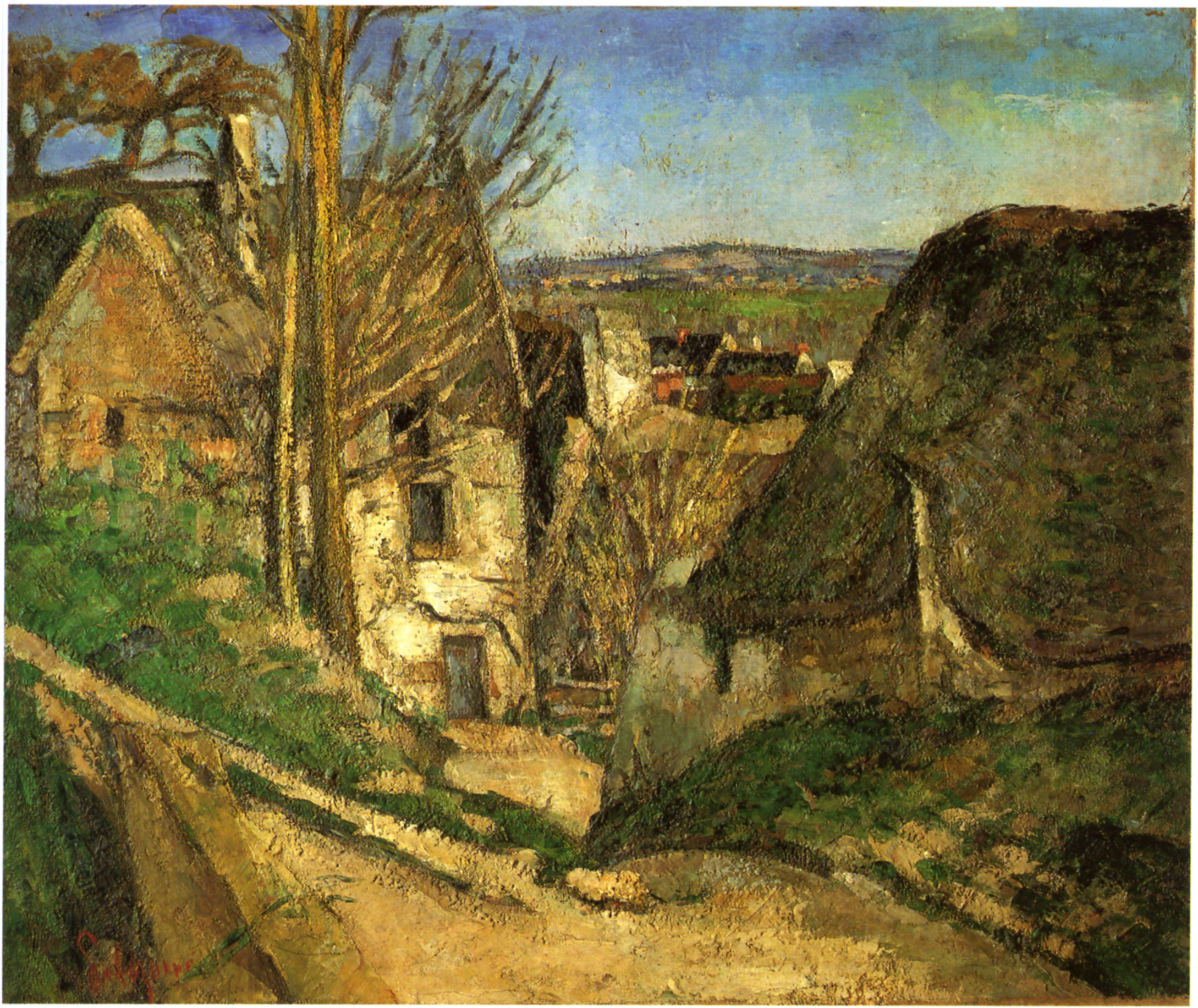
The country road bends to the right in the foreground, between farmhouses with thick thatched roofs. At the left two bare trees rise the full height of the canvas; at the right a steep roof drops almost to the ground. Between the houses a view opens into a green valley with low hills and the scattered roofs of a village. At the lower left the signature P. Cezanne is painted in red. This hand-painted painting on canvas reproduces Cézanne’s early work of about 1873, which measures 55 × 66 centimetres in the original and is held by the Musée d’Orsay in Paris under the number RF 1970.
April 1874, 35 boulevard des Capucines
This canvas hung in the exhibition that opened on 15 April 1874 in the studio of the photographer Nadar at 35 boulevard des Capucines in Paris, and ran until 15 May. It was called officially Première exposition de la Société anonyme des artistes peintres, sculpteurs, graveurs, and we know it today as the first Impressionist exhibition. The catalogue entered the work as number 42, under the title La Maison du pendu à Auvers-sur-Oise, lent by the painter himself. What was written about it at the time is not noted in the record consulted; what is noted is that the canvas was there.
From one count to another
The first known owner was Count Armand Doria, of the Château d’Orrouy. After him the canvas went to Victor Chocquet in Paris, and on his death to his widow Marie Buisson, who had it from 1891. In July 1899 the Chocquet collection was sold at the Galerie G. Petit in Paris, and this canvas went through outside the catalogue. Count Isaac de Camondo bought it, and in 1908 he bequeathed it to the Louvre.
Into the Louvre in 1911, on show from 1914
The Camondo bequest came to the Louvre in 1911, but the record says something more exact: it was exhibited from 1914 on. Between the acceptance of the bequest and the moment the work reached a wall, three years passed. In 1986 the canvas went with the rest of the nineteenth-century holdings to the newly opened Musée d’Orsay, where it carries the number RF 1970 and where it is today.
Painted with a palette knife
Among the technical headings the catalogue raisonné gives this canvas palette knife and signed work. Both are visible. The paint stands in places in thick flat layers a brush could not have laid: the house wall at the left is built from such faces, and so is the road in the foreground. That is why the surface of the work is grainy and dense, and why the houses look made of the same material as the earth beneath them. The signature at the lower left is painted in red, and the catalogue gives it word for word.
Auvers-sur-Oise
Among the locales the catalogue names Auvers-sur-Oise for this work, a village north-west of Paris on the river Oise. The name that attached itself to the work refers to a house said to have been called that in the village; about the origin of the name the catalogue says nothing, and so neither will we. What is on the canvas is a village bend: two houses, a roof, a road and the view across the valley – a motif found a few steps from the door.
An auction that went outside the catalogue
The note on the Chocquet sale of 1 to 4 July 1899 is worth pausing on: the canvas was sold hors catalogue, outside the catalogue, as an addition to the numbered works. For a work that twenty-five years earlier had hung in the first Impressionist exhibition and would later end up in the Louvre, that is an unexpected detail – and it stands in the provenance just so, without explanation.
Its warm earth range and quiet motif let this canvas settle in a room with wood and natural colours. There are fifteen sizes to choose from, from 50 × 42 to 180 × 151 centimetres, with in-between measurements on request, and the effect of the chosen frame shown in advance by our 3D application. From the same early years come The Murder, the Portrait of the Painter Achille Emperaire and The Stove in the Studio.
- Subject: The House of the Hanged Man at Auvers-sur-Oise, Paul Cézanne, about 1873, Musée d’Orsay, Paris
- Technique: hand-painted painting, oil on canvas, reproduction
- Sizes: 15 dimensions, custom size on request
- Of note: in April 1874 the canvas hung in the first Impressionist exhibition at Nadar’s as number 42, lent by the painter himself