







































Description
The Murder – three works under one title
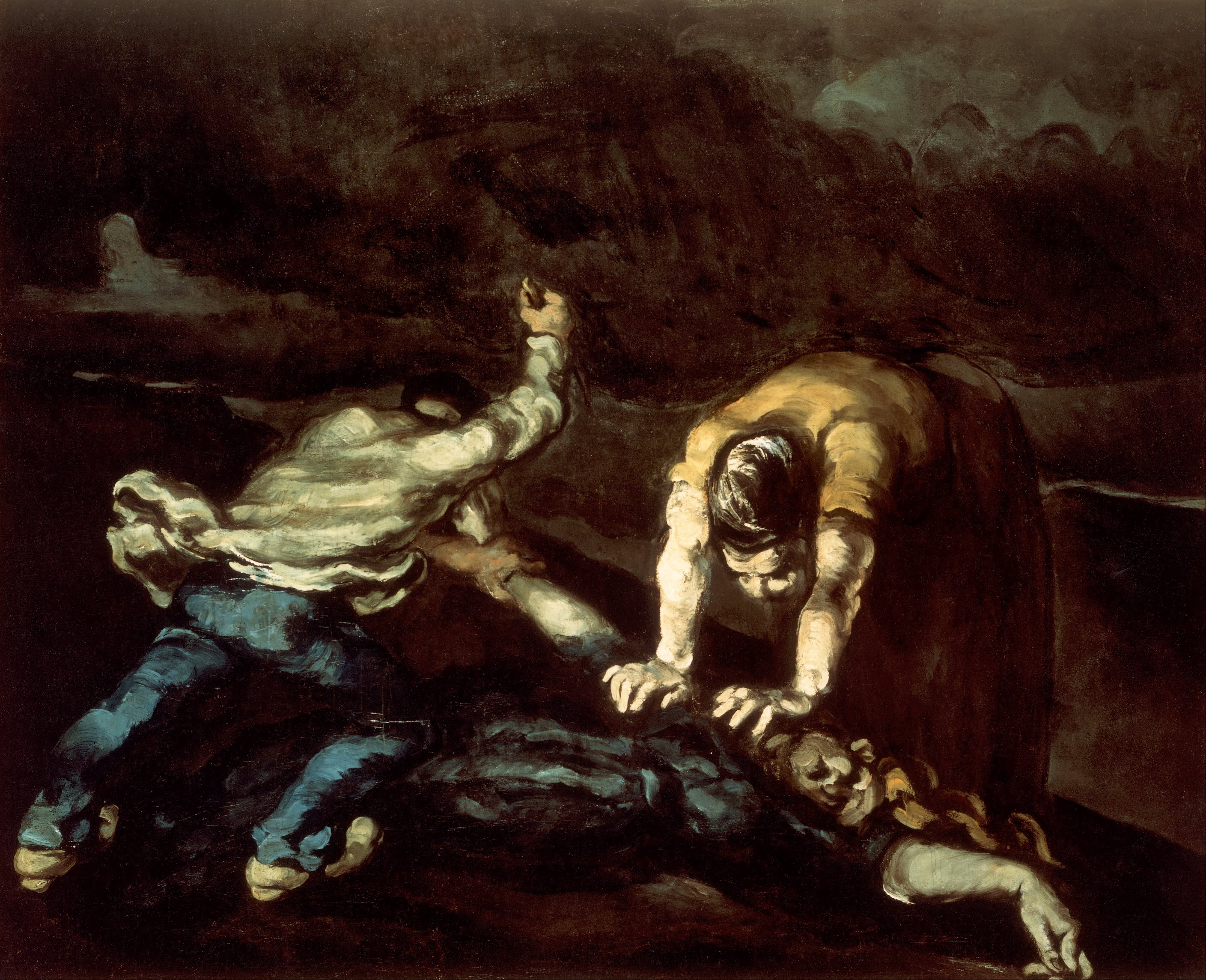
The canvas is dark almost throughout: a low horizon, above it a heavy brown-black sky, and a single lighter patch at the upper right. Three figures are on the ground. At the left a man in a white shirt and blue trousers, his right arm raised. At the right a stooping figure in an ochre garment and a dark skirt, pressing down with both hands. Between them lies a third figure in dark blue, the head at the right and one arm stretched towards the lower edge. This hand-painted painting on canvas reproduces Cézanne’s early work of about 1870, which measures 65 × 80 centimetres in the original and is held by the Walker Art Gallery in Liverpool.
Three entries with the same title
The catalogue raisonné lists three different works under the title Le Meurtre. The first is this oil canvas, dated about 1870 and measuring 65 × 80 centimetres. The second is a graphite drawing of 1868 to 1871, barely 13 × 15.5 centimetres, in a private collection in New York. The third is a sheet in graphite and watercolour of 1874 to 1875, 14.6 × 17.5 centimetres, in Greenville, Delaware. The catalogue does not say that the two smaller ones are studies for this canvas, and neither will we – what is recorded is only that three works in three media carry the same title, made about seven years apart.
A work made almost entirely of dark
The range of colour is extremely narrow. Brown, black and dark blue cover most of the surface; the only light passages are the white shirt, the ochre garment, and the skin of hands and faces. The strokes are broad and loaded, laid on quickly, in places so that a single fold of cloth reads as one sweep. The sky is painted not as space but as a dark mass pressing down on the scene, and it is because of this that the action seems squeezed against the lower edge. It is one of those early works in which the painter is working with the density of paint rather than with light.
From Vollard to Liverpool
The first known owner was the dealer Ambroise Vollard in Paris. On 16 October 1916 the canvas passed by way of Paul Cassirer in Berlin to Sally Falk in Mannheim, on 11 April 1918 to Cassirer again, and on 3 May 1918 to Dr Julius Elias in Berlin; in 1927 it went to Julie Sara Elias, in 1949 to Mrs C. Levy, and then to the Wildenstein galleries in Paris, London and New York. In 1964 the Walker Art Gallery in Liverpool bought it, and there it remains.
Two transfers recorded to the day
Two dates in the provenance are unusually exact. On 16 October 1916 the work passed the same day through Cassirer’s hands to the collector Sally Falk in Mannheim. Barely a year and a half later, on 11 April 1918, Cassirer took it back, and already on 3 May of that year, three weeks afterwards, Dr Julius Elias bought it. Both transfers fell in the middle of the war years, in a German art trade that stayed in motion through them.
In Germany it was known as Der Mord
Between 1913 and 1921 this canvas was on view in Germany regularly, always under the title Der Mord. In the spring of 1913 it hung in the XXVI exhibition of the Berlin Secession as number 24a, lent by Vollard; in the autumn of the same year in Cologne as number 8, in 1914 in Dresden as number 8, and then at Paul Cassirer’s in Berlin, where it returned in December 1915 as number 54. In November 1921 it was at Cassirer’s in the exhibition of Cézanne’s works in German private hands – and there it carried number 1, as the opening work, lent by Dr Elias. The Kunsthalle in Basel followed in 1936.
The heading the catalogue gives it
Among the keywords for this canvas the catalogue names two: figures in a landscape, or figure composition, and scene of violence. That is all the record says about the content. It names no literary source, no names, no event after which the scene would have been painted. Who the three people on the canvas are, and what happened before this moment, is not recorded in any source consulted – so we will not fill it in. No weapon and no wound is visible on the canvas: what is painted is a moment, not a narrative.
This is a dark, heavy work and we will not pretend otherwise: it holds a place where it has its own wall and enough distance, not above a bed or behind a dining table. Fifteen sizes are on offer, from 50 × 41 to 180 × 146 centimetres, intermediate measurements made to order, and the effect of the chosen frame is shown by our 3D application. From the same early years come the Portrait of Antony Valabrègue, the Portrait of the Painter Achille Emperaire and The Stove in the Studio.
- Subject: The Murder, Paul Cézanne, about 1870, Walker Art Gallery, Liverpool
- Technique: hand-painted painting, oil on canvas, reproduction
- Sizes: 15 dimensions, custom size on request
- Of note: the catalogue lists three works under the title Le Meurtre – this canvas, a drawing and a watercolour sheet