



Description
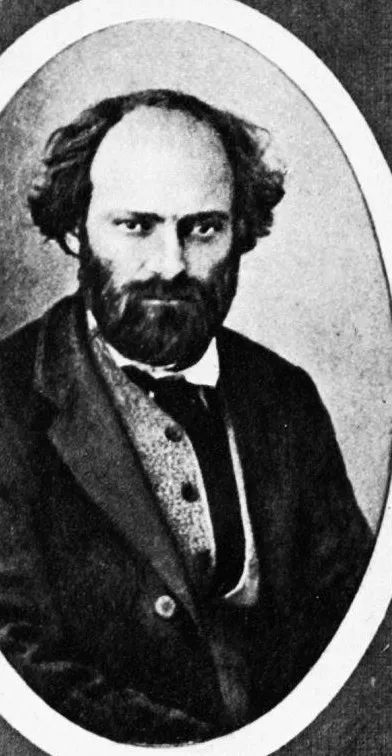
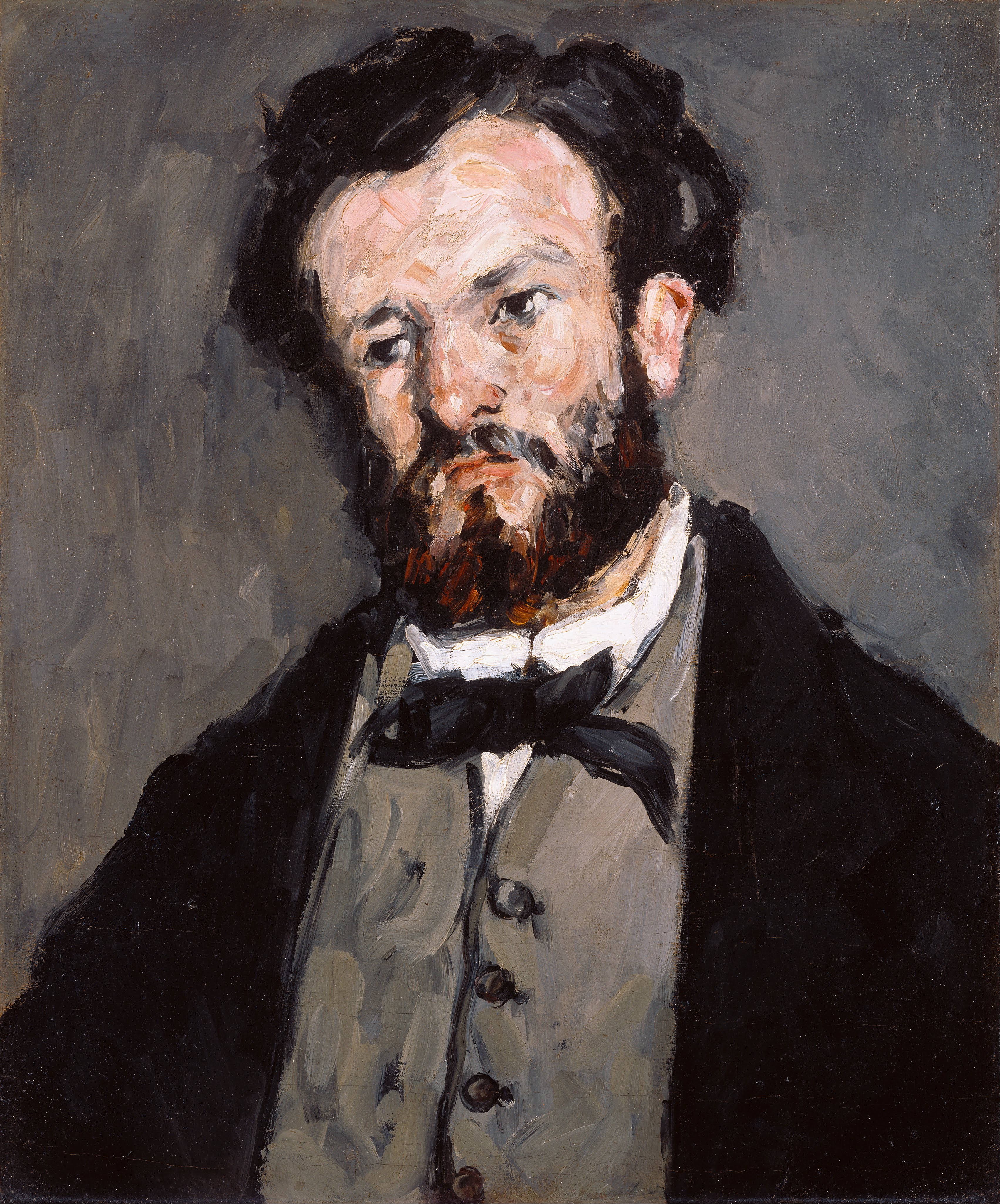
Portrait of Antony Valabrègue – the canvas an auction brought into a museum
The man sits close in front of a grey-green wall laid on in broad, plainly visible strokes. He has dark hair and a full reddish-brown beard, and he wears a black coat, a grey waistcoat with three buttons showing, a white upright collar and a black bow tie loosely knotted. Nothing else is there: no furniture, no book, no table. This hand-painted painting on canvas reproduces Cézanne’s early work of 1869 to 1870, which measures 60 × 50.2 centimetres in the original and is held by the J. Paul Getty Museum in Los Angeles under the inventory number 85.PA.45.
The auction that moved it from private hands into public ones
For a century this canvas passed from one private owner to the next, and could be seen only when somebody lent it to an exhibition. That ended on 22 October 1982, when it sold at Sotheby’s in New York as lot 21 of the André Meyer collection sale. The Galerie Beyeler in Basel bought it, and in 1985 the Getty acquired it. It has hung since then in a building open to anyone – which is the moment the work stopped being something people were lent and became something people visit.
Who Antony Valabrègue was
Antony Valabrègue (1844–1900) was a French poet and critic, born in Aix – the same town as Cézanne, Émile Zola and Baptistin Baille. He studied in Paris and settled there from the middle of the 1860s. In the capital he belonged to the circle of Provençals gathered around Zola and Cézanne, and the portrait comes out of that friendship: the painter was not painting a client but an acquaintance from his own town.
A name the record once hedged on
The catalogue raisonné lists seven further titles under which this canvas has appeared, and two of them are telling. One is simply Portrait d’homme, Portrait of a Man, with no name at all. The other is Portrait présumé d’Antony Valabrègue – the presumed portrait of Antony Valabrègue. It was under that second title that the work was shown in 1936 at the Musée de l’Orangerie in Paris as number 17. Today the catalogue heads it with the sitter’s name and no qualifier. Who settled the doubt, and when, the record does not say, and we will not supply what is missing from it.
A portrait with nothing in it but the man
It is the absence of objects that gives this canvas its character. The ground is not smooth but built from short flat loadings of grey-green that visibly cross one another; the same hand built the face, out of separate patches of pink, cream and grey meeting without soft transitions. The paint stands thick, almost as though set with a blade. The man’s gaze does not go straight out at the viewer but slips a little to one side. Because there is no table, no window and no book, the head has to carry everything on its own – and that is why this is one of those early canvases in which you can already see where the painter went later.
Nine owners in four countries
The first known owner was the dealer Ambroise Vollard in Paris. The canvas then went to Count Armand Doria at the Château d’Orrouy, next to the collector Auguste Pellerin, and from him to his son Jean-Victor Pellerin. There followed the Wildenstein galleries in Paris and New York, then the New York banker André Meyer, after the 1982 sale the Galerie Beyeler in Basel, and finally the Getty. The same Auguste Pellerin appears in the history of the Portrait of Gustave Geffroy – a collector who was buying Cézanne when few people were.
From Berlin in 1904 to the Grand Palais
The canvas was first exhibited in 1904 at Paul Cassirer’s in Berlin, in the Sonderausstellung Paul Cézanne, from 22 April to 15 June. In 1913 it was in Stuttgart as number 330, lent by Count Doria from his château in the Oise. Brussels followed in 1935, London in 1939 at Wildenstein, and Washington in 1962, when the National Gallery of Art showed the collection of Mr and Mrs André Meyer. In 1988 the work was at the Royal Academy of Arts in London for Cézanne: The Early Years 1859–1872 as number 56, travelling from there to the Musée d’Orsay and to Washington; in 1995 it was at the Grand Palais as number 8.
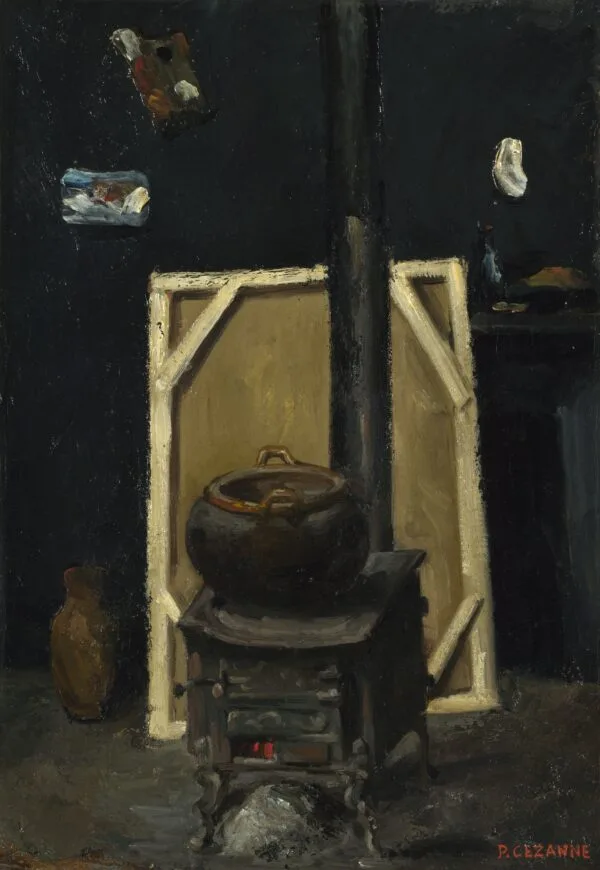
For a home it is an obliging format: a portrait with no narrative in it, which holds its own beside a bookcase or in a working corner, where it competes with no other subject. We paint it in fifteen sizes, from 42 × 50 to 149 × 180 centimetres, and intermediate measurements we stretch on a made-to-measure stretcher; how it will look in the chosen frame is shown by our 3D application. From the same early years come the Portrait of the Painter Achille Emperaire and The Stove in the Studio.
- Subject: Portrait of Antony Valabrègue, Paul Cézanne, 1869-1870, J. Paul Getty Museum, Los Angeles
- Technique: hand-painted painting, oil on canvas, reproduction
- Sizes: 15 dimensions, custom size on request
- Of note: the catalogue once recorded it as a presumed portrait; today it is headed with the sitter’s name