







































Description
The Village of Gardanne – the canvas confiscated as enemy property
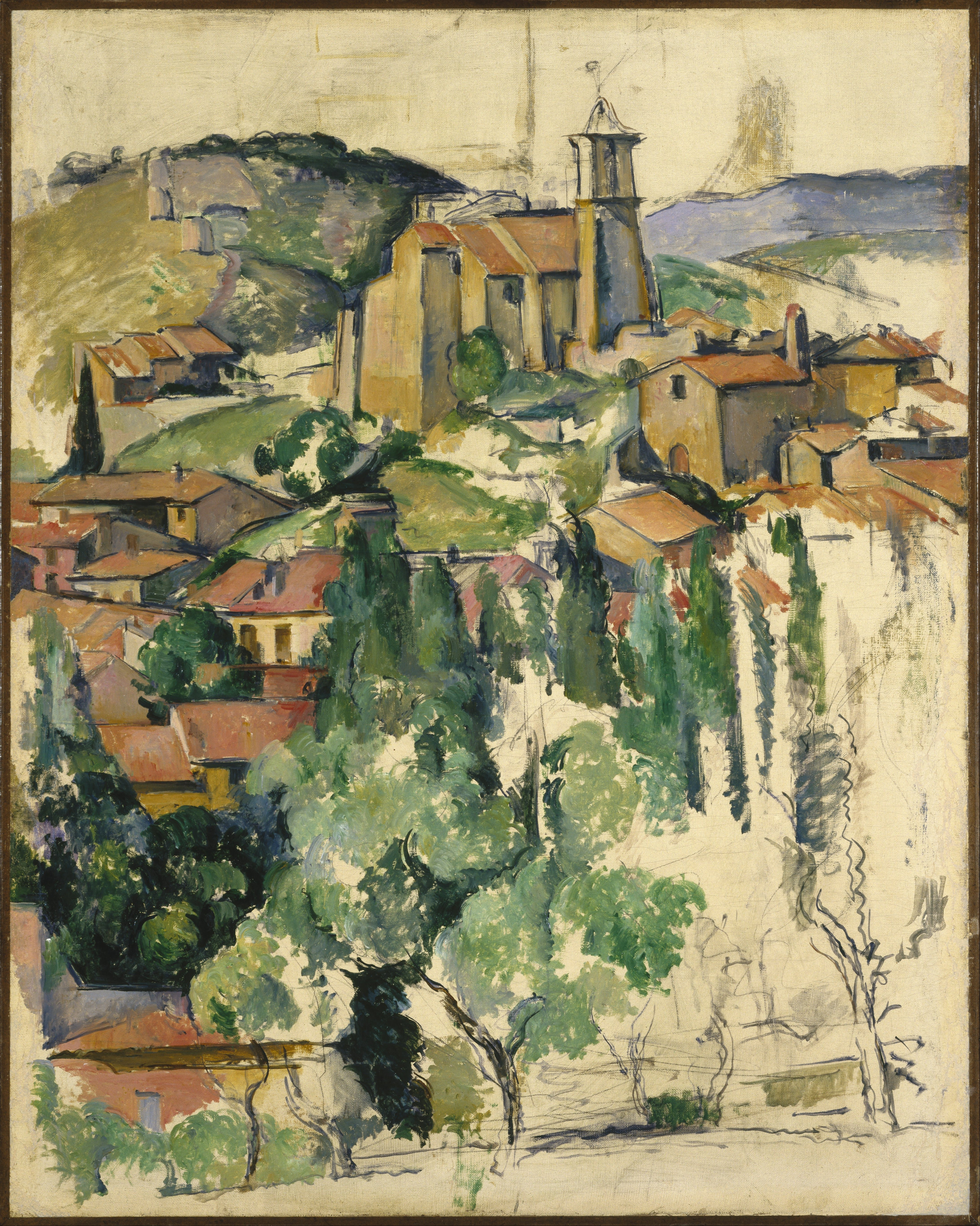
The houses climb the hill in steps, one above another: ochre and reddish walls, flat roofs, narrow shadows between them. At the top stands a church steeple, the only vertical accent in the whole upper half. Below runs a band of green trees, and behind it pale blue hills. This hand-painted painting on canvas reproduces Cézanne’s work of 1885 to 1886, which measures 92.1 × 73.2 centimetres in the original and is held by the Brooklyn Museum of Art under the inventory number 23.105.
Confiscated as enemy property
The provenance of this canvas carries a phrase one rarely reads beside a work by Cézanne. After the German collector Gottlieb Friedrich Reber the work went to Dr Hans Wendland in Berlin and Paris, and against his name the record notes: confiscated as enemy property. Then comes the sale: Séquestre Wendland at the Hôtel Drouot in Paris on 24 February 1922, where the canvas was number 209. What happened and why, the record does not explain beyond what is given here, and we will add no explanation – the name, the note, the date and the number are what stand.
From Vollard to Brooklyn
The first known owner was the dealer Ambroise Vollard in Paris. On 7 May 1913 Gottlieb Friedrich Reber bought the canvas in Barmen, after him Hans Wendland had it, and after the 1922 auction the Galerie Durand-Ruel in Paris and New York. From Durand-Ruel it reached the Brooklyn Museum of Art, where it remains. The route therefore runs from a Paris shop into a German collection, through a confiscation and a sale in Paris, and across the ocean into an American museum.
Exhibited under another town’s name
The catalogue raisonné lists nine titles for this canvas, among them two that name not Gardanne but an entirely different place: Avignon and Paysage de l’Estaque. The first is not merely recorded in the catalogue but was used: in May and June 1913 the work was shown in Darmstadt in the exhibition of the Reber collection as number 16, under exactly that title, Avignon. Only in 1934 in Philadelphia do we find it as The Village of Gardanne, lent by the Brooklyn Museum. The record thus preserves the memory that for a time the village went unrecognised.
Houses as blocks
The village is painted without detail: no windows in any real sense, no doors, no people. Each house is a few flat faces of ochre, pink or grey set side by side, and precisely because only thin dark lines divide them, the whole hill reads as a stacked mass rather than as a crowd of buildings. The steeple at the top is the one element that interrupts that stacking. The band of trees below is by contrast soft and restless, and the band of hills above so pale that it almost merges with the sky – the village stays the only solid thing on the canvas.
Darmstadt, Philadelphia, Toledo
Besides the Darmstadt exhibition of 1913, the canvas was at the Pennsylvania Museum of Art in Philadelphia in November and December 1934 as number 15, and at the Toledo Museum of Art in Ohio in November and December 1936 in Cézanne and Gauguin as number 21; both times the Brooklyn Museum lent it. In 1937 it was in Portland and then in San Francisco in Paul Cézanne: Exhibition of Paintings, Water-colors, Drawings and Prints. Through the American thirties this canvas was often on the road.
What Vollard entered beside number 3877
The dealer’s description has an unusually narrative tone: huile; tout un petit village avec des maisons rouges et des arbres, au loin on aperçoit la montagne – oil; a whole small village with red houses and trees, in the distance one glimpses the mountain. Beside it stand the measurement 92 × 73 centimetres and the price of 200 francs. Vollard therefore described even the hardest thing to see: the pale hills at the back. The catalogue names among the motifs the houses and the church steeple, which are exactly the two elements the village is made of.
An upright village view in warm ochre tones holds its own in a room with a white or sand-coloured wall, where the colour of the houses can come forward. We paint it in fifteen sizes, from 40 × 50 to 144 × 180 centimetres, intermediate measurements we stretch on a made-to-measure stretcher, and how it will look in the chosen frame is shown in advance by our 3D application. From the same country come The Bay of Marseille, Seen from L’Estaque, The Red Rock and Mont Sainte-Victoire Seen from Bibémus.
- Subject: The Village of Gardanne, Paul Cézanne, 1885-1886, Brooklyn Museum of Art
- Technique: hand-painted painting, oil on canvas, reproduction
- Sizes: 15 dimensions, custom size on request
- Of note: in 1913 in Darmstadt the canvas was exhibited under the title Avignon – the name of another place