Description
Aha oe feii? (What! Are You Jealous?) – a question painted into the corner of the canvas
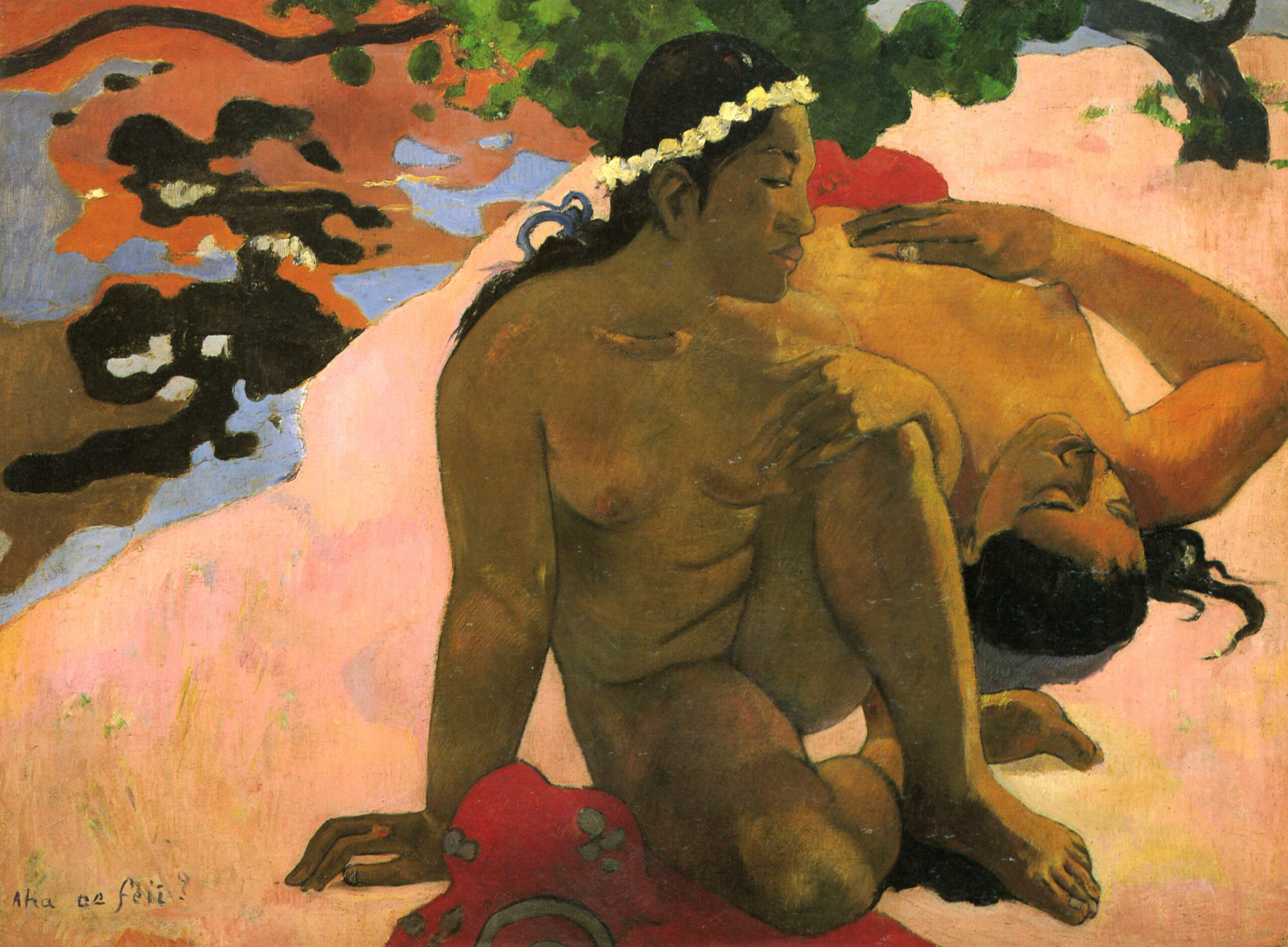
In 1892, during his first stay in Tahiti, Paul Gauguin painted two women on the sand beside water. One sits upright, knees drawn up, turned almost in profile to the right; she wears a wreath of small white blossoms in her hair and a blue ornament at the back of her head. The other lies close beside her, head thrown back, her dark hair spread across the ground. Beneath them both lies a deep red cloth with a pale pattern. At the upper left a bluish-white run of water glints between black shadows, and at the upper right deep green foliage comes down into the picture. The work is held by the Pushkin State Museum of Fine Arts in Moscow under the inventory number Zh-3269. The museum gives the measurement as height by width: 66 x 89 cm, a landscape format.
The question the painter wrote on the canvas
In the lower left corner, in small dark script, stands the phrase Aha oe feii ?. It is not a later label and not a museum marking, but part of the painting itself. The museum record states that the painter wrote these words on the picture at the lower left, setting down the sound of the Tahitian words; they are indeed visible on the canvas. The title of the work is therefore not the description of a scene but a question – a sentence somebody speaks. It is painted so small that many people miss it, although it carries the whole picture.
Two attitudes, side by side
The scene is built from two opposite attitudes. The seated figure is gathered and closed, her hand resting on her own shoulder; the reclining one is open and loose, her arm stretched above her companion’s shoulder. Nothing happens between them that could be read as a story: two bodies in different rhythms on the same surface. It is precisely this difference of posture that makes the picture feel like an exchange of words rather than a scene.
The pink sand
The ground is neither yellow nor grey, as one would expect on a shore. It is painted pink, in places almost salmon, and it is this colour that holds the picture together: the red cloth below, the broad pink surface in the middle and the dark green above form three large bands. Colour here does not describe nature; it is a decision.
How a hand-painted reproduction is made
Every reproduction here is hand-painted in oil on canvas, stroke by stroke. In this motif the pink surface is the hardest part: if it turns too grey or too pale, both figures lose their support and the picture breaks into two separate shapes. Before dispatch you receive a photograph of the finished work for approval.
- Subject: two women on pink sand, one seated in profile, the other reclining with her head thrown back.
- Technique: oil on canvas, broad areas of colour and firm outlines.
- Sizes: landscape format, from 40 x 30 cm to 200 x 150 cm; 80 x 60 cm and 100 x 75 cm are often chosen.
- Of note: the title is a question, which the painter painted into the lower left corner of the canvas.
If the same period interests you, see also Mahana no atua (Day of the God), Ta matete (The Market) and Fatata te Miti (By the Sea), in which Gauguin builds the picture from broad areas of colour in the same way.