


Description
I Raro Te Oviri (Under the Pandanus) – two different hands on one canvas
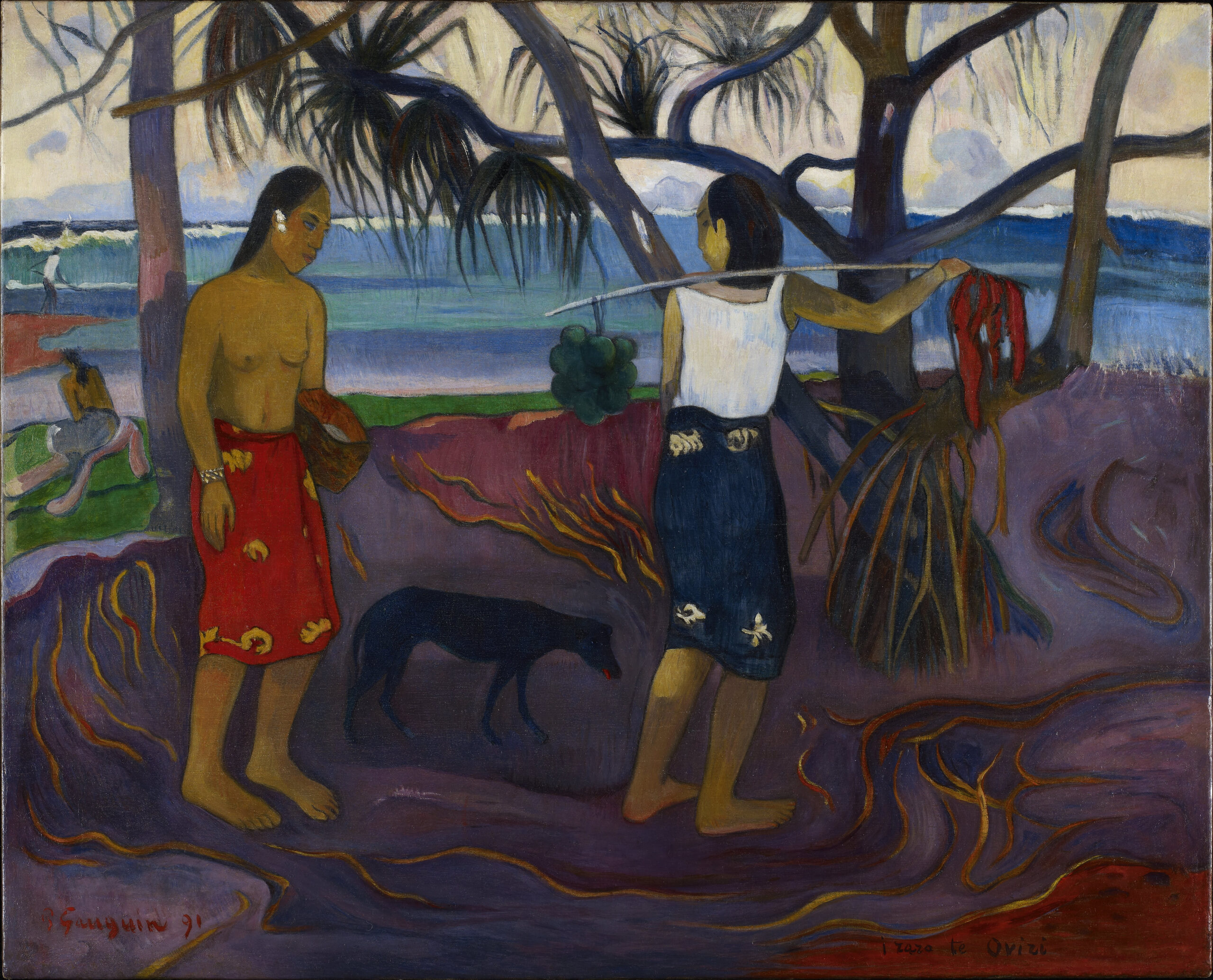
Under the tousled branches of a pandanus tree stand two figures. The left one is seen from behind, bare to the waist, with a red cloth around the hips; the right one faces her in a dark blue cloth and a pale upper garment, holding a long staff propped against the ground. Between them, on violet-brown ground, lies a dark animal. Behind stretches a pale band of sand and beyond it blue water; from the very top long leaves descend into the picture. On the right, among the trees, two further small figures can be made out. The work is held by the Minneapolis Institute of Art under the inventory number 41.4, and the year is 1891.
Signature and title are not by the same hand
This is the most interesting detail about the canvas, and it comes from the museum’s entry for the inscriptions. The museum states that the title at the lower right is written in a hand different from the painter’s and was probably added by Daniel de Monfreid. We keep the word probably on purpose: that is how the museum record puts it, and that is how we repeat it, without hardening it into certainty.
The difference can be seen
What is remarkable is that the difference between the two scripts really is visible. The signature with the year is red, flowing and slanted, drawn in a single movement. The title at the lower right is darker, more upright and stiffer, its letters set beside one another rather than joined. Museum record and painting therefore agree, which with inscriptions is rare.
Why this matters for this shelf
On several of Gauguin’s canvases the title is written by the painter himself, and that writing is part of the picture. Here it is otherwise: the signature is his, the title in all likelihood not. For a buyer this is no fault and takes nothing from the work; it means only that the writing at the lower right should not be read as the painter’s own stroke, and we do not claim that it is.
How a hand-painted reproduction is made
Every reproduction here is hand-painted in oil on canvas, stroke by stroke. In this motif the two scripts are the hardest part: painted alike, exactly what makes this canvas particular disappears. Before dispatch you receive a photograph of the finished work for approval.
- Subject: two figures under a pandanus tree by the water, a dark animal between them.
- Technique: oil on canvas, violet-brown ground and a cool blue band of water.
- Sizes: landscape format, from 40 x 32 cm to 200 x 160 cm; 80 x 64 cm and 100 x 80 cm are often chosen.
- Of note: by the museum’s record the title on the canvas was not written by the painter.
If the same period interests you, see also Fatata te Miti (By the Sea), Mahana no atua (Day of the God) and Arearea (Joyousness). The museum gives the measurement as height by width: 73.03 x 91.44 cm.