





Description
Landscape from Brittany – the pollarded trees the museum calls by their name
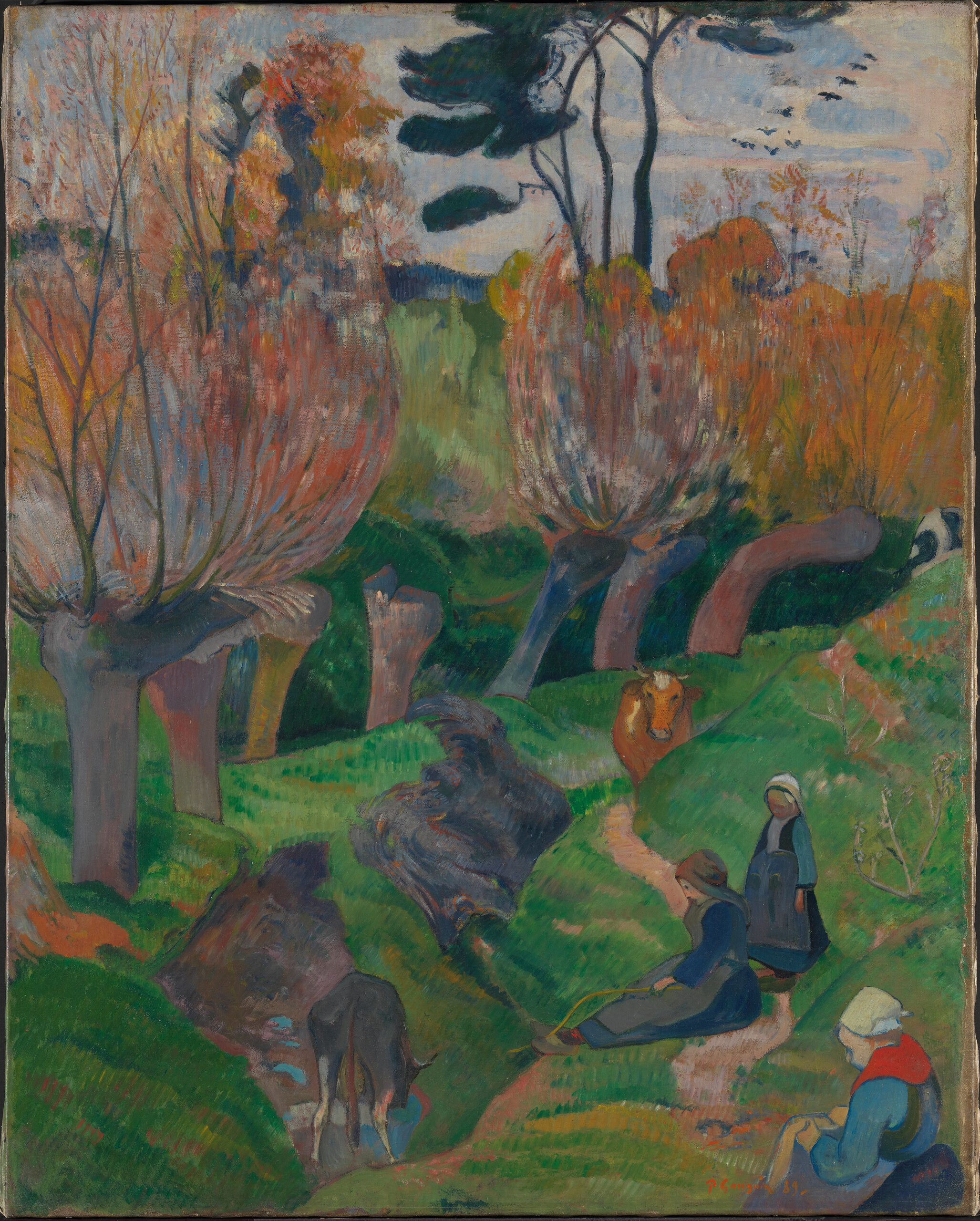
The upright canvas is a landscape without a horizon in the usual sense: the ground rises and places the viewer above the scene. In front stand thick trees with their tops cut off, from which bunches of thin rods sprout in pink and orange. The trunks are violet and grey, and the grass between them is a strong green. At the centre of the canvas stands a brown and white cow; a second drinks at the water on the lower left. At the lower right sit two women in blue with white coifs and a girl in a yellow cap with a red collar. Above, slender conifer trunks rise, and a few birds cross the sky. The work is held by the Nasjonalmuseet in Oslo under number NG.M.01006; it was made in 1889.
Trees shaped by centuries of cutting
The museum’s text beside this work says the motif is dominated by a magnificent row of trees that Norwegian calls styvinger: old broadleaf trees that took their characteristic shape through centuries of cutting the branches for fodder. In English we call them pollarded trees. That is exactly what explains their unusual look: they are neither diseased nor invented, but the result of long farming use. The museum adds that from their strong, almost amoeba-shaped trunks in violet and pink, long bunches of thin branches stretch towards the sky.
A work of transition
The same record calls the picture transitional: the will towards decorative simplification is still combined in it with impressionist observation of detail. Beside the slender conifer trunks on the skyline the museum also raises the question whether Gauguin’s synthesis may have drawn on Japanese art. The question is the museum’s, and it leaves it open; we do not close it either.
The signature the record does not list
The museum record for this work contains no field for inscriptions. On the painting itself, however, at the lower right, in red on the green grass, the signature P. Gauguin with the year 89 is clearly visible, which agrees with the museum’s dating. So we state both: what the record says and what the canvas shows.
How a hand-painted reproduction is made
Every reproduction here is hand-painted in oil on canvas, stroke by stroke. In this motif the bunches of thin rods are the hardest part: they must be painted as a mist of colour and not as separate lines, or the trees lose their weight. Before dispatch you receive a photograph of the finished work for approval.
- Subject: a hilly landscape with pollarded trees, two cows and three figures.
- Technique: oil on canvas, violet trunks and strong green grass.
- Sizes: portrait format, from 40 x 50 cm to 160 x 200 cm; 87 x 110 cm and 110 x 140 cm are often chosen.
- Of note: the shape of the trees was made by people, not by nature.
If the same period interests you, see also Winter Landscape (Vinterlandskap), Breton Peasant Women and La belle Angèle. The museum record gives the measurement as height by width: 92 x 73.5 cm.