







































Description
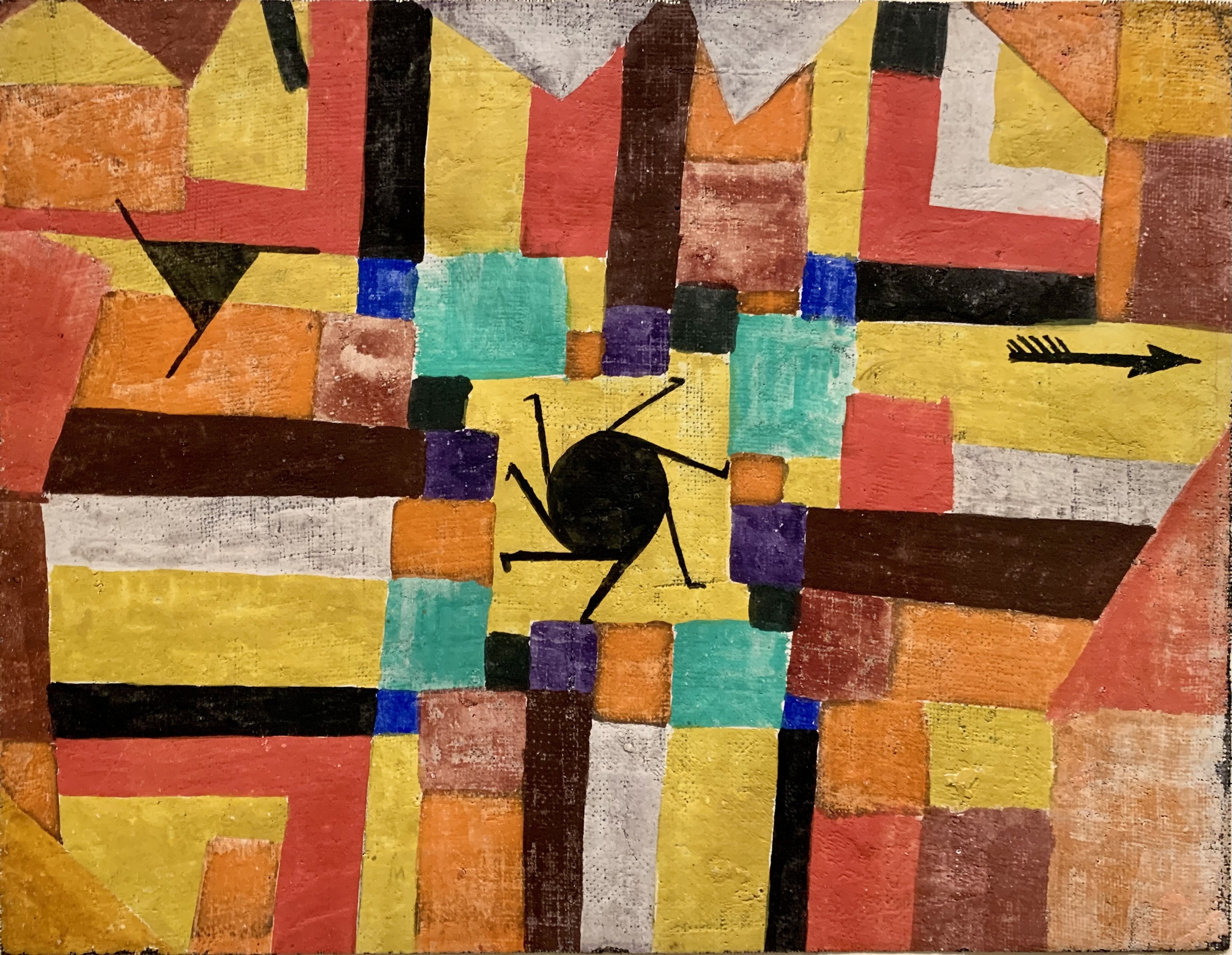
With the Rotating Black Sun and the Arrow is a painting by Paul Klee from 1919: a dense weave of rectangles and stripes in yellow, orange, coral red, cream, dark brown and black, with a small black disc with curved spokes spinning at its centre and a black arrow flying at the upper right. The original is a tiny work in gouache, tempera and chalk on canvas, only 24.5 x 31.5 cm; it belongs to the Fondation Jean et Suzanne Planque and is on view at the Musée Granet in Aix-en-Provence. Our painter paints it for you by hand on canvas, in oil or acrylic, in 8 landscape sizes from 40 x 30 to 200 x 162 cm or made to measure. When it is finished, we show it to you in a photograph before dispatch.
| Title: | With the Rotating Black Sun and the Arrow |
| Other titles: | Mit der rotierenden schwarzen Sonne und dem Pfeile (German title) · Con il sole nero rotante e la freccia (Italian title) |
| Painter: | Paul Klee (1879–1940) |
| Year painted: | 1919 |
| Original size: | 24.5 cm x 31.5 cm (height x width) |
| Original technique: | Gouache, tempera and chalk on canvas |
| Painting style: | Modernism |
| Located at: | Fondation Jean et Suzanne Planque, on view at the Musée Granet, Aix-en-Provence, France |
| Our reproduction: | Hand-painted in oil or acrylic on canvas, 8 sizes or made to measure |
With the Rotating Black Sun and the Arrow – Paul Klee
What does this Klee painting show?
The whole surface is a patchwork of rectangles, stripes and triangles. Warm tones lead: saffron yellow, orange, coral and brick red, with cream-white fields between them and broad dark brown and black bands running across and down.
Small squares of turquoise, violet and bright blue gather around the central yellow field like a cool frame. On the yellow sits a small black disc with curved spokes. It looks like a wheel that has just been set turning, or a sun throwing out rays in every direction.
At the upper right a thin black arrow with a feathered tail flies along a yellow band, pointing towards the right edge. At the upper left a black triangle hangs point down, with a fine line slanting out of it, rather like a pennant on a pole.
What does the title tell us?
The title tells no story. It names two signs you can actually find in the picture: a black sun that turns, and an arrow.
The curved spokes give a sense of rotation, so you can read it as a sun or as a rolling wheel. The arrow adds a direction: everything else is still, and only the arrow hints where the movement might go next.
Our sources give no explanation of this work from Klee himself, so we do not make one up. Each viewer decides whether the patchwork is a landscape, a cluster of roofs or simply a rhythm of colours and signs.
Why does such a small work hold the eye?
The warm, almost glowing fields are dense and lively, while the three black signs are spare and exact.
By then colour was fully Klee’s own. In 1914 he travelled to Tunisia with August Macke and Louis Moilliet, and that trip was his breakthrough in colour. Five years on, he builds the whole space here out of colour alone.
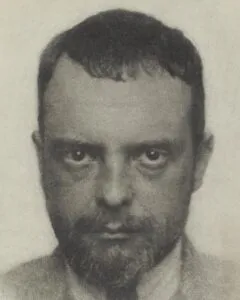
Born in 1879 in Münchenbuchsee near Bern, he played the violin from childhood. The poet Rilke wrote that his drawings seemed like transcriptions of music.
To learn more about the painter, read the Wikipedia article on Paul Klee; it is in English and covers the artist and his life rather than this particular work.
Where is the original, and how did it come about?
The original belongs to the Fondation Jean et Suzanne Planque and is shown at the Musée Granet in Aix-en-Provence, in the south of France.
Klee painted it in 1919, just before his Bauhaus years; he taught there from January 1921 to April 1931, alongside Wassily Kandinsky.
The technique is unusual: gouache, tempera and chalk on canvas. The work is small, just 24.5 x 31.5 cm (height x width).
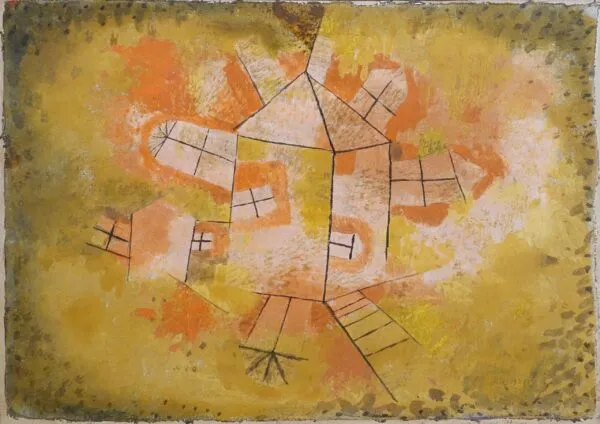
In 1937 the Nazis showed seventeen of Klee’s works in the so-called Degenerate Art exhibition and seized 102 of his pieces from public collections. That same year he made Revolution of the Viaduct, in which the arches of a bridge step out of line. By his death in 1940 Klee had made more than 9,000 works.
This work or another Klee?
This canvas painting suits anyone who loves colour without a story.
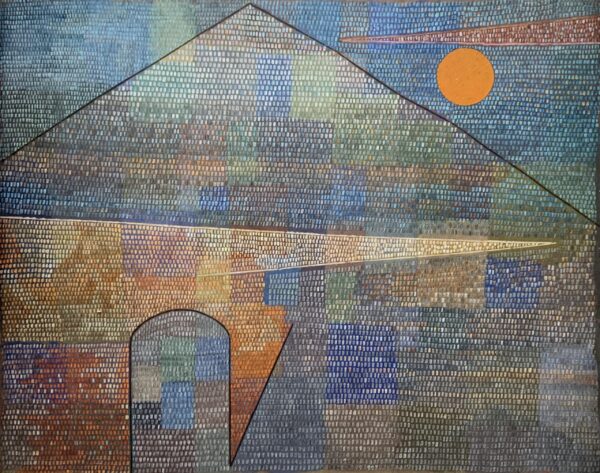
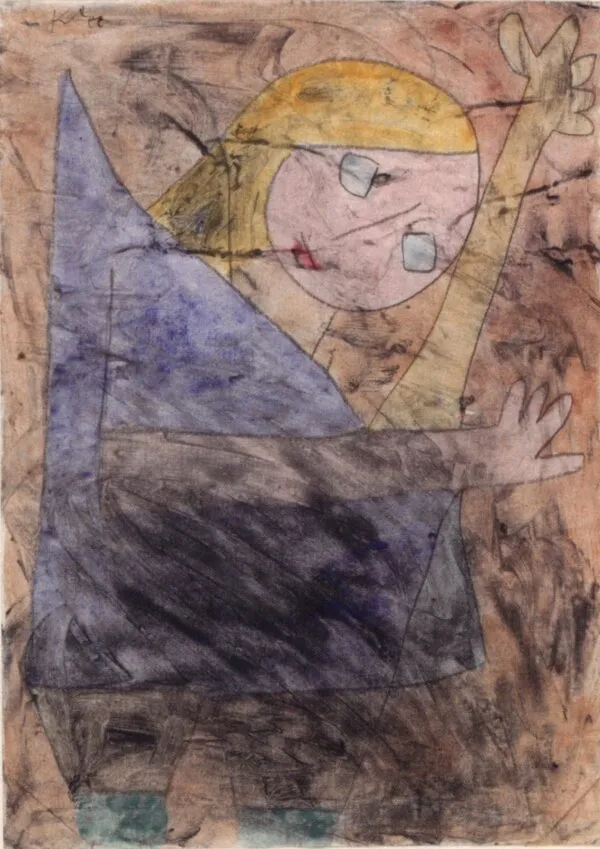
If the arrow draws you, look at Arrow in the Garden from 1929, a copper-brown garden of signs with one small black arrow. If you like strict rectangles, you will enjoy Rhythmical from 1930, a loose chequerboard of black, white and grey fields. For something more playful there is Little Jester in a Trance, a dancing figure drawn in thin brown lines.
The Paul Klee page gathers all the famous Paul Klee paintings we paint to order.
How do we hand-paint this work on canvas?
Klee’s original is a small piece in gouache, tempera and chalk, not an oil. Ours is an oil painting reproduction on canvas, painted in oil or acrylic, in the size you choose, so it hangs on your wall like any other painting.
The painter first marks out the fields, the stripes and the three black signs with a thin line. Then come the warm colours, then the cool squares at the centre, and the black signs last, with a finer brush.
Thin layers and slightly uneven edges keep the patchwork as lively as the matt original.
Which size suits which wall?
In short: 40 x 30 or 50 x 38 cm for a shelf, a hallway or a work corner, 65 x 49 and 80 x 63 cm above a chest of drawers or a bed, 100 x 79 cm above a sofa, and 130 x 100, 160 x 129 or 200 x 162 cm for a large wall in a living or dining area.
We paint it in 8 landscape sizes (width x height): 40 x 30, 50 x 38, 65 x 49, 80 x 63, 100 x 79, 130 x 100, 160 x 129 and 200 x 162 cm. The original measures 31.5 x 24.5 cm (width x height), so even our smallest size is a little larger, and at 200 x 162 cm it is more than six times as wide as in Aix-en-Provence. The fields are large and clear, so nothing is lost in the enlargement.
As a painting for the living room it works best at 130 x 100 or 160 x 129 cm above the sofa.
Can I order a custom size and a frame?
Yes. If you need other proportions, we arrange the composition so that the disc, the arrow and the triangle stay whole, and lengthen or shorten the patchwork at the edges. Tell us the dimensions you need, and our reply will carry a price and a delivery date.
It can travel to you rolled, stretched on a stretcher bar or already framed, as you prefer. Stretching and framing happen in our workshop in Slovenia, where each painting is also packed with care for the road. The 3D app on our site lets you choose the moulding and nothing else; a view of the painting on your own wall is a separate service.
A slim black frame or natural oak suits it well.
How soon will the painting arrive?
After you confirm the order the painter starts, and within 15 to 45 working days the painting is ready to travel. We send you a photograph of the finished work before dispatch, and if you would like a change, we make it.
There are no customs duties within Slovenia and the EU, and every order is covered by our returns policy.
A painting this colourful makes a lovely present for a new home, a wedding or an office. If you are unsure which size would fit, give a wall art voucher and leave the choice to the person receiving it.
Frequently asked questions
Where is the original on display?
At the Musée Granet in Aix-en-Provence, France, as part of the Fondation Jean et Suzanne Planque collection.
What sits at the centre of the painting?
A small black disc with curved spokes, like a sun or a rolling wheel, ringed by turquoise and violet squares.
Will I get a print?
No. You get a hand-painted copy: our painter works it with brushes on canvas, in oil or acrylic.
How big is the original?
Only 24.5 x 31.5 cm (height x width); our sizes go up to 200 x 162 cm (width x height).
Could you make it in dimensions outside your list?
Yes. Tell us the width and height and we will send an offer with a price and a making time.
How long will I wait for it?
Making it takes 15 to 45 working days, and before dispatch we send you a photograph of the finished painting.
Is it right for a lounge, or as a gift?
Yes. Its warm colours sit well above a sofa, and it pleases anyone who likes colourful modern art.
What does the black sun mean?
Our sources give no reading; the title only names the sign, so each viewer decides whether it is a sun, a wheel or pure form.
- Subject: a patchwork of yellow, orange, red, brown and black fields with a turning black disc at the centre and an arrow at the upper right.
- Original: gouache, tempera and chalk on canvas, 1919, 24.5 x 31.5 cm, Fondation Jean et Suzanne Planque, Musée Granet.
- Ours: a Paul Klee reproduction painted by hand in oil or acrylic on canvas, 8 landscape sizes from 40 x 30 to 200 x 162 cm, or made to measure.
- Worth knowing: Klee made it in 1919, five years after his trip to Tunisia and just before his Bauhaus years.