







































Description
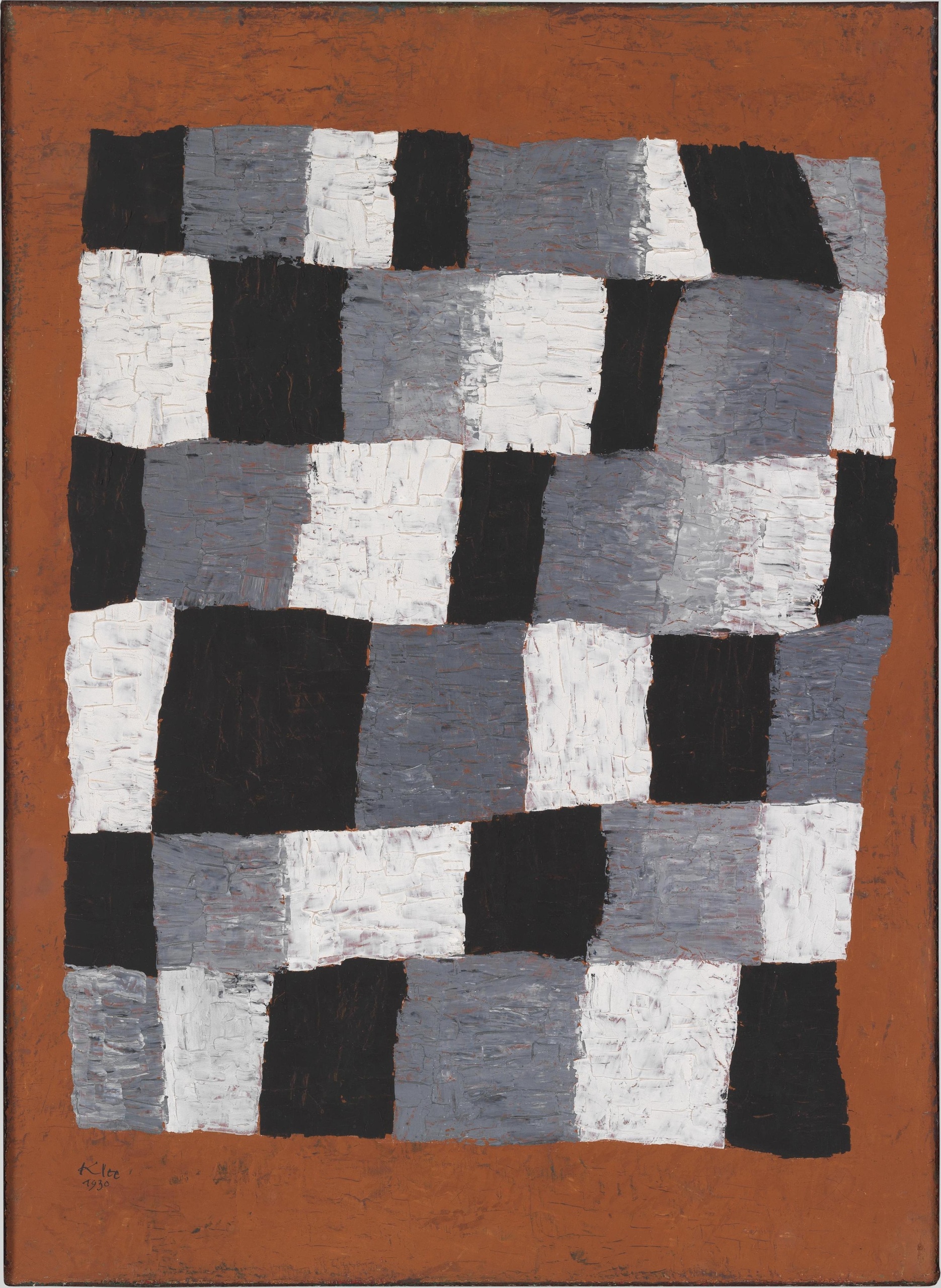
Rhythmical is a painting by Paul Klee from 1930: on a warm rust-orange ground stands a loose chequerboard of black, white and grey rectangles, laid on with thick, visible brushstrokes, and its rows tilt and shift like a beat that speeds up and then settles again. The original is oil on hessian, 69.6 cm high and 50.5 cm wide, and it belongs to the Centre Pompidou in Paris. For you, our painter paints it by hand on canvas, in oil or acrylic, in one of 8 upright sizes from 30 x 40 to 151 x 200 cm or made to measure. Before dispatch we send you a photograph of the finished grid.
| Title: | Rhythmical |
| Other titles: | Rhythmisches (German title) · Ritmico (Italian title) |
| Painter: | Paul Klee (1879–1940) |
| Year painted: | 1930 |
| Original size: | 69.6 cm x 50.5 cm (height x width) |
| Original technique: | Oil on hessian |
| Painting style: | Modernism |
| Located at: | Centre Pompidou, Musée National d’Art Moderne, Paris, France |
| Our reproduction: | Hand-painted in oil or acrylic on canvas, 8 sizes or made to measure |
Rhythmical – Paul Klee
What does Rhythmical show?
A grid of rectangles in three tones, black, grey and white, fills almost the full height. They sit in six horizontal rows, but none of the rows is quite straight. Some climb towards the right, others dip, and the blocks vary in width and lean a little to the left or right.
The tones always follow the same order: black, grey, white, then black again. Yet each row starts at a different point in that sequence, so slanting diagonals of the same tone run across the surface. Follow the rows with your eye and you find yourself counting along: one, two, three, one, two, three.
The paint is thick, applied in short, visible strokes. The white blocks are the heaviest, with ridges and cracks in the paste, while here and there the rust-orange ground peeps out between the dark ones. At the lower left Klee added his name and the year 1930 with a fine brush.
What does the title Rhythmical mean?
The title names no object; it names the way the painting works. There is no landscape and no figure, only areas of three tones repeating at a changing pace. Rhythm itself is the subject here.
Klee took violin lessons from the age of seven and was so gifted that at eleven he was invited to play with the Bern Music Association. He looked for parallels between music and painting. The English Wikipedia article on Paul Klee, which is about the painter himself, notes that the coloured rectangle became his basic building block, one that some scholars associate with a musical note.
Whether Klee meant black, grey and white as three notes, we do not know; the title only says this is about rhythm, and the eye does the rest.
Why does this grid hold the eye?
Because it does a great deal with very little. Three colourless tones and one warm ground, and still the painting is not cold. The rusty orange warms the greys, and the heavy paint gives the surface a tactile quality you rarely meet in geometric art.
Music ran in the family: the Swiss-born German artist was the son of a German music teacher and a Swiss singer. Expressionism, cubism and surrealism all shaped him, and his breakthrough in colour came on a 1914 trip to Tunisia with August Macke and Louis Moilliet.
In 1921 Rilke wrote that Klee’s drawings were often like transcriptions of music.
Where is the original, and what is it painted on?
The original belongs to the Centre Pompidou in Paris, in the collection of the Musée National d’Art Moderne, under inventory number AM 1984-356. Klee painted it in 1930, in his last years of teaching at the Bauhaus, where he taught from January 1921 to April 1931 alongside Wassily Kandinsky.
The support is not a conventional canvas but hessian, a coarse jute cloth whose fibres show through the paint. The work measures 69.6 x 50.5 cm (height x width).
The same Paris collection also holds Arrow in the Garden from 1929, a copper-coloured garden of tiny drawn plants and signs around one black arrow.
In 1937 the Nazis showed seventeen of Klee’s works in the “Degenerate art” exhibition and seized 102 of his works from public collections. By his death in 1940 his output ran to more than 9,000 works.
Rhythmical or another Klee?
Rhythmical is a canvas painting for people who like order, but not the stiff kind. Black, white and grey get on with almost any furniture, from pale wood to bare concrete, and the orange border brings warmth.
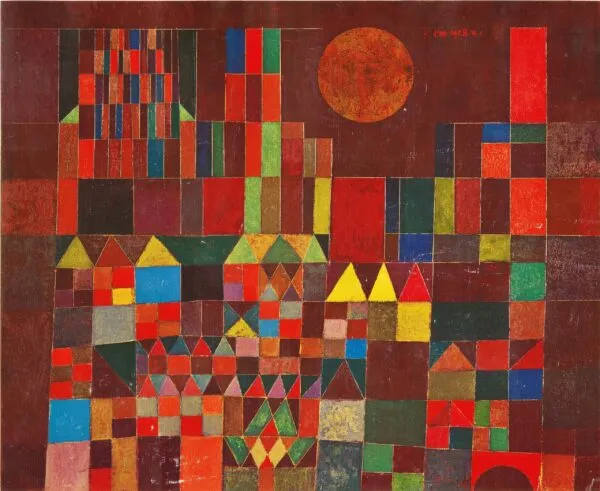
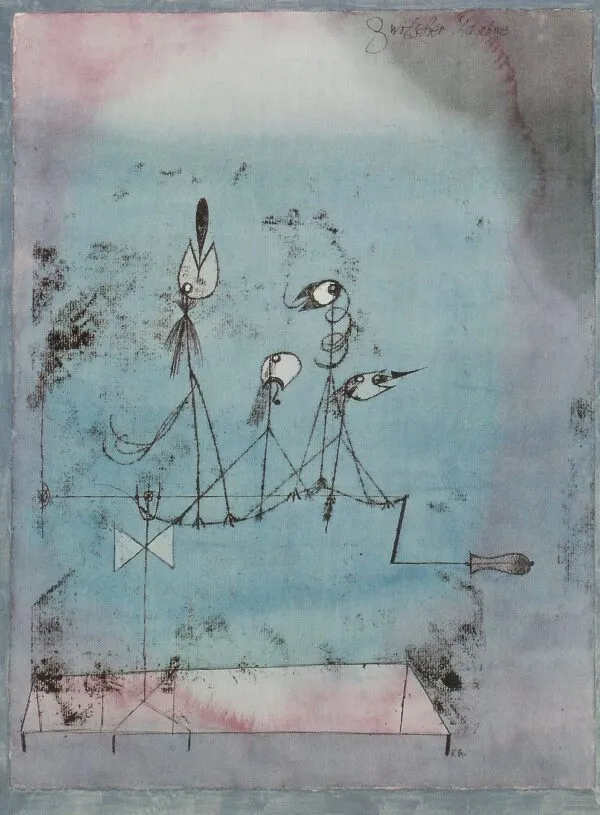
If you want strong colour, look at With the Rotating Black Sun and the Arrow from 1919, a dense patchwork of yellow, orange and red fields. Revolution of the Viaduct from 1937, is often read as a response to the threat of Nazism. Gentler and bluer is Dance of the Moth from 1923, a winged figure dancing downwards across a grid of blue squares.
The rest of our famous Paul Klee paintings are gathered on the Paul Klee page.
How do we hand-paint Rhythmical on canvas?
Klee’s original is oil on coarse hessian. Ours is an oil painting reproduction on canvas: the painter works in oil or acrylic, in the size you choose, and builds it up layer by layer.
First he lays down the rust-orange ground. Then he draws the six rows and the edges of the blocks, because the tilts and offsets must sit as they do in Paris, or the rhythm falls apart.
In those fields the brushstroke decides everything. The painter loads the paint thickly, in short strokes, so the white blocks gain raised ridges and narrow gaps stay open between the dark ones, letting the orange flash through.
Which size suits which wall?
In short: 30 x 40 or 40 x 55 cm for a hallway, a shelf or a narrow wall, 47 x 62 and 60 x 81 cm above a chest of drawers or a desk, 74 x 104 and 95 x 128 cm above a sofa or a bed, and 120 x 160 or 151 x 200 cm for a tall empty wall or a stairwell.
We paint Rhythmical in 8 upright sizes (width x height): 30 x 40, 40 x 55, 47 x 62, 60 x 81, 74 x 104, 95 x 128, 120 x 160 and 151 x 200 cm. The original measures 50.5 x 69.6 cm (width x height). The three smallest sizes are therefore smaller than it, while from 60 x 81 cm upwards we enlarge the work; at 151 x 200 cm the grid is about three times as wide as it is in Paris.
As a painting for the living room it works best at 95 x 128 or 120 x 160 cm, above the sofa or beside the dining table.
Can I order another size or a frame?
Yes. If you need other proportions, we keep the grid whole and widen or narrow only the orange border. Tell us the size you need, and we will come back with a price and a lead time.
Rhythmical leaves us rolled, stretched on a stretcher bar or framed. Our workshop in Slovenia does the stretching and framing and prepares the painting for the road. The moulding is picked in our 3D app, which exists only for choosing a frame; viewing the painting on your own wall is a separate service.
A slim black or dark wood frame suits the blocks; natural oak echoes the orange border.
When will the painting arrive, and how does it travel?
The painter starts as soon as you confirm, and Rhythmical is ready to ship within 15 to 45 working days. Before packing it we send you a photograph of the finished painting; if you want a change, we make it.
Within Slovenia and the rest of the EU, Rhythmical travels free of customs duties, and this order, like every other, falls under our returns policy.
For a musician, an architect or a friend who likes clean shapes, it is a thoughtful present. If you are unsure which size will fit, give a wall art voucher and let them choose.
Frequently asked questions
Where is the original kept?
At the Centre Pompidou in Paris, in the Musée National d’Art Moderne collection, number AM 1984-356.
What exactly is in the painting?
Six tilted rows of black, grey and white rectangles in thick brushstrokes on a rust-orange ground.
Is it a print?
No. Our painter lays every field with a brush on canvas, in oil or acrylic, so what you get is a hand-painted copy.
How big is the original?
69.6 x 50.5 cm (height x width); our sizes run from 30 x 40 to 151 x 200 cm.
Is Rhythmical available in a size not on the list?
Yes. Send us the width and height, and we will reply with an offer.
How long does it take?
From 15 to 45 working days, and before dispatch you get a photograph of the finished painting.
Will it suit a bedroom or an office?
Yes. Calm black, grey and white impose no colour, so it suits a bedroom or an office.
Why do the rows tilt?
Klee shifted and tipped the blocks, so the grid never stands still; it pulses, faster here, slower there.
- Subject: six tilted rows of black, grey and white rectangles on a rust-orange ground.
- Original: oil on hessian, 1930, 69.6 x 50.5 cm, Centre Pompidou, Paris.
- Ours: a Paul Klee reproduction hand-painted in oil or acrylic on canvas, 8 sizes from 30 x 40 to 151 x 200 cm, or made to measure.
- Worth knowing: Klee was a violinist who liked to compare painting with music; this work dates from his last Bauhaus years.