







































Description
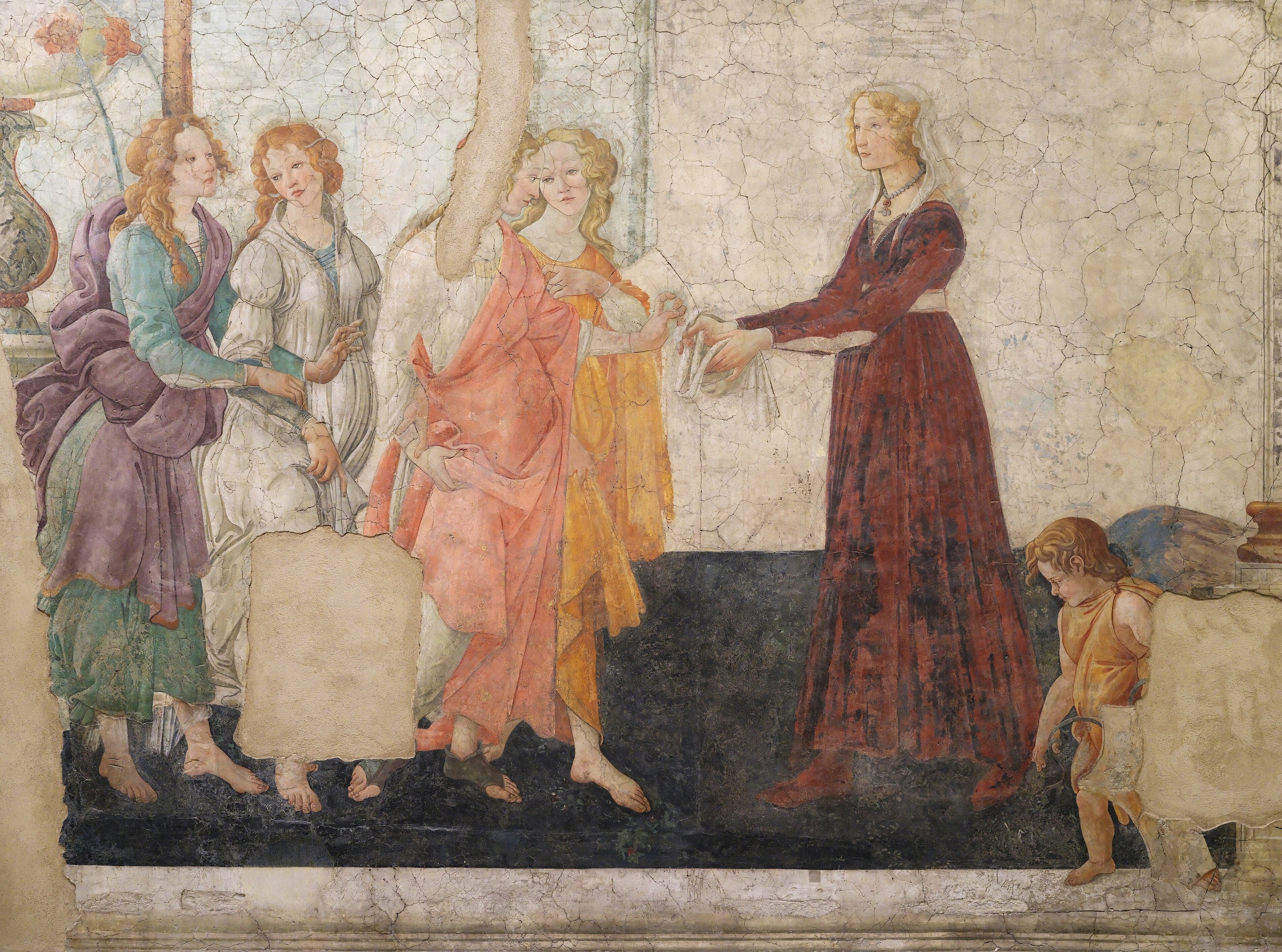
Venus and the Three Graces Presenting Gifts to a Young Woman is a fresco by Sandro Botticelli from about 1483–1485: on the left, Venus and the three Graces in long pastel robes step towards a young woman in a dark red dress, who holds out a white cloth to receive their gift. The original, 211 x 283 cm, once decorated a wall of the Villa Lemmi near Florence and is now in the Louvre in Paris. Our painter paints it for you by hand in oil on canvas, in 8 landscape sizes from 40 x 30 to 200 x 148 cm or made to measure. You receive a photograph before it is sent.
| Title: | Venus and the Three Graces Presenting Gifts to a Young Woman |
| Other titles: | Venere e le tre Grazie offrono doni a una giovane (Italian title) · Vénus et les trois Grâces offrant des présents à une jeune fille (French title) |
| Painter: | Sandro Botticelli (c. 1445–1510) |
| Year painted: | c. 1483–1485 |
| Original size: | 211 cm x 283 cm (height x width) |
| Original technique: | Fresco transferred to canvas |
| Painting style: | Early Renaissance |
| Located at: | Musée du Louvre, Paris, France (acc. no. RF 321) |
| Our reproduction: | Hand-painted in oil on canvas, 8 sizes or made to measure |
Venus and the Three Graces Presenting Gifts to a Young Woman – Sandro Botticelli
What does the fresco show?
Five women meet on a dark strip of ground in front of a pale wall. Four come in from the left in loose, flowing robes of violet and green, white, salmon pink and saffron yellow. They are Venus, the goddess of love, and her companions, the three Graces.
On the right stands the young woman. She wears the dark red gown of a Florentine lady, a thin veil and a pendant necklace, and holds a white cloth open with both hands. Venus, at the head of the group, reaches into the cloth; according to descriptions of the fresco, she is laying roses in it, flowers of beauty and love.
At the lower right Cupid, a small winged child in a yellow tunic, walks away with his head bowed. Large parts of the plaster are lost: a pale band runs down the middle, a square patch hides the Graces’ feet and fine cracks cover the wall.
Who is the young woman, and what does the scene mean?
The fresco was made for Giovanni Tornabuoni, uncle of Lorenzo de’ Medici and head of the Roman branch of the Medici Bank, who owned the villa outside Florence. It was probably commissioned for the wedding of his son Lorenzo Tornabuoni to Giovanna degli Albizzi in 1486.
That is why the young woman is often identified as Giovanna herself, receiving the gifts of the goddess of love on her marriage. This is not certain; some sources point instead to an earlier marriage between the two families, in 1483.
The usual reading: Venus and the Graces bring beauty, love and grace to the bride, and the white cloth is ready to hold them. Scholars often link it to Neoplatonic ideas of the time; that is an interpretation, not a record.
Its companion fresco shows a young man, usually taken to be the bridegroom Lorenzo, being introduced to the seven liberal arts.
Why is the fresco so admired?
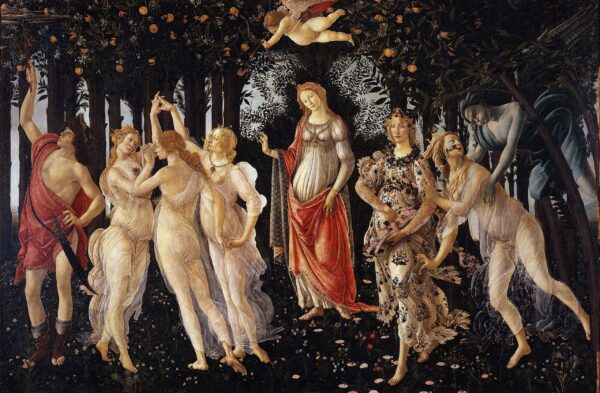
Here Botticelli sets a real Florentine bride of his own day face to face with the goddesses of his mythologies. Venus wears almost the same dress as in Primavera; together with The Birth of Venus, that panel is his best-known work.
The drawing carries the fresco. Long, supple outlines, learned from his teacher Filippo Lippi, shape the billowing robes and loose hair, while the clear, light colours of fresco fill the figures with light.
The cracks and bare patches show that this was once the living wall of a family villa. The Wikipedia article on the fresco, written in English, tells more of its story.
Where is the original, and how did it reach the Louvre?
The fresco hangs in the Musée du Louvre in Paris, inventory number RF 321.
The villa belonged to the Tornabuoni until the 16th century and later passed to the Lemmi family. In 1873 both frescoes were discovered under a coat of whitewash; Crowe and Cavalcaselle, among the first art historians to see them, attributed them to Botticelli.
They were then removed from the wall, transferred to a canvas support and offered for sale, and in 1882 the Louvre bought them.
Botticelli, born in Florence around 1445 and trained under Filippo Lippi, worked for the Medici and their circle. The 1480s, when this fresco was painted, were his most successful decade; shortly before, in 1481–82, he had worked in the Sistine Chapel in Rome. His fame faded after his death in 1510 and revived in the late 19th century, just as this fresco came to light.
This fresco or another Botticelli?
This is a canvas painting for a calm, light room: a row of graceful figures in soft pastel shades on a pale ground, with a story of love and marriage behind them. It suits a bedroom, a long hallway or a dining room.
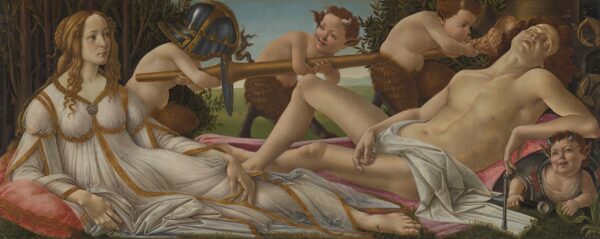
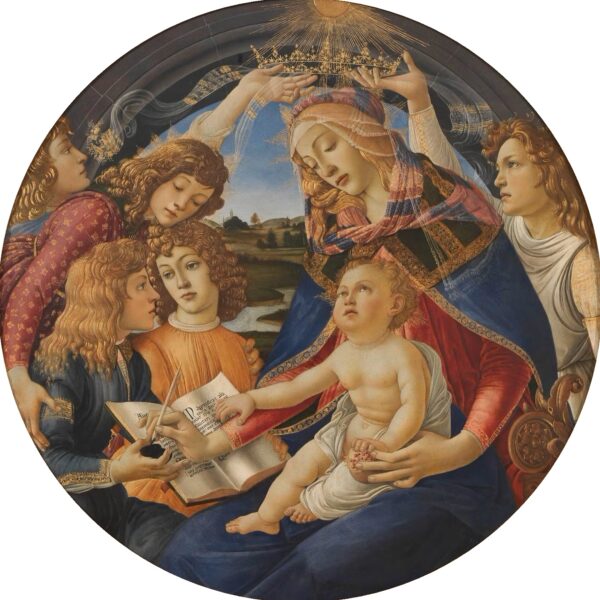
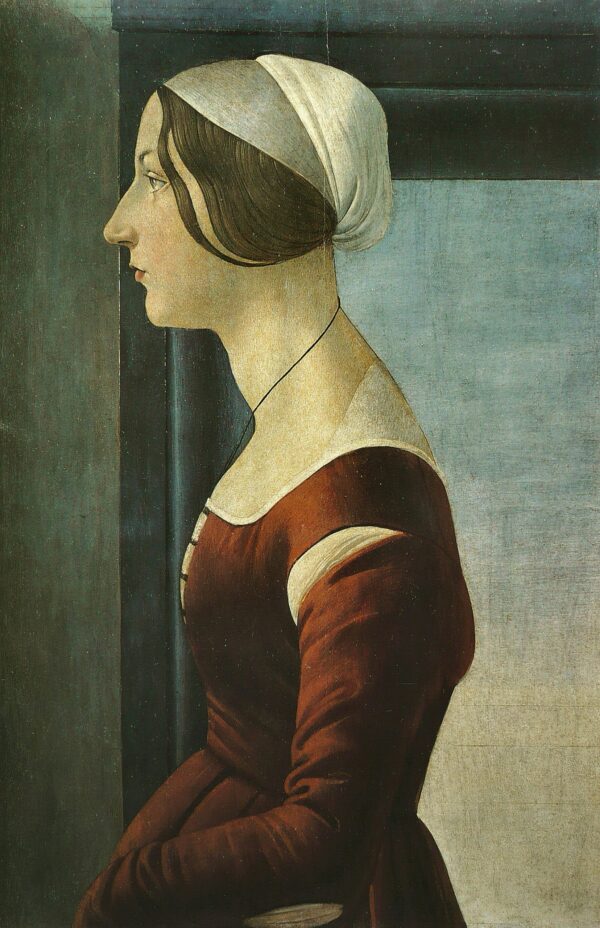
For another mythology, see Venus and Mars, where the goddess watches over the sleeping god of war. A single Florentine woman in profile fills the Portrait of a Young Woman, and for a devotional work in gold and blue there is the round Madonna of the Magnificat.
All the famous Botticelli paintings we paint to order are gathered on the Sandro Botticelli page.
How do we hand-paint a fresco in oil on canvas?
Botticelli’s original is a fresco, painted straight onto the plaster of a villa wall. Ours is not a fresco and not on plaster. It is a Sandro Botticelli reproduction painted by hand in oil on canvas, layer by layer, in the size you choose, so you can have it rolled, stretched on a stretcher bar or framed.
The painter first draws the long outlines of the five women and Cupid, then lays in the pale wall and the dark ground. The robes follow in thin, light layers of pink, saffron, violet, green and white, to keep the colours as light as in the fresco; the faces and the folds of the white cloth come last.
We paint the fresco as it looks today, cracks and missing plaster included, because they are part of its history. If you would rather have the damaged areas treated differently, tell us when you order.
Which size suits which wall?
In short: small sizes for a desk or hallway, middle ones above a chest of drawers or bed, the largest for a long wall above a sofa.
We paint the fresco in 8 landscape sizes (width x height): 40 x 30, 53 x 38, 65 x 50, 87 x 62, 98 x 70, 120 x 90, 160 x 115 and 200 x 148 cm. The original measures 283 x 211 cm (width x height), so every one of our sizes is smaller; the largest, 200 x 148 cm, reaches about 70 % of its width.
From 40 x 30 to 65 x 50 cm the scene works on a shelf, beside a desk or between two doors; 87 x 62 to 120 x 90 cm hang well above a bed, a sideboard or a smaller sofa. As a painting for the living room it comes into its own at 160 x 115 or 200 x 148 cm.
Can I order another size or a frame?
Yes. For a different proportion we keep all six figures whole and adjust only the wall and the ground. In any format it stays a complete oil painting reproduction of the scene. Tell us the size you have in mind and we will come back with a price and a delivery date.
Our workshop in Slovenia sends it rolled in a tube, stretched on a stretcher bar or framed. In our 3D app you choose the frame moulding and nothing else; seeing the painting on your own wall is a separate service.
When will the painting arrive?
Count on 15 to 45 working days between your confirmed order and dispatch. We then send you a photograph of the finished canvas and make any change you ask for before packing.
Within the EU there are no customs duties to pay, and our returns policy covers every order.
Probably painted for a wedding, the fresco makes a fitting gift for newlyweds. Unsure of the size? A wall art voucher lets them choose.
Frequently asked questions
Where can I see the original fresco?
In the Musée du Louvre in Paris, where it has inventory number RF 321.
Who is the woman in the red dress?
Often Giovanna degli Albizzi, bride of Lorenzo Tornabuoni, though this is not certain.
Is it a print on canvas?
No. Each one is a hand-painted copy, worked with brush and oil paint by our painter.
How big is the original fresco?
211 x 283 cm (height x width); our largest size, 200 x 148 cm, reaches about 70 % of its width.
Will the cracks and missing plaster appear in my painting?
Yes, we paint the fresco as it looks today. If you want it otherwise, tell us when you order.
Could I have a size not listed here?
Yes. Name the width and height and we will quote you.
How long do painting and delivery take?
Allow 15 to 45 working days until dispatch; a photograph of your painting reaches you first.
Is it a good wedding present?
Yes. It was probably painted for a wedding, and it suits a bedroom or a living room.
- Subject: Venus and the three Graces bring gifts to a young woman in red holding a white cloth.
- Original: fresco transferred to canvas, c. 1483–1485, 211 x 283 cm, Musée du Louvre, Paris.
- Ours: painted by hand in oil on canvas, in 8 sizes from 40 x 30 to 200 x 148 cm, or to your measurements.
- Worth knowing: the fresco lay hidden under whitewash until 1873 and probably celebrated a Florentine wedding of 1486.