







































Description
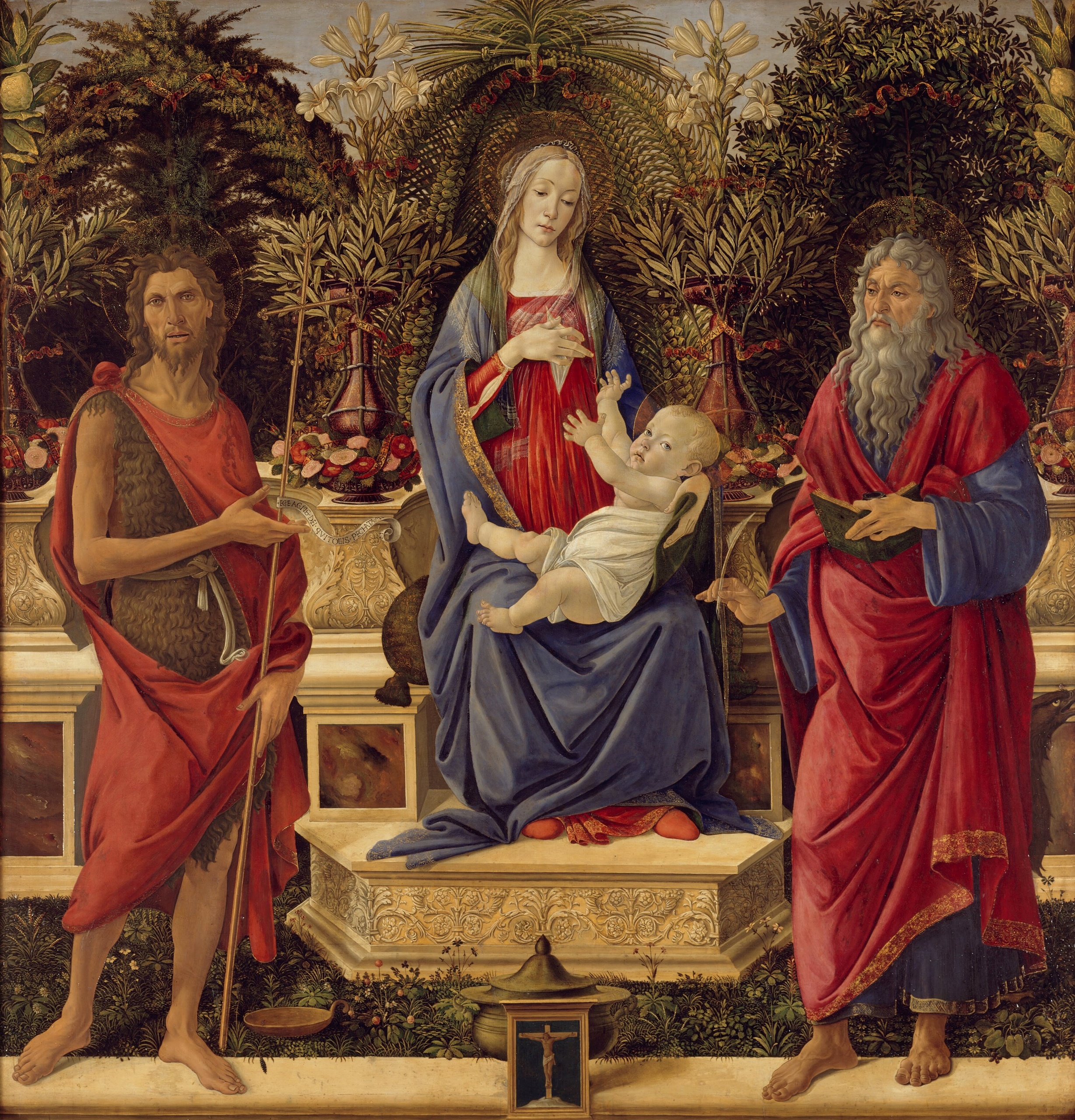
The Bardi Madonna is the altarpiece Sandro Botticelli completed around the end of 1485 for the family chapel of the Florentine banker Agnolo Bardi in Santo Spirito: Mary sits with the Christ Child on a marble throne between Saint John the Baptist and Saint John the Evangelist, in front of a walled garden of palms, olives and lilies. The original, tempera on poplar panel measuring 185 x 180 cm, belongs to the Gemäldegalerie in Berlin. Our painter hand-paints it for you in oil on canvas, in 6 nearly square sizes from 60 x 60 to 200 x 200 cm or made to measure, and we send you a photograph of the finished painting before dispatch.
| Title: | The Bardi Madonna |
| Other titles: | Madonna Bardi (Italian title) · Madonna and Child with Saint John the Baptist and Saint John the Evangelist |
| Painter: | Sandro Botticelli (c. 1445–1510) |
| Year painted: | 1484–1485 |
| Original size: | 185 cm x 180 cm (height x width) |
| Original technique: | Tempera on poplar panel |
| Painting style: | Early Renaissance |
| Located at: | Gemäldegalerie, Berlin, Germany |
| Our reproduction: | Hand-painted in oil on canvas, 6 sizes or made to measure |
The Bardi Madonna – Sandro Botticelli
What does the Bardi Madonna show?
The altarpiece is almost square and strictly symmetrical. Mary sits at the centre on a tall throne of coloured marble carved with leaves and rosettes, in a red dress and a dark blue mantle edged in gold, her eyes lowered to the child.
Jesus lies across her lap, half wrapped in white linen, reaching up with both arms. Mary opens her dress to nurse him, an old devotional theme that Botticelli paints with calm restraint, while the child turns his head and looks straight out at us.
On the left stands John the Baptist, gaunt and barefoot, in animal skin and a red cloak. He holds a slender cross-staff whose scroll names the Lamb of God and points to Jesus with his right hand; a shallow bowl lies at his feet.
On the right stands John the Evangelist, white-bearded, in red over blue, with an open book and a quill. His eagle appears behind him at the edge of the panel.
Behind the marble parapet rise three arched niches of dense foliage, tied together above Mary by a small golden cross. White lilies, yellow lemons, vases of red and pink flowers and ribbons with Latin inscriptions fill the garden, and at the bottom centre a tiny panel of the Crucifixion leans before a metal vessel.
What do the garden, the flowers and the ribbons mean?
The walled garden is read as a hortus conclusus, the enclosed garden that stands for Mary’s virginity. The white lilies signal her purity, and the white flowers in the so-called mystic vase at the foot of the throne her sinless state.
Myrtle, sacred to Venus in antiquity, is taken as a hint that Mary is a new Venus. The red flowers are said to foreshadow the Passion and the martyrdom of both Johns, and the olive and laurel to point to the mystery of the Incarnation.
The ribbons carry fifteen Latin lines from the Book of Sirach, read as praise of the Virgin: a rose in Jericho, an olive in the fields, a cedar on Lebanon, a cypress on Mount Zion. John the Baptist, on the left, is the patron saint of Florence.
Why is this altarpiece so admired?
In 1550 Giorgio Vasari praised the care that went into it, singling out the olive trees and the palms.
It belongs to the 1480s, Botticelli’s most successful decade. For the mantles of Mary and the Evangelist he used costly ultramarine, and with gold paint he picked out the light on leaves and palm fronds.
Compare it with Madonna and Child with an Angel, painted almost twenty years earlier and still close to his teacher Filippo Lippi: here Mary is tall, slender and grave. Her ascetic look is often linked to the preacher Savonarola, though that remains an interpretation.
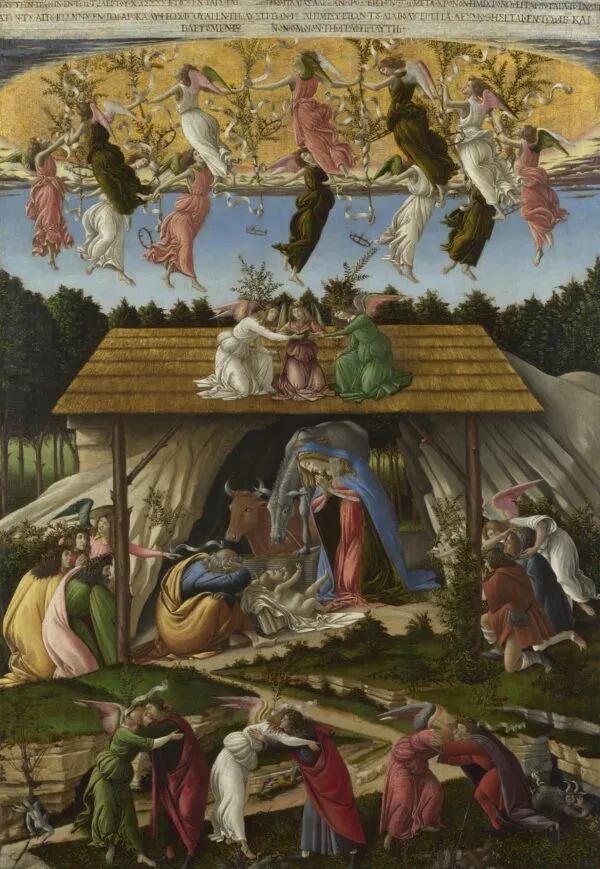
His late, almost visionary side shows in The Mystical Nativity, with angels dancing above the stable. The English-language Wikipedia article on the altarpiece explains the plant symbols.
Where is the original, and how did it reach Berlin?
The original hangs in the Gemäldegalerie in Berlin, which owns five more works by Botticelli.
It first stood on the altar of the Bardi Chapel in Santo Spirito, in a tall niche beneath a narrow window. Its frame, from the workshop of the architect and woodcarver Giuliano da Sangallo, was removed in the 17th century and is lost.
After a painting by Jacopo Vignali replaced it on the altar, the Bardi family sold the panel in 1825 to the painter and dealer Fedele Acciai, who in 1829 passed it on through Carl Friedrich von Rumohr to the Royal Museums in Berlin.
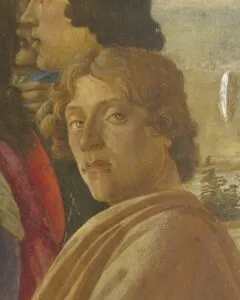
Botticelli, born Alessandro di Mariano di Vanni Filipepi, was a tanner’s son who lived his whole life near the Florentine church of Ognissanti, where he is buried. He trained under Filippo Lippi, died in 1510 and was long neglected until the Pre-Raphaelites revived his name.
The Bardi Madonna or another Botticelli Madonna?
The Bardi Madonna is a canvas painting for people who love calm and order. Its large, nearly square format needs a wide wall, a stairwell or a chapel.
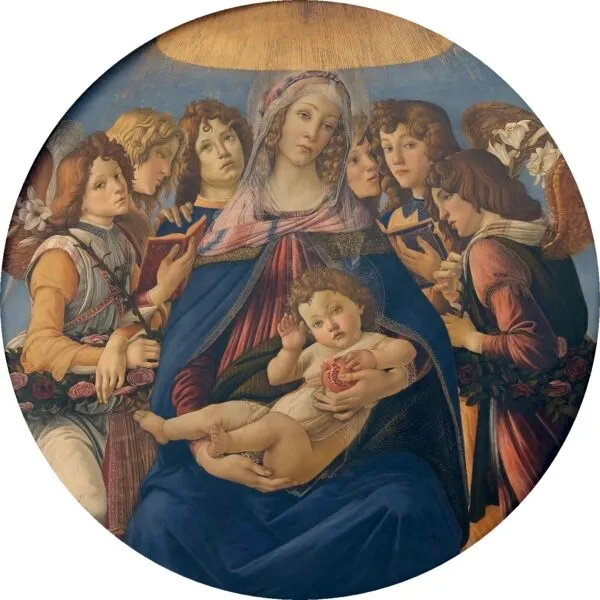
For a smaller, more intimate round Madonna, see Madonna of the Magnificat, where Mary writes in a book among angels, or Madonna of the Pomegranate, where mother and child touch the opened fruit.
The whole range is on our Sandro Botticelli page, which gathers the famous Botticelli paintings we paint to order.
How do we hand-paint the Bardi Madonna?
Botticelli’s panel is not an oil painting but tempera on glued poplar boards, 185 x 180 cm. Ours is a Sandro Botticelli reproduction in oil on canvas, built up layer upon layer, so it can travel rolled in a tube, stretched on a stretcher bar or framed.
The painter sketches the throne, the screens and the three niches, then places the figures and lays in the broad colours: the Virgin’s blue, the red cloaks, the marble. The garden takes longest: every palm frond, lily and lemon is shaped one by one before the gold glints, the ribbons and finally the faces.
Which size suits which wall?
In short: 60 x 60 or 70 x 70 cm for a smaller wall, 90 x 90 or 120 x 120 cm above a sofa, 150 x 155 and 200 x 200 cm for a large, high wall.
We paint the Bardi Madonna in 6 sizes (width x height): 60 x 60, 70 x 70, 90 x 90, 120 x 120, 150 x 155 and 200 x 200 cm. The original measures 180 x 185 cm (width x height), so all five sizes up to 150 x 155 cm are smaller than it and 200 x 200 cm is a little larger than the panel in Berlin.
As a painting for the living room it comes into its own from 120 x 120 cm, when the saints’ faces read from the sofa. The two largest sizes want a stairwell or an entrance hall; the smaller ones suit a bedroom or a study.
Can I order a custom size, and which frame should I choose?
Yes. For other proportions we keep Mary, both Johns and the throne whole and adjust only the foliage, sky or ground, so it stays a complete oil painting reproduction. Tell us the size you have in mind and we will quote a price and a date for this altarpiece.
We ship it rolled in a sturdy tube, stretched or ready framed; our workshop in Slovenia stretches, frames and packs it. You pick the moulding in our 3D frame app, while a view of the painting on your own wall is a separate service. A wide gilded frame suits the reds and golds.
When will your Bardi Madonna arrive?
Your Bardi Madonna is painted in 15 to 45 working days from the order confirmation. Once it is finished you get a photograph of it, and any change you request is made before we pack it.
It travels to Slovenia and the other EU countries with no customs duties, and our returns policy applies to every purchase.
Mary and the Child between two saints makes a fine wedding or christening gift. Unsure of the size? Give a wall art voucher and the recipient picks the painting and the size.
Frequently asked questions
Where can I see the original?
In the Gemäldegalerie in Berlin, which acquired it in 1829.
Who are the two saints beside Mary?
John the Baptist with his cross-staff on the left, John the Evangelist with book and quill on the right.
Is it a print?
No. Every leaf and fold is brushed by our painter: it is a hand-painted copy in oil.
How big is the original?
185 x 180 cm (height x width); our 200 x 200 cm size is a little larger.
Can you paint the Bardi Madonna in an unlisted size?
Yes. Send the width and height you need and we will quote the Bardi Madonna with a delivery date.
How long will I wait, and how is it shipped?
15 to 45 working days; it leaves rolled, stretched or framed.
Does it suit a bedroom or a living room?
Yes: smaller sizes a bedroom, larger ones a wide living-room wall or a stairwell.
What do the lilies beside Mary mean?
White lilies stand for Mary’s purity, the enclosed garden for her virginity.
- Subject: Mary and the Christ Child on a marble throne between John the Baptist and John the Evangelist, with a garden of palms, olives and lilies behind.
- Original: tempera on poplar panel, 1484–1485, 185 x 180 cm, Gemäldegalerie, Berlin.
- Ours: hand-painted in oil on canvas, 6 sizes from 60 x 60 to 200 x 200 cm, or made to measure.
- Worth knowing: it was painted for the Bardi family chapel in the Florentine church of Santo Spirito.