







































Description
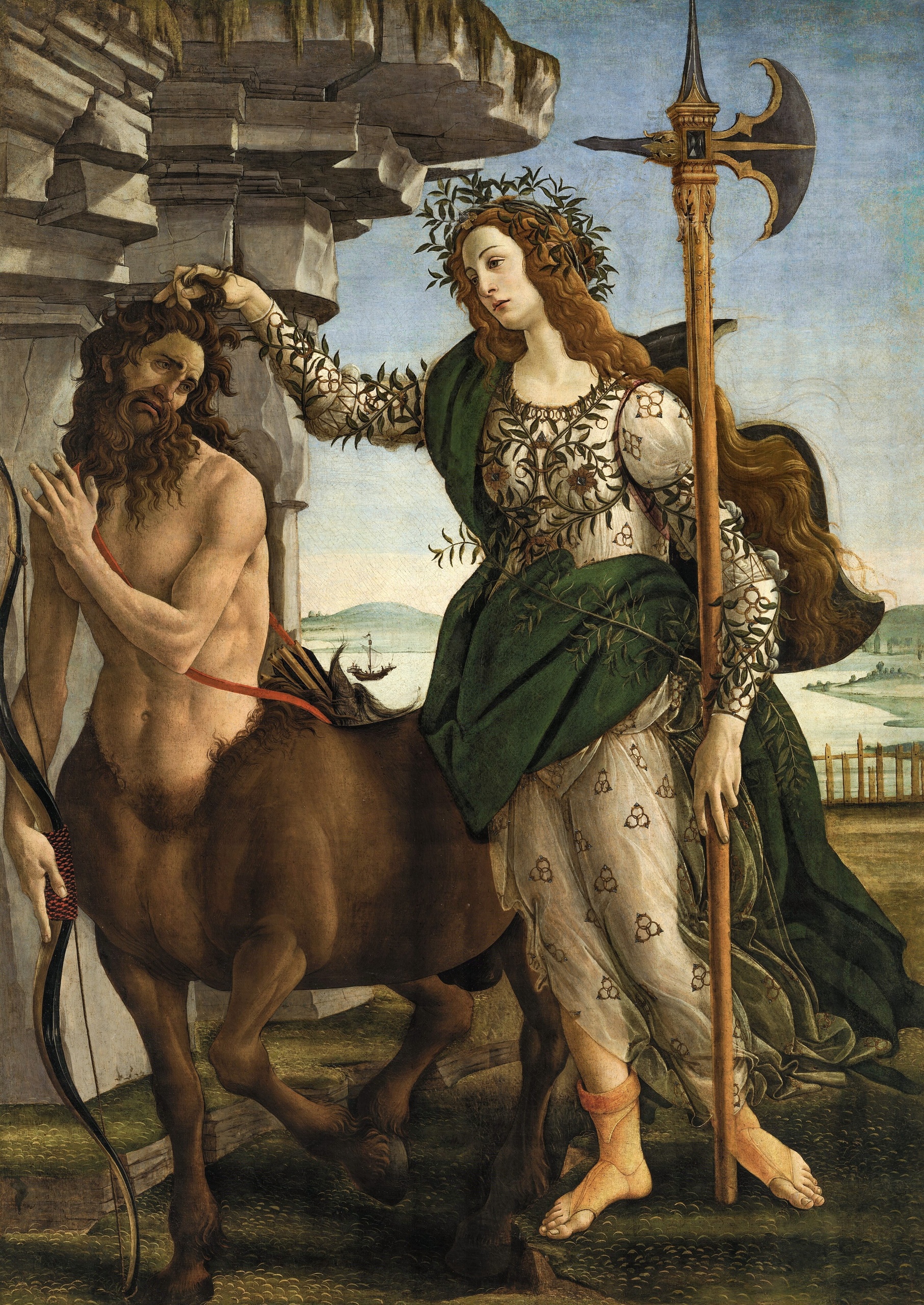
Pallas and the Centaur is a large mythological painting by Sandro Botticelli from about 1482, made soon after he came back from Rome: a tall young woman in a sheer white dress, olive branches in her hair, grips a bearded centaur with a bow by the hair, and he looks up at her, abashed. The original, tempera on canvas measuring 207 x 148 cm, is in the Uffizi Gallery in Florence. Our painter paints it to order by hand in oil on canvas, in 6 portrait sizes from 45 x 60 to 151 x 200 cm or made to measure. Before the painting sets off to you, we send you a photograph of the finished work.
| Title: | Pallas and the Centaur |
| Other titles: | Pallade e il centauro (Italian title) · Palas in kentaver (Slovene title) |
| Painter: | Sandro Botticelli (c. 1445–1510) |
| Year painted: | c. 1482 |
| Original size: | 207 cm x 148 cm (height x width) |
| Original technique: | Tempera on canvas |
| Painting style: | Early Renaissance |
| Located at: | Uffizi Gallery, Florence, Italy |
| Our reproduction: | Hand-painted in oil on canvas, 6 sizes or made to measure |
Pallas and the Centaur – Sandro Botticelli
What does Pallas and the Centaur show?
On the right stands a tall young woman in a thin white dress scattered with dark three-ring marks, a dark green cloak over her shoulder and hips. Olive branches wind round her arms, breast and hips; a wreath of leaves sits in her long reddish-gold hair.
Her left hand holds a tall, ornate halberd with a gilded shaft and a broad iron blade; her right reaches up and grips the centaur by the hair.
The centaur is a bearded man with unruly curls above and a brown horse below. One hand holds a large bow, a quiver sits on his back, and the other hand rests on his chest as he looks at her like a child caught out.
On the left rises a rock face with remains of walls; on the right lies a calm bay with a small ship, bluish hills and a low wooden fence.
What does the meeting of goddess and centaur mean?
The scene is most likely an allegory rather than one myth. Centaurs stood for uncontrolled passion and lust, so scholars read the painting, at least in part, as passion submitting to reason or chastity.
Today the woman is usually identified as Pallas Athena, whom the Romans called Minerva, goddess of wisdom. The earliest record, an inventory of 1499, calls her Camilla, a virgin warrior of Roman myth raised in the forest. An inventory of 1516 already names her Minerva.
Ronald Lightbown believes she is Camilla: the halberd is a guard’s ceremonial weapon and a fence stands behind, so a guard may be catching the centaur on forbidden ground, a favourite 15th-century theme of chastity overcoming lust.
Other readings point to Marsilio Ficino’s idea of a soul that is part animal and part human, or to the peace after the Pazzi wars.
Why is this Botticelli allegory so well known?
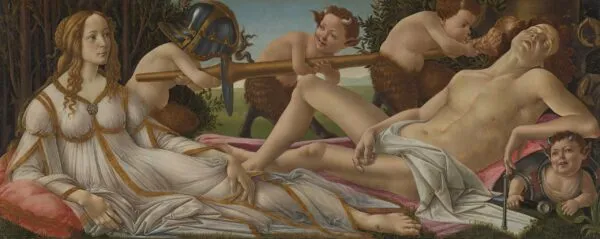
It belongs to Botticelli’s great mythologies of the 1480s, his most successful decade. It has been proposed as a companion piece to Primavera, though its shape differs, and in 1499 the two did hang in the same room.
The dress repeats the Medici emblem of three interlaced diamond rings. The branches may be olive, the tree of Pallas, or laurel; laurel often alluded to the Medici and made a pun on the name Lorenzo.
It is often linked with the 1482 wedding of Lorenzo di Pierfrancesco de’ Medici and Semiramide Appiano, perhaps as a gift from Lorenzo the Magnificent; the figures may then also stand for the couple.
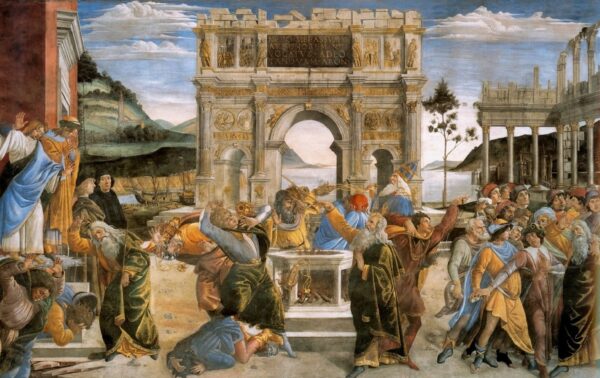
The centaur’s face is close to that of Moses in one of Botticelli’s frescos in the Sistine Chapel. The Wikipedia article on the painting, in English, sets out these readings in more detail.
Where does the original hang, and how did it get there?
The original hangs in the Uffizi Gallery in Florence, where it has been since 1922.
Given the Medici device on the dress, the family presumably commissioned it. In 1499 it was in the town palace of Lorenzo di Pierfrancesco de’ Medici and his brother Giovanni il Popolano, cousins of Lorenzo the Magnificent. Later it hung in the Palazzo Vecchio, in 1638 at the Medici villa of Castello, and by about 1830 in the Pitti Palace.
By then Botticelli was out of fashion. In 1895 the English artist William Blundell Spence, who lived in Florence, noticed the canvas in an ante-room of the Palazzo Pitti. Its many retouchings have since faded, and it has perhaps been transferred from panel to canvas.
Botticelli, born Alessandro Filipepi, spent almost his whole life in the Ognissanti district of Florence; after his death in 1510 he was long forgotten, until the Pre-Raphaelites rediscovered him.
Pallas and the Centaur or another Botticelli?
For a myth with a clear message, this is the canvas painting to choose: two figures, one decisive gesture. The tall format suits a wall between two windows or a stairwell.
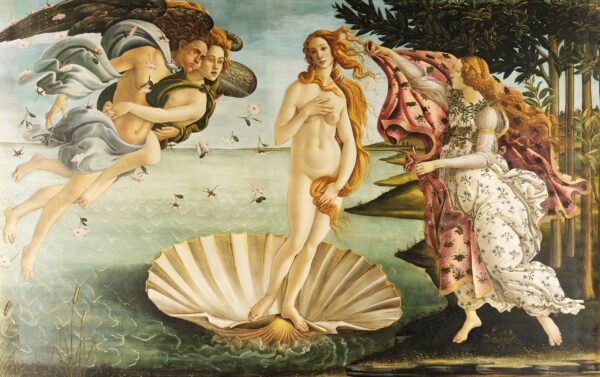
The most famous of his mythologies is The Birth of Venus, which hangs in the same museum. If the goddess’s face appeals to you, look at Idealized Portrait of a Lady (Simonetta Vespucci); for an allegory with many figures there is Calumny of Apelles.
All the famous Botticelli paintings we paint in oil to order are on our Sandro Botticelli page.
How do we hand-paint Pallas and the Centaur?
Botticelli painted this work in tempera on canvas, 207 x 148 cm; it may once have been on a wooden panel. Ours is a Sandro Botticelli reproduction in oil, not tempera: the painter works in oil on canvas, layer by layer, so we can send it rolled, stretched on a stretcher bar or framed.
He first draws the figures, halberd and rock, then lays in the sky, sea, ground and broad areas of colour.
The fine work comes last: rings, olive leaves, beard curls, the gilding of the halberd and the little ship. The result is an oil painting reproduction that keeps the calm, clear drawing of the original.
Which size is right for your wall?
In one line: up to 55 x 80 cm for a hallway or bedroom, from 73 x 101 cm for a living room, the largest for a high wall or a stairwell.
We paint Pallas and the Centaur in 6 portrait sizes (width x height): 45 x 60, 55 x 80, 73 x 101, 95 x 128, 120 x 160 and 151 x 200 cm. The original measures 148 x 207 cm (width x height), so all five sizes up to 120 x 160 cm are smaller. Our 151 x 200 cm is about as wide as the original and a little shorter.
45 x 60 cm also fits a narrow wall by a door; up to 73 x 101 cm the painting hangs well above a chest of drawers or a bed. As a painting for the living room it is at its best from 95 x 128 cm up, when the ring pattern on the dress reads from the sofa.
Can I order another size, and which frame suits it?
Of course. For other proportions we keep both figures and the halberd whole and adjust only the sky, rock or sea at the edges. Write to us with your preferred measurements; we answer with a price and a date for your Pallas.
Our workshop in Slovenia stretches, frames and carefully packs every painting we send. You choose the moulding in our 3D app; seeing Pallas on your own wall is a separate service. A slim gilded frame suits the green tones.
When will your Pallas and the Centaur arrive?
It takes 15 to 45 working days from your order confirmation. Before it is packed, a photograph of your finished painting comes to you, and any change you ask for is made first.
There are no customs charges in Slovenia or anywhere else in the EU, and returns are handled under our returns policy.
Because the painting is linked with a wedding in 1482, it makes a thoughtful wedding present. Unsure which size fits their home? A wall art voucher lets the couple choose the painting and the size themselves.
Frequently asked questions
Where can I see the original?
In the Uffizi Gallery in Florence, where it has hung since 1922.
Who is the woman with the halberd?
She is usually identified as Pallas Athena or Minerva; the earliest inventory, of 1499, calls her Camilla.
Is it a print?
No. Our painter brushes every leaf, ring and curl, so this is a hand-painted copy, not a print.
How large is the original?
207 x 148 cm (height x width); our largest size, 151 x 200 cm, is about as wide but a little shorter.
Can you paint Pallas in a size that is not listed here?
Yes. Send us the width and height for a price and a delivery time.
How long does it take, and how is it sent?
15 to 45 working days until dispatch; it travels rolled in a tube, stretched or framed.
Will it suit a bedroom or a living room?
Yes. Its quiet green, white and brown sit well with most interiors.
What does the centaur stand for?
Unbridled passion; the painting is usually read as reason or chastity winning over lust.
- Subject: Pallas, with olive branches and a halberd, holds a centaur with a bow by the hair; behind them, a bay with a small ship.
- Original: tempera on canvas, c. 1482, 207 x 148 cm, Uffizi Gallery, Florence.
- Ours: hand-painted in oil on canvas, 6 portrait sizes from 45 x 60 to 151 x 200 cm, or made to measure.
- Worth knowing: in 1499 it hung in the same room as Botticelli’s Primavera.