







































Description
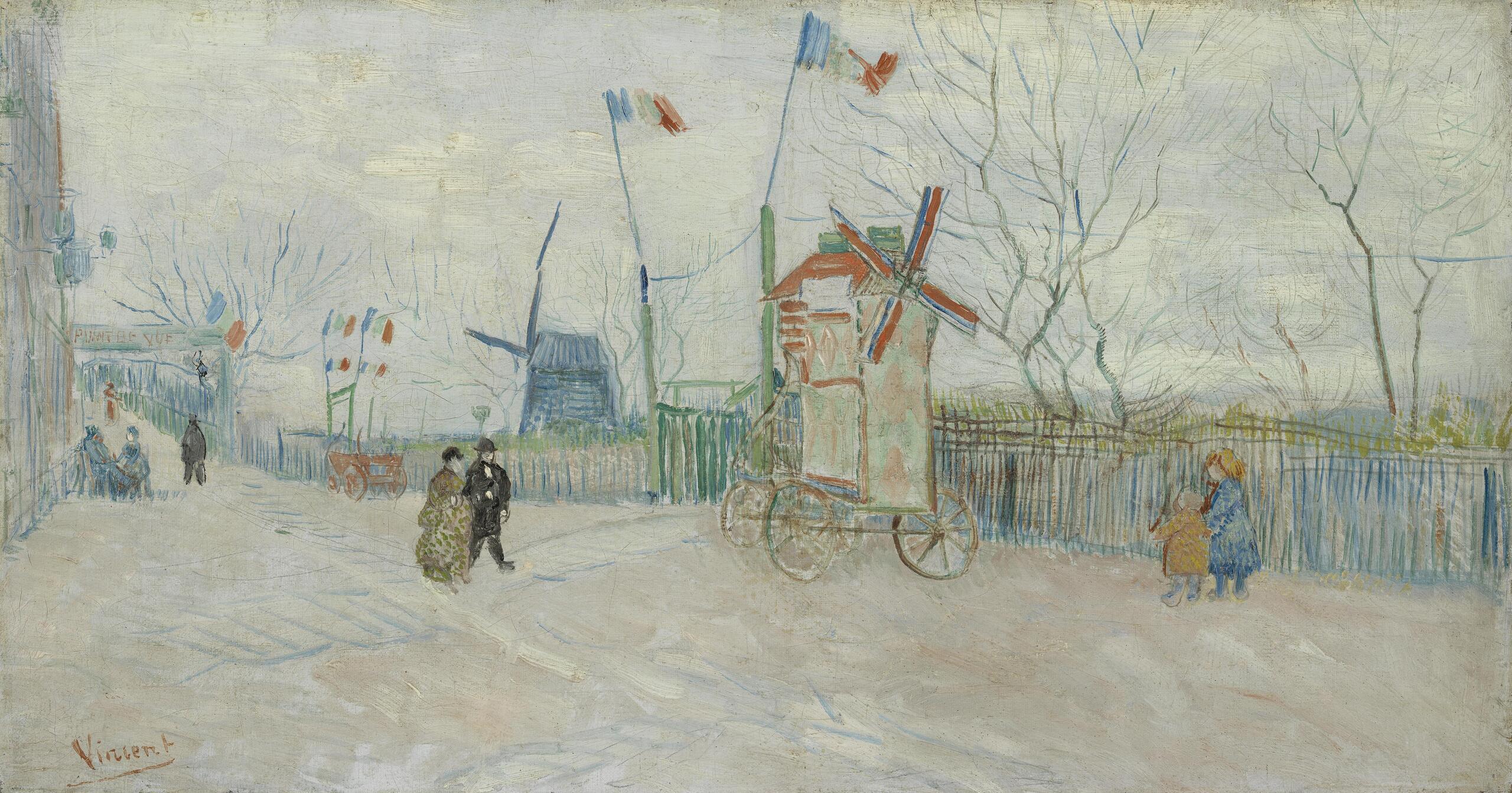
Street Scene in Montmartre is the painting Vincent van Gogh made in Paris between February and April 1887: a pale, unpaved Montmartre street with a couple walking, two children by a fence, a small mill on wheels, tricolour flags and the dark Moulin à Poivre windmill behind. The original measures 35 x 65.5 cm and is in the Van Gogh Museum in Amsterdam. We paint it by hand in oil on canvas, in 18 sizes from 50 x 30 to 150 x 80 cm or to your own measurement, and send you a photograph of the finished work for approval before dispatch.
| Title: | Street Scene in Montmartre |
| Other titles: | Impasse des Deux Frères · Le Moulin à Poivre |
| Painter: | Vincent van Gogh (1853–1890) |
| Year painted: | February–April 1887, Paris |
| Original size: | 35 cm x 65.5 cm |
| Original technique: | Oil on canvas |
| Painting style: | Post-Impressionism, Paris period |
| Located at: | Van Gogh Museum, Amsterdam (accession no. s0014V1962) |
| Our reproduction: | Hand-painted oil on canvas, 18 sizes or made to measure |
Street Scene in Montmartre – Vincent van Gogh
What does Street Scene in Montmartre show?
The canvas is almost twice as wide as it is high, and most of its lower half is the street: a pale surface of pink, cream and grey, crossed by diagonal strokes of blue. Left of the centre, a man in black with a hat and a woman in a long, spotted green and ochre coat walk side by side. Further back a man in black stands alone, and at the far left two figures sit on a bench under the wall of a house hung with lanterns.
Just right of the centre stands a small wooden mill on a cart with two large wheels, with a red roof and red, white and blue sails. Two tall poles carry French tricolour flags, and smaller flags flutter over the entrances further back, next to a red cart. Behind the fence rises the dark blue Moulin à Poivre windmill. On the right, two children, one in an ochre coat and a taller girl in blue, stand by a low picket fence of blue and grey stakes. Thin bare trees spread across a pale, overcast sky, and the signature Vincent sits in red in the lower left corner.
What is the little mill on wheels?
Probably not a working mill at all. According to the Van Gogh Museum, the mill on wheels was probably a movable billboard: a windmill in miniature with painted sails, standing on a cart.
The real windmill is the one in the background. The museum identifies it as the Moulin à Poivre, one of several mills on the hill of Montmartre. In Van Gogh’s day, the museum writes, these mills no longer worked: they served as an entertainment venue and a tourist attraction, and their entrances were decorated with flags, which explains the tricolours in the painting.
What does the painting tell us about Montmartre in 1887?
The museum calls it a scene of a street in the middle of the lively Montmartre district. The street is unpaved, and the blue stripes across it are, in the museum’s reading, its stone gutters. The Wikipedia article on Van Gogh’s Moulin de la Galette paintings describes Montmartre as a butte overlooking Paris, known for its bars, cafés and dance halls and set on the edge of the countryside.
According to the same article, the Moulin à Poivre was another windmill on the butte besides the Moulin de la Galette. Wikipedia also notes that in Paris Van Gogh met painters such as Toulouse-Lautrec, Paul Signac and Paul Gauguin, and that Impressionism led him to lighter, more colourful work. The pale street and the open sky of this canvas belong to that lighter palette.
Where is the original today?
The original is in the Van Gogh Museum in Amsterdam and belongs to the Vincent van Gogh Foundation. The museum lists it as Impasse des Deux Frères, Paris, February–April 1887, oil on canvas, 35 x 65.5 cm, under the object number s0014V1962 (F347, JH1241).
According to the museum, the canvas stayed with Theo in the apartment they shared in Paris. After Theo died on 25 January 1891, it was inherited by his widow, Jo van Gogh-Bonger, and their son, Vincent Willem van Gogh. On 10 July 1962 Vincent Willem van Gogh transferred it to the Vincent van Gogh Foundation. Wikipedia notes that Vincent and Theo shared an apartment in Montmartre from 1886 until 1888, close to the Moulin de la Galette.
Street Scene in Montmartre or another Paris painting – which to choose?
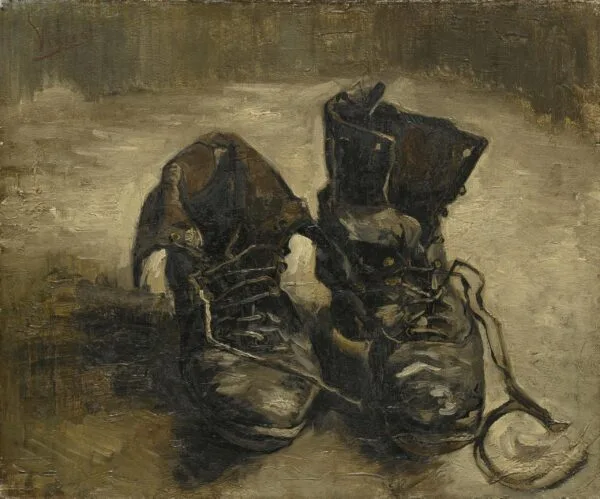
Four paintings in our range come from the same Paris years. Bridges Across the Seine at Asnières was painted in 1887 at Asnières, on the Seine just outside Paris, and shows the river with its bridges. Self-Portrait with Grey Felt Hat is from the autumn of 1887 and shows Van Gogh in a light grey hat against a blue background of short strokes. Portrait of Père Tanguy shows the Paris paint dealer Julien Tanguy in front of a wall of Japanese prints, and A Pair of Shoes is a still life of worn shoes, painted in Paris in 1886.
Choose Street Scene in Montmartre for an outdoor scene with people, flags and windmills in a pale palette and a long, low format; the bridges for a river view, one of the portraits for a face, or the shoes for a dark still life.
How is our hand-painted Street Scene in Montmartre made?
The painter first sets out the line of the fence, the street, the poles and the two mills, then places the figures, the cart and the trees. The pale street and the sky come next, in long, loose strokes, and last the blue gutters, the sails and flags, the thin branches and the small details. Our oil painting reproduction is painted by hand in oil on canvas with real impasto: the paint goes on thickly, so the brushstrokes stand up from the canvas as they do in the original and catch the light.
On this painting the relief shows most in the streaks of the street, in the sky and in the stakes of the fence. A print shows only a flat surface; on our painting the strokes are real.
Every painting is a hand-painted copy made for your order, so no two are quite the same.
Which size for which wall?
Short answer: 90 x 48 cm above a sideboard or a bed, 120 x 65 cm above a sofa, and 150 x 80 cm for a large wall. These three keep the long, low shape of the original best.
There are 18 sizes, from 50 x 30 to 150 x 80 cm (width x height), among them 65 x 35, 80 x 45, 110 x 62 and 125 x 75 cm. The original is 65.5 cm wide and 35 cm high, so our 65 x 35 cm size is practically its exact size and fits above a desk, a hall table or a narrow shelf. The smallest size, 50 x 30 cm, fits above a bedside table or on a bookshelf. With its pale pinks, greys and blues, it sits well on a white, light grey or soft blue wall. A painting for the living room should take up about two thirds of the width of the furniture below it.
Hang it with the centre of the canvas about 150 cm above the floor, leaving 20 to 30 cm between the furniture and the bottom edge.
What if I need a custom size or a frame?
If none of the 18 sizes fits your wall, we paint it to measure. Keep the proportions close to the original, otherwise the street gets squeezed or the sky stretched. Send us the width and height you want and we will quote a price and a lead time. Every painting we make is stretched over a wooden stretcher and ready to hang.
For the moulding, use our 3D application: it shows each of our frame profiles on this subject, so you can compare gold, silver, black, white and natural wood – the application is for choosing the frame only. Seeing the painting on your own wall is our separate room placement service. A white or light wood frame keeps the pale mood; a slim gold frame picks up the pink of the street.
How does delivery work, and what is the guarantee?
Every painting is made to order in our studio in Slovenia, so allow 15 to 45 days depending on the size you choose. We ship it stretched and protected, framed if you chose a frame, across the EU with no customs. Before dispatch you receive a photograph of the finished work to approve, and we correct anything that is not right. Our returns policy applies to every order.
You will find more famous Van Gogh paintings among all our Vincent van Gogh paintings, and there is more about the painter in our article on Vincent van Gogh. If you are giving it as a present and are not sure of the size, a wall art voucher lets the recipient choose.
Frequently asked questions
Where is the original of Street Scene in Montmartre today?
In the Van Gogh Museum in Amsterdam; it belongs to the Vincent van Gogh Foundation. The museum lists it as Impasse des Deux Frères, Paris, February–April 1887, oil on canvas, 35 x 65.5 cm, with the object number s0014V1962. It passed from Theo’s family to the foundation in 1962.
When and where did Van Gogh paint Street Scene in Montmartre?
In Paris, between February and April 1887, as the Van Gogh Museum dates it. The street lies on the hill of Montmartre, the district where, according to Wikipedia, he shared an apartment with his brother Theo from 1886 until 1888. According to the museum, the canvas stayed with Theo in the apartment they shared.
What is the mill on wheels in Street Scene in Montmartre?
According to the Van Gogh Museum, it was probably a movable billboard. It looks like a small windmill, with a red roof and red, white and blue sails, but it stands on a cart with two large wheels. The real windmill in the painting is the dark one in the background, which the museum identifies as the Moulin à Poivre.
Which windmill stands in the background of Street Scene in Montmartre?
The Moulin à Poivre, as the Van Gogh Museum identifies it. Wikipedia describes it as another windmill on the butte of Montmartre besides the Moulin de la Galette. The museum adds that in Van Gogh’s day the mills on the hill no longer worked but served as an entertainment venue and a tourist attraction, with flags at their entrances.
Why is Street Scene in Montmartre also called Impasse des Deux Frères?
Because that is the title the Van Gogh Museum gives it in its collection. Impasse is the French word for a dead-end street, so the title names a street rather than the windmill. Wikipedia lists the same canvas as Street Scene in Montmartre: Le Moulin a Poivre, with the catalogue number F347, so both names refer to the painting in Amsterdam.
How big is the original of Street Scene in Montmartre?
The original is 35 cm high and 65.5 cm wide, a long, low landscape format. Our 65 x 35 cm size is practically its exact size, and there are smaller and larger sizes from 50 x 30 up to 150 x 80 cm, as well as custom sizes painted to measure. Above a sofa, 120 x 65 cm keeps the original shape, and 90 x 48 cm suits a sideboard.
Does your Street Scene in Montmartre have the raised brushstrokes of the original?
Yes. We paint our copy in impasto: the paint goes on thickly, so the brushstrokes stand up from the canvas as on Van Gogh’s original. You see it best in the long strokes of the pale street, in the blue gutters, in the stakes of the fence and in the sky, where the relief catches the light and changes as you walk past the painting.
Is Street Scene in Montmartre a good gift?
It suits someone who is drawn to Paris, Montmartre and its windmills, or to Van Gogh’s lighter Paris years, and it works well above a sofa, a bed or a long sideboard. As a canvas painting in pale pinks, greys and blues with touches of red, white and blue, it brings a calm, airy street scene into a room, and a voucher lets the recipient choose the size.
- Subject: a pale, unpaved street on the hill of Montmartre, with a couple walking, two children by a picket fence, a mill on wheels, tricolour flags and the Moulin à Poivre windmill behind.
- Original: February–April 1887, Paris, 35 x 65.5 cm, Van Gogh Museum, Amsterdam.
- Ours: a Van Gogh reproduction painted by hand in oil on canvas, in 18 sizes from 50 x 30 to 150 x 80 cm or made to measure.
- Worth knowing: our 65 x 35 cm size is practically the exact size of the original in Amsterdam.