







































Description
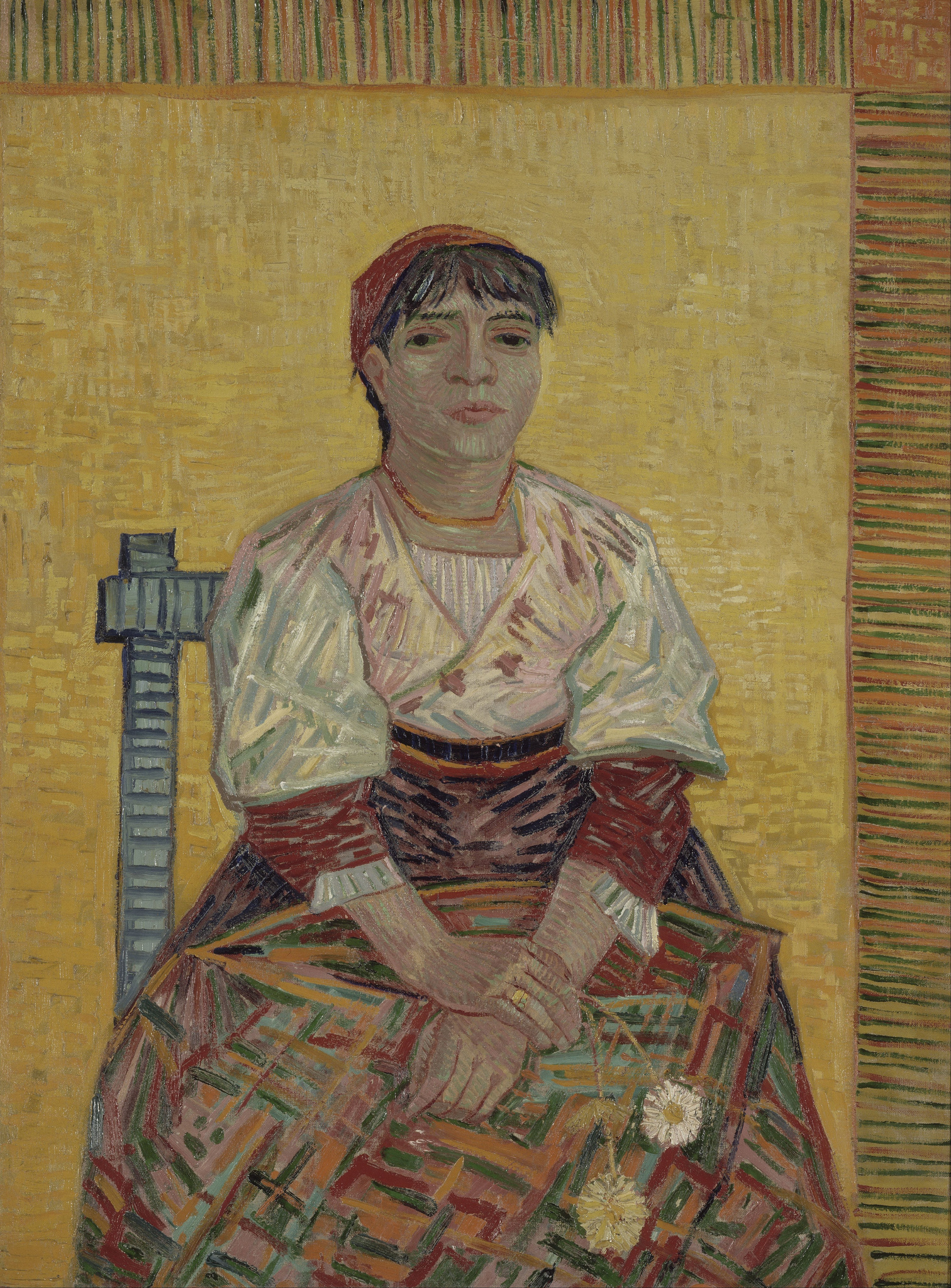
The Italian Woman is the portrait Vincent van Gogh painted in Paris in 1887: a woman in a red headscarf and a white blouse sits facing us, her hands folded in the lap of a long checked skirt, against a flat yellow ground, with a striped border of red and green strokes painted along the top and the right edge of the canvas. The original, oil on canvas, measures 81.5 x 60.5 cm and hangs in the Musée d’Orsay in Paris. We paint it by hand in oil on canvas, in 16 sizes from 40 x 50 to 100 x 130 cm or to your own measurement, and send you a photograph of the finished work for approval before dispatch.
| Title: | The Italian Woman |
| Other titles: | L’Italienne · Italian Woman |
| Painter: | Vincent van Gogh (1853–1890) |
| Year painted: | 1887, Paris |
| Original size: | 81.5 cm x 60.5 cm |
| Original technique: | Oil on canvas |
| Painting style: | Post-Impressionism, Japonisme |
| Located at: | Musée d’Orsay, Paris (accession no. RF 1965 14) |
| Our reproduction: | Hand-painted oil on canvas, 16 sizes or made to measure |
The Italian Woman – Vincent van Gogh
What does The Italian Woman show?
A woman sits on a chair and looks straight at us, shown to below the knees. She wears a red headscarf over her black hair, a loose white blouse marked with small red strokes, a dark red bodice and a long, full skirt woven from short strokes of red, green, yellow and blue. Her hands are folded in her lap, and two pale flowers on a long stem hang down beside her knee. At the left, the blue back of the chair shows behind her shoulder.
Behind her there is no room at all, only an even yellow ground laid in short, crossing strokes. Along the top and down the right side runs a band of red and green stripes, painted on the canvas itself like a frame. Without any perspective, the woman fills the space and holds it.
Who was the woman who sat for The Italian Woman?
Probably Agostina Segatori. The French Wikipedia article on the painting says that the seated woman is probably Agostina Segatori, a former model who ran the Café du Tambourin on the boulevard de Clichy in Paris, and that Van Gogh had a short love affair with her a few months before he painted this portrait.
The Musée d’Orsay connects the portrait with her as well and adds that she had posed for Corot, Gérôme and Manet. The title itself gives no name: it calls her simply the Italian woman, and the museum keeps that title, L’Italienne.
What does The Italian Woman mean?
It is a portrait in which Van Gogh tries out what he had learned in Paris. The Musée d’Orsay explains that during his Paris years, from 1886 to 1888, he studied the colour theory of the Neo-Impressionists and was drawn to Japanese prints, and that this portrait combines the two. Instead of the small dots of Seurat and Signac, he lays complementary colours side by side in overlapping hatched strokes, red against green in the skirt and the border, blue against yellow in the chair and the ground.
In the museum’s reading, several features recall Japanese prints, among them the asymmetrical border, and the flat colour points ahead to Fauvism.
Where does the original hang, and how did it get there?
The original hangs in the Musée d’Orsay in Paris, which lists it as L’Italienne, 1887, oil on canvas, 81.5 x 60.5 cm, under the inventory number RF 1965 14.
It came to the French national collections as a gift from Baroness Eva Gebhard-Gourgaud in 1965. It was kept at the Jeu de Paume, then part of the Louvre, and was assigned to the Musée d’Orsay in 1986.
The Italian Woman or another Van Gogh – which should you choose?
This portrait is Van Gogh in Paris, with flat colour and a painted border learned from Japanese prints. Two works in our range show that interest even more directly, both from 1887: Courtesan, a Japanese courtesan in a patterned kimono after a print by Keisai Eisen, and Bridge in the Rain, his copy after a print by Hiroshige. From his Paris years also comes Self-Portrait as an Artist, in which he shows himself at the easel with his palette.
If you want another portrait of a woman, L’Arlésienne shows Madame Ginoux, painted later in Arles. Choose this portrait for one strong figure on a yellow ground, the Courtesan or the bridge for Japanese pattern, and the self-portrait or L’Arlésienne to hang a second face beside it.
How is our hand-painted The Italian Woman made?
The painter first draws the figure, the chair and the border and checks the proportions against the original, so that the head, the folded hands and the wide skirt sit where Van Gogh placed them. Then come the yellow ground in short crossing strokes, the chair and the clothes stroke by stroke, the face and hands, and last the red and green stripes of the border and the two flowers. Our oil painting reproduction is painted by hand in oil on canvas with real impasto: the paint goes on thickly, so the brushstrokes stand up from the canvas as they do in the original and catch the light.
On this painting the relief shows most in the hatched strokes of the yellow ground, in the woven strokes of the skirt and in the stripes of the border. A print shows only a flat surface; on our painting the strokes are real.
Every painting is a hand-painted copy made for your order, so no two are quite the same. Before dispatch we photograph it, sending you the photograph to approve.
Which size for which wall?
Short answer: 40 x 50 or 50 x 70 cm for a narrow wall in a hallway or beside a window, 60 x 80 or 64 x 81 cm above a chest of drawers or a bed, and 75 x 100 or 90 x 120 cm above a sofa.
There are 16 sizes: 40 x 50, 50 x 66, 50 x 69, 50 x 70, 54 x 75, 59 x 75, 60 x 80, 64 x 81, 70 x 90, 74 x 94, 75 x 100, 80 x 100, 80 x 105, 84 x 105, 90 x 120 and 100 x 130 cm (width x height). The original is 60.5 cm wide and 81.5 cm high, so our 60 x 80 cm size is almost exactly the size of the painting in Paris, and 75 x 100 and 90 x 120 cm keep its proportions. The yellow ground is the brightest part, so the painting looks best on a white, light grey or warm beige wall and in warm light. A painting for the living room should cover about two thirds of the width of the furniture below it.
Hang it with the centre of the canvas about 150 cm above the floor. Above a sofa, a bed or a sideboard, leave 20 to 30 cm between the furniture and the bottom edge.
What if I need a custom size or a frame?
If none of the 16 sizes fits your wall, we paint it to measure in any width and height you need. Send us the width and height you want and we will quote a price and a lead time. Every painting we make is stretched over a wooden stretcher and ready to hang.
For the moulding, use our 3D application: it shows each of our frame profiles on this subject, so you can compare gold, silver, black, white and natural wood – the application is for choosing the frame only. Seeing the painting on your own wall is our separate room placement service. Because the painted border already frames the woman on two sides, a narrow, plain moulding suits her best; a thin gold one picks up the yellow ground, a dark wood one the deep red of the bodice.
How does delivery work, and what is the guarantee?
Every painting is made to order in our studio in Slovenia, so allow 15 to 45 days depending on the size you choose. We ship it stretched and protected, framed if you chose a frame, across the EU with no customs. Before dispatch you receive a photograph of the finished work to approve, and we correct anything that is not right. Our returns policy applies to every order.
You will find more famous Van Gogh paintings among all our Van Gogh paintings, and more about the painter in our article on Vincent van Gogh. If you are giving it as a present, to someone who loves Paris, portraits or strong colour, and are not sure of the size, a wall art voucher lets the recipient choose.
Frequently asked questions
Where is the original The Italian Woman today?
In the Musée d’Orsay in Paris, which lists it as L’Italienne, 1887, oil on canvas, 81.5 x 60.5 cm, under the inventory number RF 1965 14. Baroness Eva Gebhard-Gourgaud gave it to the French national collections in 1965; it was shown at the Jeu de Paume and moved to the Musée d’Orsay in 1986.
When and where did Van Gogh paint The Italian Woman?
In Paris, in 1887. Van Gogh lived in Paris from 1886 to 1888, and the Musée d’Orsay places the portrait in those years, when he was studying Neo-Impressionist colour and Japanese prints. According to French Wikipedia, it was painted a few months after his short affair with the woman who probably sat for it, before he left Paris for Arles in 1888.
Who is the woman in The Italian Woman?
Probably Agostina Segatori, who ran the Café du Tambourin on the boulevard de Clichy in Paris. French Wikipedia gives her name with “probably”, and the Musée d’Orsay links the portrait to her, adding that she had posed for Corot, Gérôme and Manet. According to French Wikipedia, Van Gogh had a short affair with her a few months before the painting. The title itself gives no name.
Why does The Italian Woman have a striped border?
Van Gogh painted a band of red and green stripes along the top and the right edge, so the canvas carries its own frame. The Musée d’Orsay counts this asymmetrical border among the features that recall Japanese prints, and French Wikipedia notes that its colours repeat those of the woman’s skirt. The border sits on only two sides, which makes the frame look deliberately uneven.
How did Japanese prints influence The Italian Woman?
In the flat colour and the border. According to the Musée d’Orsay, Van Gogh was drawn to Japanese prints in Paris, and this portrait mixes their influence with Neo-Impressionist colour theory. The yellow ground has no depth, the figure is not set in a room, and the uneven painted border recalls the edges of a print. The colour, laid in hatched strokes, is his own.
Why are red and green so strong in The Italian Woman?
Because they are complementary colours, and Van Gogh set them side by side to make each one stronger. The Musée d’Orsay describes how he placed complementaries in overlapping hatched strokes, and quotes his later wish to express “the terrible passions of humanity by means of red and green”. You see the pair in the headscarf, the skirt and the striped border.
How big is the original The Italian Woman?
81.5 cm high and 60.5 cm wide, a medium upright format. Our 60 x 80 cm size is almost the same, and 75 x 100 and 90 x 120 cm keep the same proportions. If you want her as a large canvas painting, there are 16 sizes up to 100 x 130 cm, as well as custom sizes in any proportions you need.
Which size of The Italian Woman suits a living room?
Above a sofa, choose 75 x 100 or 90 x 120 cm, so that the upright painting has presence without crowding the wall. On a narrower wall or above a sideboard, 60 x 80 or 64 x 81 cm is enough. Between two windows or beside a tall cupboard, the upright format of 50 x 70 or 54 x 75 cm fits well.
Does your The Italian Woman have the raised brushstrokes of the original?
Yes. We paint our portrait in impasto: the paint goes on thickly, so the brushstrokes stand up from the canvas as on Van Gogh’s original. You see it best in the short crossing strokes of the yellow ground, in the woven strokes of the checked skirt and in the stripes of the border, where the relief catches the light. A print cannot have this relief, because its surface is flat.
- Subject: a woman in a red headscarf, white blouse and long checked skirt, seated with folded hands against a flat yellow ground, with a red and green striped border along two edges.
- Original: 1887, Paris, oil on canvas, 81.5 x 60.5 cm, Musée d’Orsay, Paris.
- Ours: a Van Gogh reproduction painted by hand in oil on canvas, in 16 sizes from 40 x 50 to 100 x 130 cm or made to measure.
- Worth knowing: you receive a photograph of the finished work for approval before dispatch.