







































Description
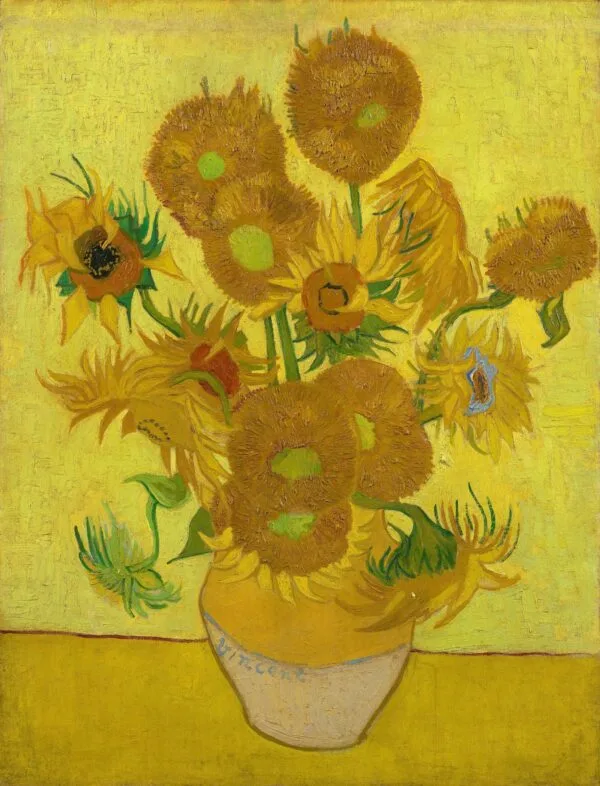
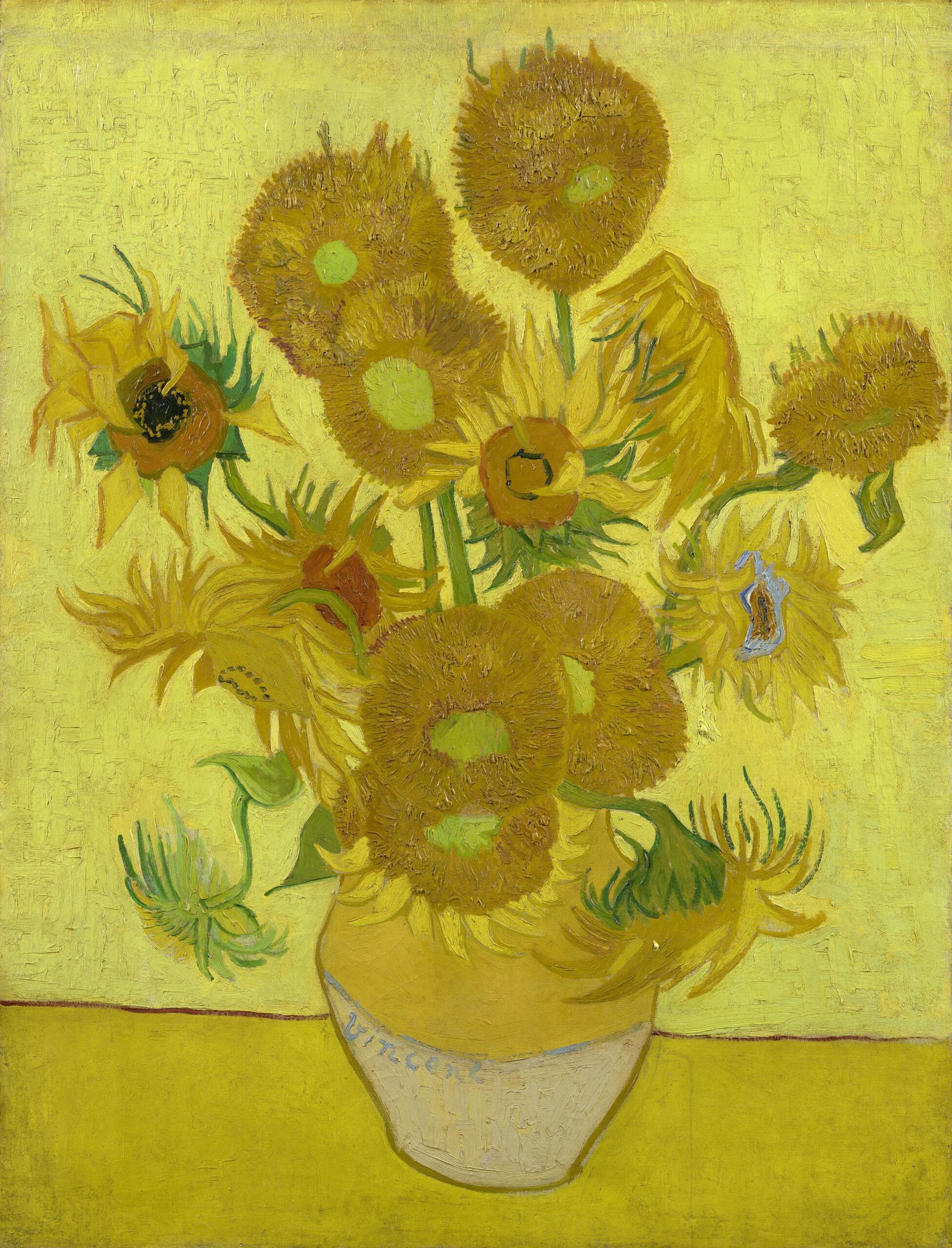
Sunflowers (Amsterdam Version) is one of the two still lifes of fifteen sunflowers that Vincent van Gogh painted in Arles in January 1889, his own repetitions of the yellow sunflower canvas he had made the previous August: a bouquet of open, wilting and seeded flower heads in an earthenware vase signed ‘Vincent’, on a yellow table against a pale yellow wall. The original, oil on canvas, measures 95 x 73 cm and is in the Van Gogh Museum in Amsterdam. We paint it by hand in oil on canvas, in 18 sizes from 25 x 32 to 160 x 200 cm or to your own measurements, and send you a photograph of the finished painting for approval before dispatch.
| Title: | Sunflowers (Amsterdam Version) |
| Other titles: | Sunflowers · Still Life: Vase with Fifteen Sunflowers |
| Painter: | Vincent van Gogh (1853–1890) |
| Year painted: | January 1889, Arles |
| Original size: | 95 cm x 73 cm |
| Original technique: | Oil on canvas |
| Painting style: | Post-Impressionism |
| Located at: | Van Gogh Museum, Amsterdam (acc. no. s0031V1962) |
| Our reproduction: | Hand-painted oil on canvas, 18 sizes or made to measure |
Sunflowers (Amsterdam Version) – Vincent van Gogh
What does Sunflowers (Amsterdam Version) show?
A round earthenware vase stands on a yellow table, and out of it rises a dense bouquet of sunflowers that spreads almost to both edges of the canvas. Some flowers are wide open, pointed yellow petals around an orange or dark brown centre, the one on the far left with a nearly black heart. Others have lost most of their petals and show only a heavy round head of short ochre and brown strokes with a small green disc in the middle, three of them at the top and two low down above the vase.
On the right a head with a pale blue centre turns towards us, and long thin petals hang over the table on both sides. The vase is ochre at the top and cream below, and along the line between the two colours Van Gogh wrote his name, Vincent, in blue. The wall is a light lemon yellow covered in short criss-cross strokes, the table a deeper, greener yellow, and a thin red-brown line separates them. Along the very top edge runs a narrow band: a strip of wood added later, which we come back to below.
Is the Amsterdam Sunflowers a copy of the London painting?
It is Van Gogh’s own repetition of it. The English Wikipedia article on the Sunflowers series lists four sunflower still lifes from Arles, August 1888; the fourth, fifteen sunflowers on yellow, is in the National Gallery in London. In January 1889 he repeated the twelve flowers once and the fifteen flowers on yellow twice. Wikipedia calls the Amsterdam canvas, F458, the repetition of the fourth version.
According to the Van Gogh Museum, Paul Gauguin later asked for one of the sunflower paintings as a gift, which Van Gogh was reluctant to give him, and he then produced two loose copies, one of which is the canvas in Amsterdam. Wikipedia adds that a strip of wood was added at the top, probably by Van Gogh himself.
What did the sunflowers mean to Van Gogh?
According to the Van Gogh Museum, the sunflowers communicated ‘gratitude’, as he wrote. He hung the first two in the room of his friend Gauguin, who came to live with him for a while in the Yellow House in Arles, and Gauguin was impressed: he thought them ‘completely Vincent’. The museum also points to the colour: three shades of yellow ‘and nothing else’, proof that many variations of a single colour need lose none of its eloquence.
In January 1889, having just finished the first repetitions of La Berceuse and of the sunflowers, Van Gogh told his brother Theo that he imagined the Berceuse between two sunflower canvases, which in his words ‘would thus form torches or candelabra beside them’.
Where is the original today?
The original is in the Van Gogh Museum in Amsterdam, which lists it as Sunflowers, Arles, January 1889, oil on canvas, 95 x 73 cm, under the object number s0031V1962. It belongs to the Vincent van Gogh Foundation.
The museum records that Van Gogh sent it from Arles to his brother Theo in Paris at the end of April 1889. After Theo’s death on 25 January 1891 it passed to his widow Jo van Gogh-Bonger and their son Vincent Willem van Gogh. On 10 July 1962 Vincent Willem transferred it to the Vincent van Gogh Foundation, and the canvas has been in the Van Gogh Museum since that museum opened on 2 June 1973.
Which Van Gogh sunflowers should you choose?
Sunflowers I is the canvas this one repeats: fifteen sunflowers on a yellow background, painted in Arles in August 1888 and now in the National Gallery in London, 92.1 x 73 cm according to Wikipedia. The Amsterdam repetition is a few centimetres taller, partly because of the added strip. Sunflowers II is the Neue Pinakothek canvas in Munich, also from August 1888, with twelve sunflowers on a blue-green background.
Almond Blossom, painted at Saint-Rémy in 1890, is a different kind of flower painting: flowering branches against a blue sky. The Yellow House shows his house in Arles, the house the sunflowers were painted to decorate. Choose this canvas for the January 1889 repetition with the strip along the top, Sunflowers I for the August 1888 original, Sunflowers II for yellow on cool blue-green, and Almond Blossom for calm blue.
How is our hand-painted Sunflowers (Amsterdam Version) made?
The painter first draws the vase, the table edge and each flower head and checks the proportions against the original. Then come the pale wall and the yellow table, the vase with its blue signature, stems and leaves, and last the fifteen flowers, petal by petal. Our oil painting reproduction is painted by hand on canvas, with real impasto: the paint goes on thickly, so the brushstrokes stand up from the canvas as they do in the original and catch the light.
On this painting the relief shows most in the seeded heads, built from short, dense dabs of ochre and brown, and in the criss-cross strokes of the wall. A print is completely flat; on our painting every brushstroke stands out in real paint.
Every painting is a hand-painted copy made for your order, so no two are quite the same.
Which size for which wall?
Short answer: 30 x 40 or 40 x 50 cm for a small wall in a kitchen, a hallway or beside a window, 60 x 80 or 74 x 94 cm above a chest of drawers or a bed, and 100 x 130 or 120 x 160 cm above a sofa or on a large wall.
There are 18 sizes: 25 x 32, 30 x 40, 40 x 50, 40 x 52, 50 x 65, 50 x 66, 60 x 80, 68 x 91, 74 x 94, 80 x 100, 90 x 113, 100 x 130, 108 x 145, 120 x 160, 129 x 170, 138 x 180, 147 x 193 and 160 x 200 cm (width x height). The original is about 73 cm wide and 95 cm high, so our 74 x 94 cm size is almost exactly its own size, while 50 x 65, 100 x 130 and 138 x 180 cm keep its upright proportions closely. A painting for the living room should cover about two thirds of the width of the furniture below it.
Hang it with the centre of the canvas about 150 cm above the floor. Above a sofa, a bed or a sideboard, leave 20 to 30 cm between the top of the furniture and the bottom of the canvas.
What if I need a custom size or a frame?
If none of the 18 sizes fits your wall, we paint it to measure in any width and height you need. If you want the exact size of the original, we paint it to measure at 73 x 95 cm. Send us the width and height you want and we will quote you a price and a delivery time. Every painting we make is mounted on a wooden stretcher, ready to hang.
Our 3D app shows each of our frame profiles on this painting, so you can compare gold, silver, black, white and natural wood. The app is for choosing the frame only. To see the painting on your own wall, use our separate room placement service. A gold frame deepens the ochre of the flower heads, while a white or light wood one keeps the pale yellow wall fresh and bright.
How does delivery work, and what is the guarantee?
Every painting is made to order in our studio in Slovenia, so allow 15 to 45 days depending on the size you choose. We ship it on its stretcher, carefully packed (and framed, if you chose a frame), across the EU with no customs duty. Before dispatch we send you a photograph of the finished painting to approve, and we correct anything that is not right. Our returns policy applies to every order.
You will find more of Van Gogh’s famous works among all our Vincent van Gogh paintings, and more about the painter in our article on Vincent van Gogh. If it is a present and you are not sure of the size, a wall art voucher lets the recipient choose.
Frequently asked questions
Where is the original Sunflowers (Amsterdam Version) today?
In the Van Gogh Museum in Amsterdam. The museum lists it as Sunflowers, Arles, January 1889, oil on canvas, 95 x 73 cm, object number s0031V1962, in the collection of the Vincent van Gogh Foundation. Van Gogh sent it to his brother Theo in Paris at the end of April 1889, and it stayed in the family until Theo’s son Vincent Willem transferred it to the foundation in 1962.
When did Van Gogh paint the Amsterdam Sunflowers?
In January 1889, in Arles, as the Van Gogh Museum dates it. In the same month he wrote to Theo that he had just finished the first repetitions of La Berceuse and of the sunflowers. Wikipedia lists three repetitions from that January: this canvas, one in Philadelphia and one in Tokyo.
Is the Amsterdam Sunflowers just a copy of the London Sunflowers?
It is Van Gogh’s own repetition, painted by his hand. Wikipedia calls it the repetition of the fourth version, the yellow canvas from August 1888 now in the National Gallery in London, and the Van Gogh Museum calls it one of two loose copies. Both show fifteen sunflowers on yellow; the Amsterdam canvas is a little taller, partly because a strip of wood was added at the top.
Why is there a strip of wood at the top of the Amsterdam Sunflowers?
Wikipedia states that a strip of wood was added at the top of the Amsterdam version, probably by Van Gogh himself, so the canvas is taller than when it was first painted. It is not known for certain who added it. The strip is one reason why this canvas measures 95 x 73 cm, while the London version it repeats measures 92.1 x 73 cm.
What did sunflowers mean to Van Gogh?
Gratitude – his own word, as quoted by the Van Gogh Museum. He hung the first two sunflower paintings in the room of Paul Gauguin in the Yellow House, and Gauguin found them ‘completely Vincent’. The museum adds that he painted them with three shades of yellow ‘and nothing else’, to show how much a single colour could say in its many variations.
How big is the original Sunflowers (Amsterdam Version)?
95 cm high and 73 cm wide, according to the Van Gogh Museum: an upright canvas a little under a metre tall. Our 74 x 94 cm size is almost the same, and 50 x 65 or 100 x 130 cm keep its proportions. There are 18 sizes from 25 x 32 to 160 x 200 cm, and custom sizes in any proportions.
Which size of the Amsterdam Sunflowers suits a living room?
Above a sofa, choose 100 x 130 or 120 x 160 cm, so that the canvas painting holds its own on a large wall and the fifteen flowers read clearly from across the room. Above a sideboard or on a narrower wall, 74 x 94 cm comes closest to the size of the original. For a very large wall, choose our largest size, 160 x 200 cm.
Does your Sunflowers (Amsterdam Version) have the raised brushstrokes of the original?
Yes. We paint it in impasto, building up each brushstroke in thick oil, so the surface is raised like Van Gogh’s original. You see this best in the round seeded heads, which are built from short, dense dabs of paint, in the curling petals and in the criss-cross strokes of the yellow wall, where the relief catches the light from the side.
- Subject: fifteen sunflowers, open, wilting and gone to seed, in an earthenware vase signed ‘Vincent’, on a yellow table against a pale yellow wall.
- Original: January 1889, Arles, oil on canvas, 95 x 73 cm, Van Gogh Museum, Amsterdam.
- Ours: a Van Gogh reproduction painted by hand in oil on canvas, in 18 sizes from 25 x 32 to 160 x 200 cm or made to measure.
- Worth knowing: our 3D app shows every frame profile on this painting, so you can choose the frame before you order.