







































Description
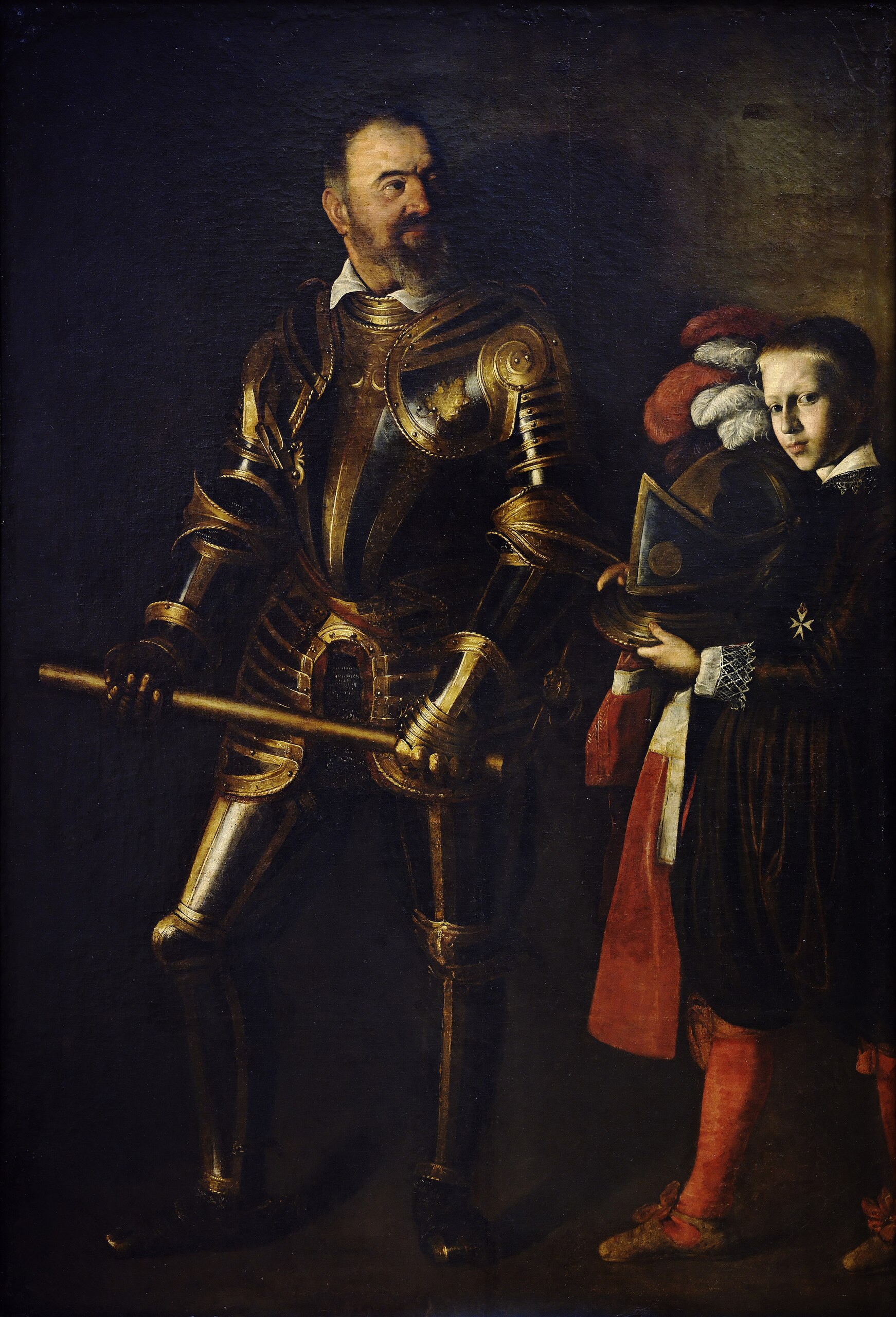
Portrait of Alof de Wignacourt and his Page is Caravaggio’s full-length portrait of the Grand Master of the Knights of Malta, made on Malta around 1607–1608. Wignacourt stands in dark damascened armour, holding his baton of command in both hands, while a young page in red and black carries his plumed helmet and looks straight out at us. The original, 194 cm high and 134 cm wide, now belongs to the Louvre in Paris. Our painter paints it for you by hand in oil on canvas in 8 upright sizes, from 40 x 56 to 136 x 193 cm, or to your own measurements; before dispatch we send you a photograph of the finished work.
| Title: | Portrait of Alof de Wignacourt and his Page |
| Other titles: | Ritratto di Alof de Wignacourt con paggio · Porträt des Alof de Wignacourt mit Pagen |
| Painter: | Michelangelo Merisi da Caravaggio (1571–1610) |
| Year painted: | c. 1607–1608 |
| Original size: | 194 cm x 134 cm (height x width) |
| Original technique: | Oil on canvas |
| Painting style: | Baroque, tenebrism |
| Located at: | Musée du Louvre, Paris, France |
| Our reproduction: | Hand-painted oil on canvas, 8 sizes or made to measure |
Portrait of Alof de Wignacourt and his Page – Caravaggio
What does the Portrait of Alof de Wignacourt show?
The canvas is upright and almost two metres tall. Against a dark, empty background the Grand Master Alof de Wignacourt stands at full length in dark armour trimmed with gold. He grips his baton of command with both hands, the sign of his authority over the Order.
His head is turned to the left and his gaze passes us by, out beyond the edge of the canvas. Wignacourt was about sixty at the time. Caravaggio shows him not as a private man but as commander and prince, his armour gleaming at every inch.
To the right, close at his side, stands a young page in red and black. He holds his master’s plumed helmet and eyes us with open curiosity. His lively face is the one warm note in an otherwise grave, metallic scene.
Who are the man in armour and the boy beside him?
Alof de Wignacourt joined the Order of the Knights of Saint John, better known as the Knights of Malta, in 1564 at the age of seventeen. The following year he made his name in the Great Siege of Malta, after which the defeated Turks never came back to the island. In 1601 he was elected Grand Master.
As Grand Master he strengthened the island’s fortifications, built an aqueduct that secured water for Valletta and turned the Order into a sovereign power. Following the fashion of princely courts, he surrounded himself with young pages drawn from the noblest Catholic families of Europe.
According to John Gash and others, the boy in the painting is probably Nicholas de Paris Boissy, a French aristocrat with a distinguished career ahead of him: in 1657 he became Grand Prior of France.
Why is this portrait so well known?
Caravaggio reached Malta from Naples in July 1607. His early biographers, Giovanni Baglione and Giovanni Bellori, say he set to work at once on portraits of Wignacourt and other knights of the highest rank. Wikipedia calls this one a famous portrait.
A double portrait with a page was an unusual combination for the time. Wignacourt may have asked for it to stress the dignity of his court, or Caravaggio may have taken his cue from a Titian he could have seen as a young man in Milan, Alfonso d’Avalos Addressing his Troops, in which a page likewise holds the commander’s helmet.
The boy’s lively expression and alert gaze are so appealing that later artists visiting Malta copied him several times. Beside the stiff, steel-clad Grand Master, the page feels like the only truly human presence on the canvas. The English Wikipedia article on the portrait has more on its background.
Where is the original today?
The original belongs to the Louvre in Paris, where it is listed under inventory number INV 57. It was painted on Malta, at the Grand Master’s court, around 1607–1608.
Our sources do not describe how the painting travelled from Malta to Paris, so we do not guess. From the same Maltese years comes the Portrait of Fra Antonio Martelli in the Palazzo Pitti in Florence: for a long time it too was thought to show Wignacourt, but the sitter is now identified as the Knight of Malta Antonio Martelli.
Wignacourt’s portrait or another Caravaggio?
This portrait is a canvas painting for anyone who loves history, the orders of knighthood and figures with real presence. Tall and narrow, it suits a high, slim wall: beside a staircase, in an entrance hall, in an office or in a library.
From the same Maltese period comes Saint Jerome Writing (Valletta), in which the old, bald saint writes at a table by candlelight while his cardinal’s hat hangs on the wall. In roughly the same years Caravaggio painted The Annunciation, where an angel in white comes down on a cloud and brings a lily to the kneeling Virgin.
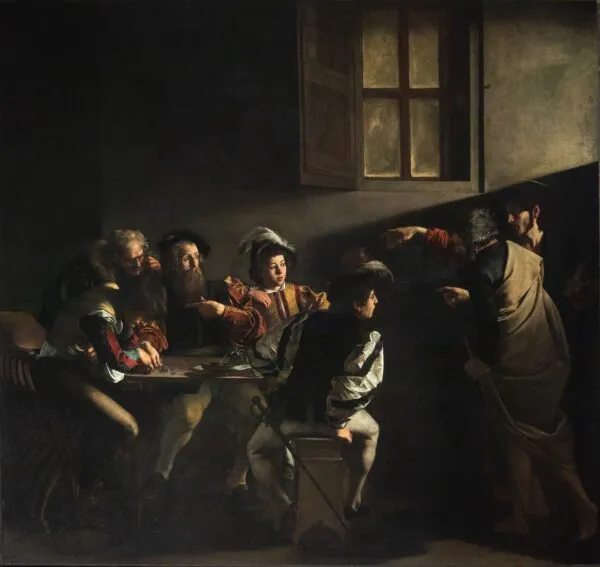
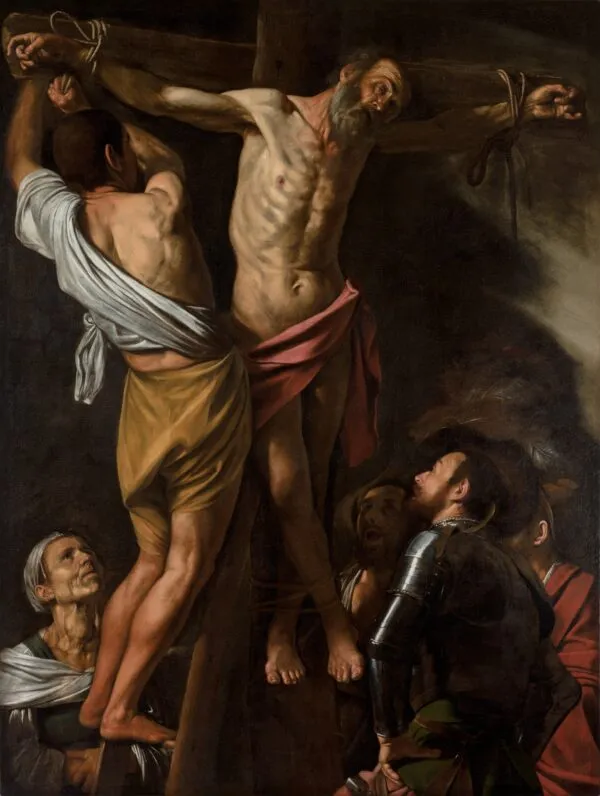
For a Gospel scene beside it, see The Calling of Saints Peter and Andrew, in which Andrew holds a fish and Peter looks towards Christ. You will find the full range of famous Caravaggio paintings we make on our Caravaggio page.
How does our painter paint this portrait?
We paint the portrait to order, in oil on canvas, layer upon layer. The painter first lays a dark ground and sketches both figures on it. He takes care that the page’s feet line up with Wignacourt’s and that his hand with the helmet overlaps the knight’s elbow, just as Caravaggio placed them.
Wikipedia explains this slightly awkward arrangement by Caravaggio’s habit of painting each live model separately: the Grand Master and the page were apparently not posing together. Our painter keeps it.
The armour takes longest. On the dark metal he builds up highlights and gilded ornament until the steel gleams, then warms the page’s red clothes and face. A Caravaggio reproduction made with the brush carries marks that a print never has, and it is these that catch the light on the armour. In lamplight this oil painting reproduction changes character, and the page’s face comes forward.
Which size is right for your wall?
In short: 40 x 56 or 45 x 65 cm for a narrow wall or above a chest of drawers, 58 x 85 or 65 x 95 cm for a hallway or office, 77 x 107 or 95 x 140 cm for a living room, and 110 x 152 or 136 x 193 cm for a tall wall by the stairs.
We paint the portrait in 8 upright sizes (width x height): 40 x 56, 45 x 65, 58 x 85, 65 x 95, 77 x 107, 95 x 140, 110 x 152 and 136 x 193 cm. The closest to the original is 136 x 193 cm, which is 2 cm wider and 1 cm shorter.
With two full-length figures, the composition needs some height to keep the faces clear. As a painting for the living room, 95 x 140 cm works well beside a bookcase or between two windows.
Can I choose another size or frame?
Of course. The portrait is tall and narrow, so we adapt it to a different ratio with care: Wignacourt’s figure and the helmet in the page’s hands must stay whole. Tell us the measurements you need and we will reply with a price and a lead time.
We send the portrait rolled, stretched on a stretcher bar or framed. Our workshop in Slovenia does the stretching and framing and gets each painting ready for its journey. You choose the frame in our 3D app, which is meant for frame choice only; a view of the painting on your own wall is a separate service.
When will the painting arrive, and how?
We start once you confirm the order and ship the painting within 15 to 45 working days. Before it leaves, you get a photograph of the finished painting, and if you wish we still make changes. Orders to Slovenia and other EU countries pay no customs, and every order is covered by our returns policy.
The portrait makes a fine gift for anyone drawn to Malta, the knightly orders or history. If the size should be their decision, a wall art voucher lets the recipient choose.
Frequently asked questions
Where is the original kept?
In the Louvre in Paris, under inventory number INV 57.
Who is the boy holding the helmet?
A page of the Grand Master; according to John Gash and others, probably Nicholas de Paris Boissy.
Is this a print or a real painting?
A real painting: every one is a hand-painted copy, done in oil paints on canvas.
What are the dimensions of the original?
It is 194 cm high and 134 cm wide; our nearest size is 136 x 193 cm.
Where and when did Caravaggio paint this portrait?
On Malta, around 1607–1608, soon after he arrived from Naples.
Is it suitable for a bedroom?
Better in a living room, hallway or office; in a bedroom it can feel formal.
Can I have it in a different size?
Yes, we also paint it to measure; just send us the width and height you want.
How long will I wait for my painting?
15 to 45 working days, with a photograph of the finished painting before it ships.
- Subject: Alof de Wignacourt, Grand Master of the Knights of Malta, in armour with his baton of command, and beside him a page holding his helmet.
- Original: c. 1607–1608, oil on canvas, 194 x 134 cm, Louvre, Paris.
- Ours: painted by hand with oil paints on canvas, in 8 upright sizes from 40 x 56 to 136 x 193 cm or made to measure.
- Worth knowing: Caravaggio probably painted the Grand Master and the page separately, which is why the page stands a little oddly.