







































Description
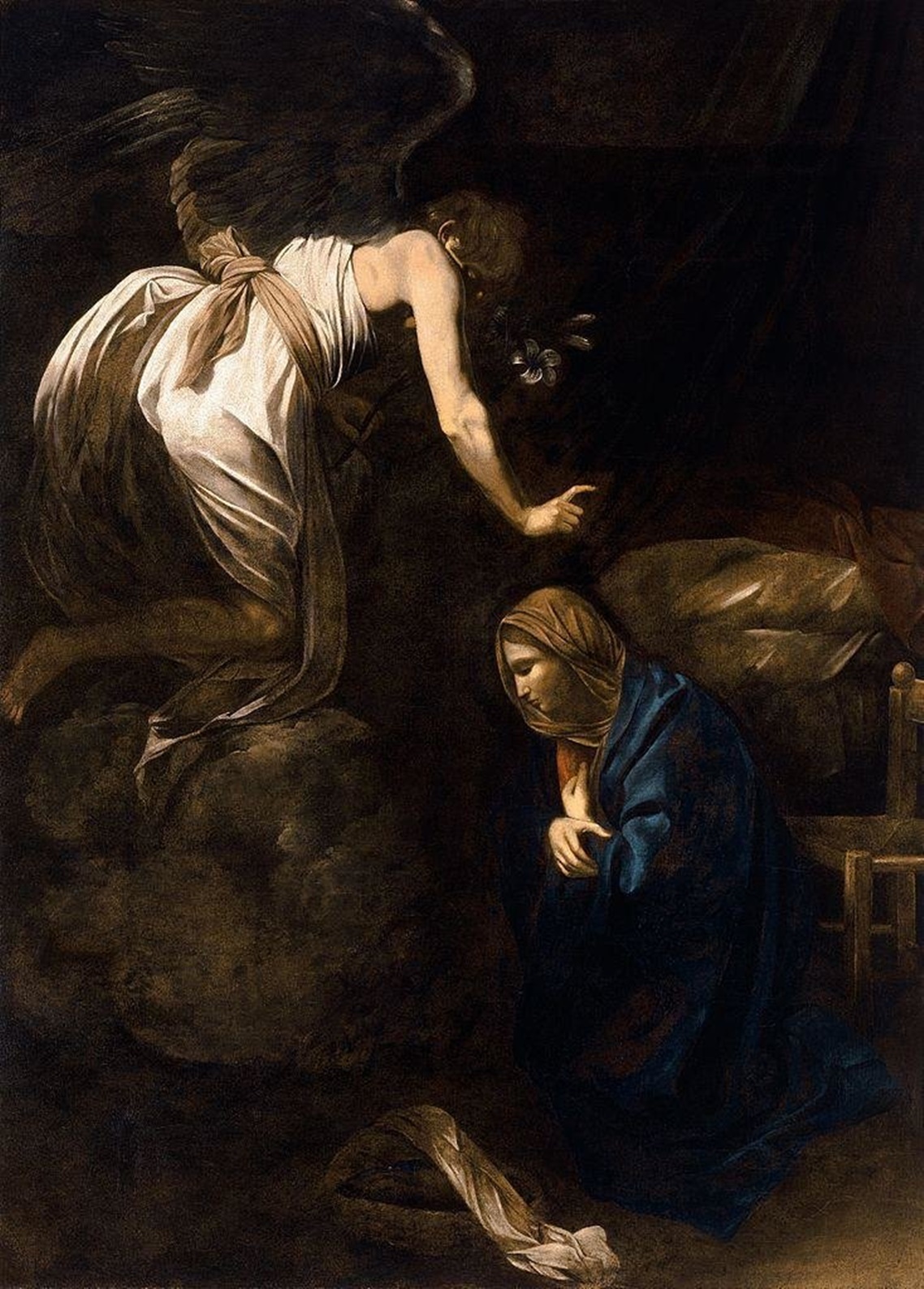
The Annunciation is an altarpiece Caravaggio finished around 1608: an angel in white comes down from above on a cloud, a lily in his hand, pointing downwards to where the Virgin Mary, dressed in blue, kneels on the right with her head bowed. The original, oil on canvas, is 285 cm high and 205 cm wide and is kept at the Musée des Beaux-Arts in Nancy, France. Our painter paints it for you by hand in oil on canvas in 8 portrait sizes, from 40 x 55 to 95 x 128 cm, or to a size you choose; before it is sent, we show you the finished painting in a photograph.
| Title: | The Annunciation |
| Other titles: | Annunciazione · Die Verkündigung |
| Painter: | Michelangelo Merisi da Caravaggio (1571–1610) |
| Year painted: | c. 1608 |
| Original size: | 285 cm x 205 cm (height x width) |
| Original technique: | Oil on canvas |
| Painting style: | Baroque, tenebrism |
| Located at: | Musée des Beaux-Arts, Nancy, France |
| Our reproduction: | Hand-painted oil on canvas, 8 sizes or made to measure |
The Annunciation – Caravaggio
What does The Annunciation show?
The canvas is upright and almost entirely dark. Light falls only on the two figures who fill the scene: the angel above and Mary below.
The angel arrives from above, as if he has only just come down from heaven. He is dressed in white, stands on a cloud, holds a lily in one hand and with the other points down towards Mary. His body leans forward and his movement is lively, almost as if he were about to step out of the canvas towards us.
Below on the right the Virgin Mary kneels in a blue garment, her head bowed, receiving the message in silence. In the dark room beside her we can pick out a basket and a chair, two plain things from an ordinary household.
What story does the scene tell?
The Gospel of Luke tells how the angel Gabriel came to Mary and announced that she would bear a son, Jesus. Christian art calls this moment the Annunciation.
The angel on Caravaggio’s canvas is Gabriel himself, the angel of the Annunciation. The lily in his hand is a symbol of the Virgin.
Mary is shown bowed low, in a humble posture, while Gabriel tells her of God’s plan for her. Caravaggio paints neither surprise nor fear but quiet acceptance: against the restless messenger he sets a calm, receptive woman.
What makes this work unusual?
First, it is unusual for Caravaggio. The angel floats on his cloud and seems to reach out past the surface of the canvas into our space; according to Wikipedia this illusionistic effect is more Baroque than is normal for him.
Then there is the contrast between the two figures. The energetic pose of the heavenly messenger and the receptive Mary give the scene a dramatic and psychological force that you feel even without knowing the story. The loose, quick brushwork is typical of his later period.
And it shows his tenebrism at its plainest: almost the whole canvas is dark, and only the two main figures are lit. You can read more in the English-language Wikipedia article on the work.
It is only fair to say that the painting has been considerably damaged and retouched. Caravaggio’s own hand is seen most clearly today in the angel, who resembles the figure in his John the Baptist at the Fountain.
Where is the original, and how did it reach Nancy?
The original is kept at the Musée des Beaux-Arts in Nancy, France, under inventory number 53.
It was painted for an altar. Henry II, Duke of Lorraine, gave it to his primatial church in Nancy, where it served as the main altarpiece.
How it came into the duke’s hands is not fully clear. Wikipedia says that one of his sons perhaps acquired it during a visit to Malta in 1608. In roughly the same years Caravaggio was working in Malta, where he also painted the Portrait of Alof de Wignacourt and his Page, a full-length portrait of the Grand Master of the Knights of Malta.
The Annunciation or another Caravaggio?
The Annunciation is a canvas painting for anyone looking for a gentler Caravaggio: no violence, no crowd, only two figures and light in the dark. The upright format suits a wall beside a staircase, a hallway or a quiet corner of a bedroom.
If a woman at the centre of the scene appeals to you, look at Saint Catherine of Alexandria, in which the richly dressed saint kneels beside the broken wheel and looks straight at us. From the same year, 1608, comes The Burial of Saint Lucy from Syracuse in Sicily, a large altarpiece with two gravediggers in the foreground.
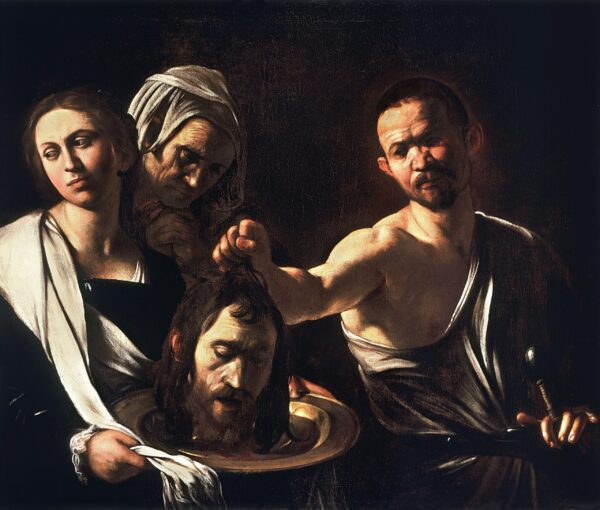
For a darker late scene there is Salome with the Head of John the Baptist from the National Gallery in London. The Caravaggio page brings together the famous Caravaggio paintings we paint to order.
How does our painter paint The Annunciation?
Every Annunciation we make is painted to order, in oil on canvas, layer by layer. The painter first covers the canvas with a dark ground, then with a few strokes he places the angel, the cloud and the kneeling Mary.
Next he builds the light. The angel’s white robe receives many tones, from cool grey in the folds to an almost pure white at the highest points, Mary’s mantle a deep blue, the lily pale blossoms.
Because the original is damaged and retouched, the painter follows the composition as it has survived and leaves the loose strokes alive rather than smoothing them away. On this Caravaggio reproduction you can feel the brushmarks under your fingertips. As an oil painting reproduction it lets the angel’s white glow more strongly under an evening lamp.
Which size suits which wall?
In short: 40 x 55 or 45 x 65 cm for a niche or narrow wall, 54 x 72 or 60 x 81 cm for a hallway or bedroom, 68 x 90 or 74 x 104 cm above a chest of drawers or a bed, and 84 x 115 or 95 x 128 cm for a tall wall by the stairs or in the living room.
We paint The Annunciation in 8 portrait sizes (width x height): 40 x 55, 45 x 65, 54 x 72, 60 x 81, 68 x 90, 74 x 104, 84 x 115 and 95 x 128 cm. The original is far larger than any of them: our biggest size, 95 x 128 cm, is 110 cm narrower and 157 cm lower.
Since the angel fills the upper part of the canvas and Mary the lower, the painting needs enough height for the eye to travel from one figure to the other. As a painting for the living room it works best at 74 x 104 cm or above, for example on the wall between two windows.
Can I have another size or a frame?
Of course. If you need a different ratio, we adapt the composition so that the angel stays at the top and Mary at the lower right, with no figure cut by the edge. Tell us the width and height you would like, and we will send you a price and a delivery time.
Your Annunciation travels rolled, stretched on a stretcher bar or framed. Stretching and framing are handled by our workshop in Slovenia, through whose hands every painting we ship passes. You choose the frame in our 3D app, which is only for choosing a frame; seeing the painting on your own wall is a separate service.
When and how will the painting arrive?
We start painting your Annunciation once you confirm the order and send it within 15 to 45 working days. Before that you receive a photograph of the finished painting, and if you would like something changed, we do it before dispatch. No customs apply within Slovenia and the EU, and our returns policy covers the order.
It makes a fine gift for someone who loves sacred art, or for a Mary on her name day. A wall art voucher lets the recipient pick the size.
Frequently asked questions
Where does the original hang?
At the Musée des Beaux-Arts in Nancy, France, under inventory number 53.
Who is the angel in the painting?
The angel Gabriel, who brings Mary the news that she will be the mother of Jesus.
Is this a print?
No. It is a hand-painted copy, worked with brushes in oil paint on canvas by our painter.
How big is the original?
It is 285 cm high and 205 cm wide, well beyond our largest size of 95 x 128 cm.
Is it suitable for a bedroom?
Yes, the quiet scene and the upright format sit well in a bedroom, a hallway or a living room.
Can I get it in a different size?
Yes, tell us the width and height you want and we will reply with a price and a lead time.
How long will I wait for the painting?
Between 15 and 45 working days, and you see a photograph of your finished Annunciation before it is packed.
What does the lily in the angel’s hand mean?
The lily is a symbol of the Virgin Mary, which is why the angel holds it as he brings her the message.
- Subject: the angel Gabriel comes down on a cloud to the Virgin Mary, who kneels in blue with her head bowed.
- Original: c. 1608, oil on canvas, 285 x 205 cm, Musée des Beaux-Arts, Nancy.
- Ours: hand-painted in oil on canvas, in 8 portrait sizes from 40 x 55 to 95 x 128 cm or made to measure.
- Worth knowing: the original is considerably damaged and retouched; Caravaggio’s hand shows most clearly in the angel.