







































Description
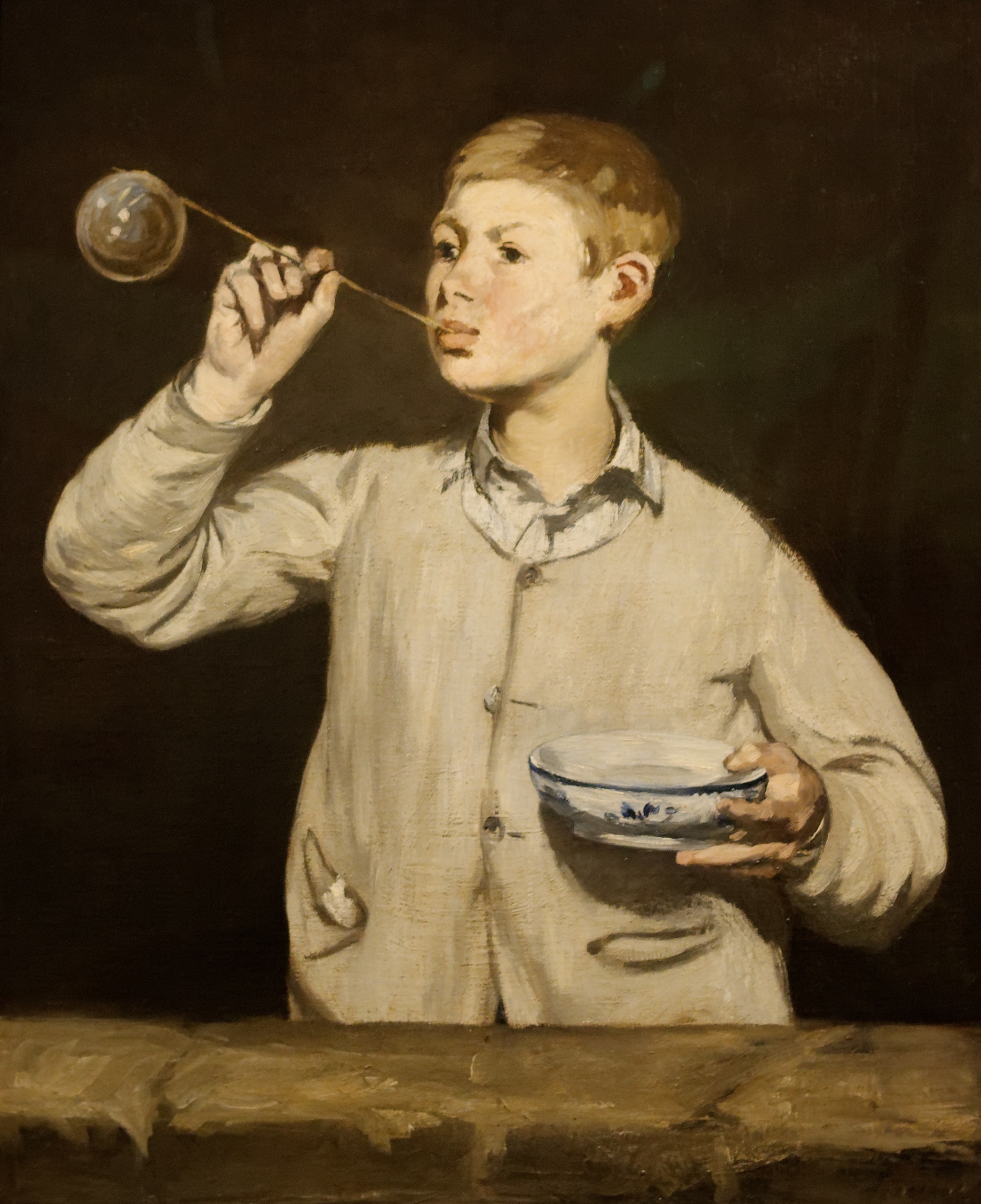
Boy Blowing Bubbles is a work by Édouard Manet from 1867: a fifteen-year-old boy in a loose, pale smock blows a large, clear soap bubble through a thin straw while his other hand holds a white bowl with a blue pattern. The original is oil on canvas, 100.5 x 81.4 cm, and belongs to the Calouste Gulbenkian Museum in Lisbon. Our painter paints it for you by hand in oil on canvas, in 8 portrait sizes from 33 x 42 to 164 x 200 cm, or made to measure. Before the boy leaves us, you get a photograph of him finished.
| Title: | Boy Blowing Bubbles |
| Other titles: | Les Bulles de savon (French title) · The Soap Bubbles |
| Painter: | Édouard Manet (1832–1883) |
| Year painted: | 1867 |
| Original size: | 100.5 cm x 81.4 cm (height x width) |
| Original technique: | Oil on canvas |
| Painting style: | Realism and Impressionism |
| Located at: | Calouste Gulbenkian Museum, Lisbon, Portugal |
| Our reproduction: | Hand-painted in oil on canvas, 8 sizes or made to measure |
Boy Blowing Bubbles – Édouard Manet
What does Boy Blowing Bubbles show?
A boy with short reddish-blond hair stands against a dark brown ground that gives nothing away about the room. He wears a loose, pale grey-beige smock with a row of buttons and two pockets, and a white shirt collar shows at his neck. His cheeks are flushed and his lips are pursed around the end of the straw.
He has raised his right hand almost to eye level and holds the thin straw between his fingers. From its far end hangs a large, clear bubble that catches the light in a few white glints. In his left hand, at hip height, he holds a white bowl decorated with a blue pattern.
Along the bottom of the canvas runs a brown stone ledge, and the boy stands just behind it. There is nothing else: face, hands, straw, bubble and bowl, with everything else sinking into shadow.
What does the soap bubble mean?
A soap bubble is an old symbol of how short life is: it forms in a moment and is gone just as fast. Manet does not spell the message out with extra objects; he leaves it in the plain gesture of a boy who blows and waits.
Manet’s teacher Thomas Couture had painted the same subject in 1859. His version, now in the Metropolitan Museum of Art in New York, tells its story through many symbolic details, among them school books and a laurel wreath. Manet dropped all of that and painted the scene naturally, with no story attached.
Closer to him is Chardin’s treatment of the theme from 1737, which hangs in the National Gallery of Art in Washington. Manet, though, dressed his own boy in the clothes of his day.
Why is this painting so admired?
Two sides of Manet meet here. The almost monochrome palette and the dark ground show his regard for the old masters he copied in the Louvre as a young painter, Velázquez and Titian among them. The contemporary clothes and the rough, thickly worked paint, on the other hand, belong to the Realist who wanted to paint the life around him.
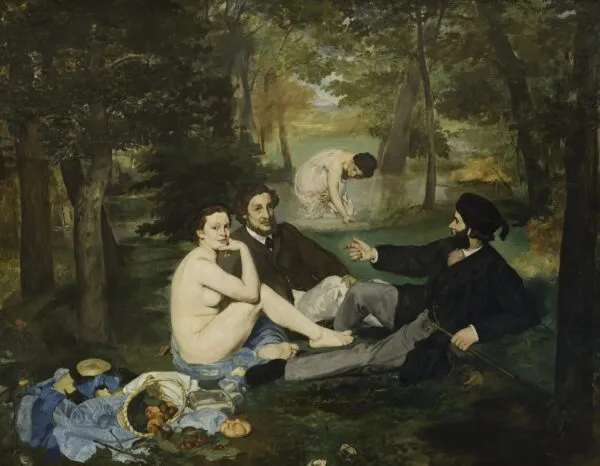
Édouard Manet (1832–1883) was born in Paris into a well-off family and is seen as a pivotal figure between Realism and Impressionism. A few years earlier his Le Déjeuner sur l’herbe and Olympia caused great scandals, and both are now regarded as the start of modern art.
For more on the sitter and on the versions by Couture and Chardin, read the Wikipedia article on the painting, which is in English.
Where is the original, and who is the boy?
The original is oil on canvas measuring 100.5 x 81.4 cm (height x width). It belongs to the Calouste Gulbenkian Museum in Lisbon, under inventory number 2361. The museum’s founder acquired it in New York in November 1943, through André Weil. The title we know it by was given by Manet himself.
The sitter is Léon Leenhoff, the son of Suzanne Leenhoff, whom Manet later married. Here he is fifteen. Across the 1860s and 1870s Manet painted him in seventeen works, which makes his face one of the most recurrent in the painter’s output.
Boy Blowing Bubbles or another Manet?
This is a canvas painting for anyone who likes calm portraits and a warm brown palette in which only the face, the hands and a tiny spark of light in the bubble glow.
If Manet’s portraits of the 1860s draw you, look too at Young Lady in 1866 and Mademoiselle V. in the Costume of an Espada. Quite different in character are Le Bon Bock and The Battle of the Kearsarge and the Alabama.
The famous Manet paintings we make to order for your walls are all on one page: Édouard Manet.
How do we hand-paint Boy Blowing Bubbles?
Manet’s original is an oil on canvas just over a metre tall. Ours is an oil painting reproduction on fresh canvas: the painter works it in oil on canvas, in the size you pick, and builds it up layer by layer.
He first lays in the dark brown ground and the stone ledge, then the pale mass of the smock, and only after that the face, the hands and the blue-patterned bowl. The bubble comes last: a fine outline, a few see-through tones and a couple of white highlights that make it round.
Manet painted the smock in coarse, heavy strokes and the face more softly. Our painter keeps that difference in the paint, so close up you see the brushwork, and from a few steps back the boy settles into a calm figure.
Which size suits your wall?
In short: 33 x 42 or 43 x 53 cm for a shelf or a narrow wall, 55 x 66 and 64 x 76 cm above a chest of drawers or a desk, 80 x 96 and 99 x 125 cm above a sofa or a bed, and 129 x 160 or 164 x 200 cm for a tall wall or a stairwell.
We paint it in 8 portrait sizes (width x height): 33 x 42, 43 x 53, 55 x 66, 64 x 76, 80 x 96, 99 x 125, 129 x 160 and 164 x 200 cm. The original measures 81.4 x 100.5 cm (width x height). The first four sizes are therefore well below it, 80 x 96 cm is almost the same and just slightly smaller, and 99 x 125, 129 x 160 and 164 x 200 cm are larger than the original.
As a painting for the living room it looks best at 80 x 96 or 99 x 125 cm above the sofa, where the face and the bubble read clearly from the doorway.
Can I order a custom size, and which frame works?
Yes. If your wall needs other proportions, we keep the boy, the straw and the bubble whole and adjust only the dark ground and the ledge at the edges. Give us the size you need for the boy and his bubble, and we will quote a price and a date.
The boy leaves us rolled, stretched on a stretcher bar or framed, and our workshop in Slovenia does the stretching and framing. His moulding is picked in our 3D app, which exists only for choosing the frame; seeing the painting on your own wall is a separate service. Dark wood carries on the brown ground.
How long do painting and delivery take?
The painter starts on the boy as soon as you confirm the order, and the painting is ready to ship within 15 to 45 working days. Before packing we send you a photograph of the finished painting and make any corrections you ask for.
Within Slovenia and to the rest of the EU it travels without customs duties, and every order falls under our returns policy.
The boy with his bubble makes a lovely gift for a young family, a child’s room or anyone fond of quiet portraits. Unsure which wall he will hang on? Then a wall art voucher puts the size in the recipient’s hands.
Frequently asked questions
Where can I see the original?
At the Calouste Gulbenkian Museum in Lisbon, under inventory number 2361.
Who is the boy with the straw?
Léon Leenhoff, son of Suzanne Leenhoff, who later became Manet’s wife; he is fifteen here.
Is this a print?
No. It is a hand-painted copy, which our painter works with brushes in oil on canvas.
How large is the original?
It measures 100.5 x 81.4 cm (height x width); our sizes from 99 x 125 cm (width x height) upwards are larger.
Can I order the boy in a size not listed?
Of course. Tell us the width and height you want, and we will prepare an offer with a price and a deadline.
How soon will my painting arrive?
Painting takes 15 to 45 working days, and before it ships you also get a photograph of it.
Does it suit a child’s room or a bedroom?
Yes, the calm scene of the boy and his bubble sits well in a child’s room, a bedroom or above a desk.
Why is the boy blowing a bubble?
Because a soap bubble is a traditional symbol of transience: life is as short as a bubble that bursts.
- Subject: a boy in a pale smock blows a large soap bubble through a straw, holding a blue-patterned bowl in his left hand.
- Original: oil on canvas, 1867, 100.5 x 81.4 cm, Calouste Gulbenkian Museum, Lisbon.
- Ours: an Édouard Manet reproduction painted by hand in oil on canvas, 8 portrait sizes from 33 x 42 to 164 x 200 cm, or made to measure.
- Worth knowing: Manet gave the work its title himself; the sitter is fifteen-year-old Léon Leenhoff.