







































Description
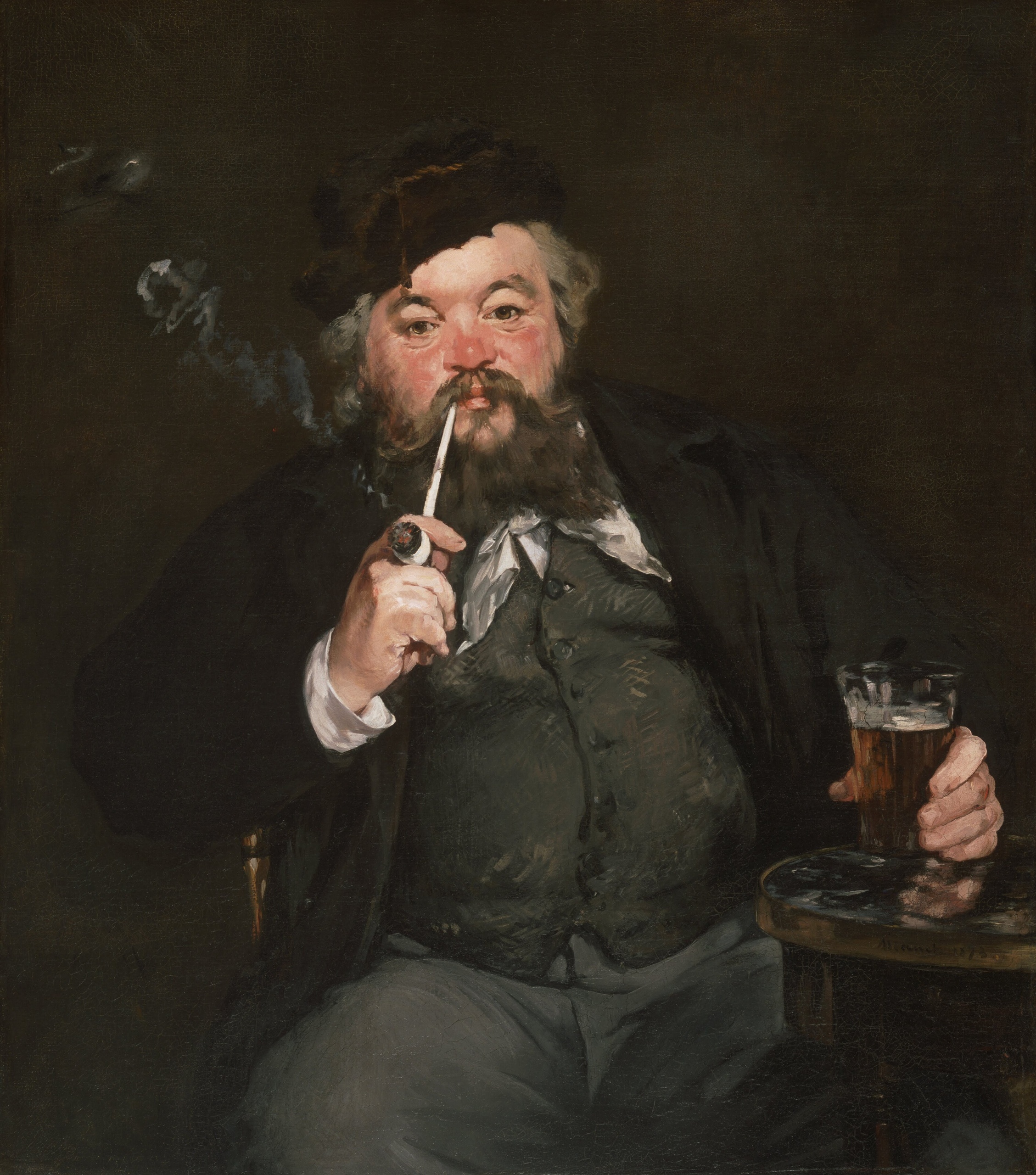
Le Bon Bock is a painting by Édouard Manet from 1873: a stout, red-faced man with a full grey-brown beard and a fur cap sits by a small round table, holding a white clay pipe to his lips with his right hand and a glass of amber beer in his left. The original is oil on canvas, 94.7 x 83.4 cm, and belongs to the Philadelphia Museum of Art. Our painter paints it for you by hand in oil on canvas, in 8 portrait sizes from 38 x 45 to 172 x 200 cm, or made to measure. Before it is shipped, we send you a photograph of the finished painting.
| Title: | Le Bon Bock |
| Other titles: | A Good Glass of Beer |
| Painter: | Édouard Manet (1832–1883) |
| Year painted: | 1873 |
| Original size: | 94.7 cm x 83.4 cm (height x width) |
| Original technique: | Oil on canvas |
| Painting style: | Realism and Impressionism |
| Located at: | Philadelphia Museum of Art, Philadelphia, United States |
| Our reproduction: | Hand-painted in oil on canvas, 8 sizes or made to measure |
Le Bon Bock – Édouard Manet
What does Le Bon Bock show?
Against a dark brown ground sits a heavy-set man who looks us straight in the eye. His cheeks and nose are flushed, his beard is thick and grey-brown, and grey curls escape from under his fur cap. He wears a dark jacket over a grey-green buttoned waistcoat, with a white neckerchief loosely knotted at his throat.
His right hand holds the long white clay pipe to his mouth, and a thread of grey smoke curls up at the top left of the canvas. His left hand closes round a tall glass of amber beer with a white head, standing on a small round table. On the edge of that table Manet signed his name in dark paint and added the year 1873.
The scene needs nothing more: one man, one pipe, one glass. That keeps the eye on his face, which shows a calm contentment.
What does the title Le Bon Bock mean?
In French, bon bock means a good glass of beer, so the title names what stands on the table rather than the man who is drinking it.
The sitter was Émile Bellot, a printer and engraver and a regular at the Café Guerbois in Paris. It has never been established that the scene is set there; the canvas shows only the dark background and the table.
The handling is close to Frans Hals, whose work Manet had admired in the Netherlands in the summer of 1872. The waistcoat and jacket are laid in with broad, visible strokes, the face with denser paint.
Why is Le Bon Bock so well loved?
The Paris Salon accepted the painting in 1873, and the critics praised it with enthusiasm. Manet always preferred the Salon to showing with the Impressionists, and two earlier works of his, Le Déjeuner sur l’herbe and Olympia, had caused great controversy.
Édouard Manet (1832–1883) was born in Paris and was one of the first nineteenth-century artists to paint modern life. He is seen as a pivotal figure between Realism and Impressionism, and he counted Monet, Degas and Renoir among his friends.
This work has no Wikipedia article of its own, but the cheerful pipe smoker is mentioned in the Wikipedia article on the painter Édouard Manet, which is in English.
Where is the original today?
The original, oil on canvas measuring 94.7 x 83.4 cm (height x width), belongs to the Philadelphia Museum of Art in the United States, under accession number 1963-116-9.
The baritone Jean-Baptiste Faure bought it directly from the artist. In 1963 it came to the museum in Philadelphia as a bequest.
Le Bon Bock or another Manet?
Le Bon Bock suits anyone who likes warm, dark tones, good company and a face that returns your gaze; as a canvas painting it brings a convivial mood to a room.
Another model in costume appears in Mademoiselle V. in the Costume of an Espada, a young woman dressed as a bullfighter. Parisian life outdoors fills Chez le Père Lathuille, a couple at a table in a garden restaurant, and The Races at Longchamp, where the horses gallop straight at the viewer. If you love the sea, see The Battle of the Kearsarge and the Alabama.
Every one of the famous Manet paintings we paint to order is listed on our Édouard Manet page.
How do we hand-paint Le Bon Bock?
Manet’s original is an oil on canvas 94.7 cm high. Yours is made as an oil painting reproduction: our painter works it with brushes in oil on canvas, in the size you choose, one layer after another.
He first sets down the outline of the body, the cap and the table, and covers the dark brown ground that surrounds the man on every side. Then come the flushed face and the hands, the grey-green waistcoat and the heavy dark jacket; last of all the white of the pipe and neckerchief, the head on the beer and the thin wisp of smoke.
As in Manet’s canvas, the waistcoat and jacket stay broad and loose and the face denser, so that on your wall too the face remains the centre of the painting.
Which size fits which wall?
In short: 38 x 45 or 51 x 60 cm for a hallway, a shelf or a work corner, 59 x 65 and 72 x 85 cm for a kitchen, dining room or home bar, 97 x 106 and 109 x 120 cm above a sofa, and 135 x 160 or 172 x 200 cm for a tall wall or a pub.
We paint it in 8 portrait sizes (width x height): 38 x 45, 51 x 60, 59 x 65, 72 x 85, 97 x 106, 109 x 120, 135 x 160 and 172 x 200 cm. The original measures 83.4 x 94.7 cm (width x height), so the four sizes up to 72 x 85 cm are smaller than it, 97 x 106 cm is already slightly larger, and 109 x 120, 135 x 160 and 172 x 200 cm are considerably larger.
As a painting for the living room it works best at 97 x 106 or 109 x 120 cm above the sofa, where the face, the pipe and the glass read clearly from across the room.
Can I order a different size or a frame?
Yes. For other proportions we keep the man, the pipe and the glass whole and adjust only the dark background. Send us the size you need for the pipe smoker, and we will quote a price and a delivery date.
We ship it rolled, stretched on a stretcher bar or framed, and our workshop in Slovenia takes care of the stretching and the framing. You choose the moulding in our 3D app, which is used only to pick the frame; seeing the painting on your own wall is a separate service.
Dark wood picks up the brown background, while warm gold brings out the beer and the ruddy cheeks.
When will my painting arrive?
The painter begins with the face, the pipe and the glass as soon as you confirm the order, and your Le Bon Bock is ready to ship within 15 to 45 working days. Before we pack it, you receive a photograph of the finished canvas, and we make any changes you ask for.
There are no customs duties within Slovenia or anywhere else in the EU, and every order falls under our returns policy.
A man with a pipe and a beer makes a fine present for a beer lover, a brewer or the opening of a pub. If you are not sure where the beer drinker will hang, give a wall art voucher so that the recipient can choose the size.
Frequently asked questions
In which museum is the original?
In the Philadelphia Museum of Art in the United States, accession number 1963-116-9.
Who is the man with the pipe?
Émile Bellot, a printer and engraver who was a regular at the Café Guerbois in Paris.
Is this a print?
No. It is a hand-painted copy, brushed by our painter in oil on canvas.
How big is the original?
It is 94.7 cm high and 83.4 cm wide; our sizes from 97 x 106 cm upwards are larger.
Can I order a size that is not listed?
Of course. Tell us the width and height you have in mind for the pipe smoker, and we will send a price and a delivery time.
How long does it take?
From 15 to 45 working days until dispatch, and before that you see the finished painting in a photograph.
Does it suit a dining room or make a good gift?
Yes. The warm scene with the beer glass fits a dining room, kitchen or home bar, and as a present it pleases any beer lover.
What does bon bock mean?
In French it means a good glass of beer, which is exactly what the man holds in his left hand.
- Subject: a stout man in a fur cap with a white clay pipe and a glass of beer against a dark background.
- Original: oil on canvas, 1873, 94.7 x 83.4 cm, Philadelphia Museum of Art.
- Ours: an Édouard Manet reproduction painted by hand in oil on canvas, 8 sizes from 38 x 45 to 172 x 200 cm, or made to measure.
- Worth knowing: the sitter was the printer Émile Bellot; the Salon of 1873 accepted the painting.