







































Description
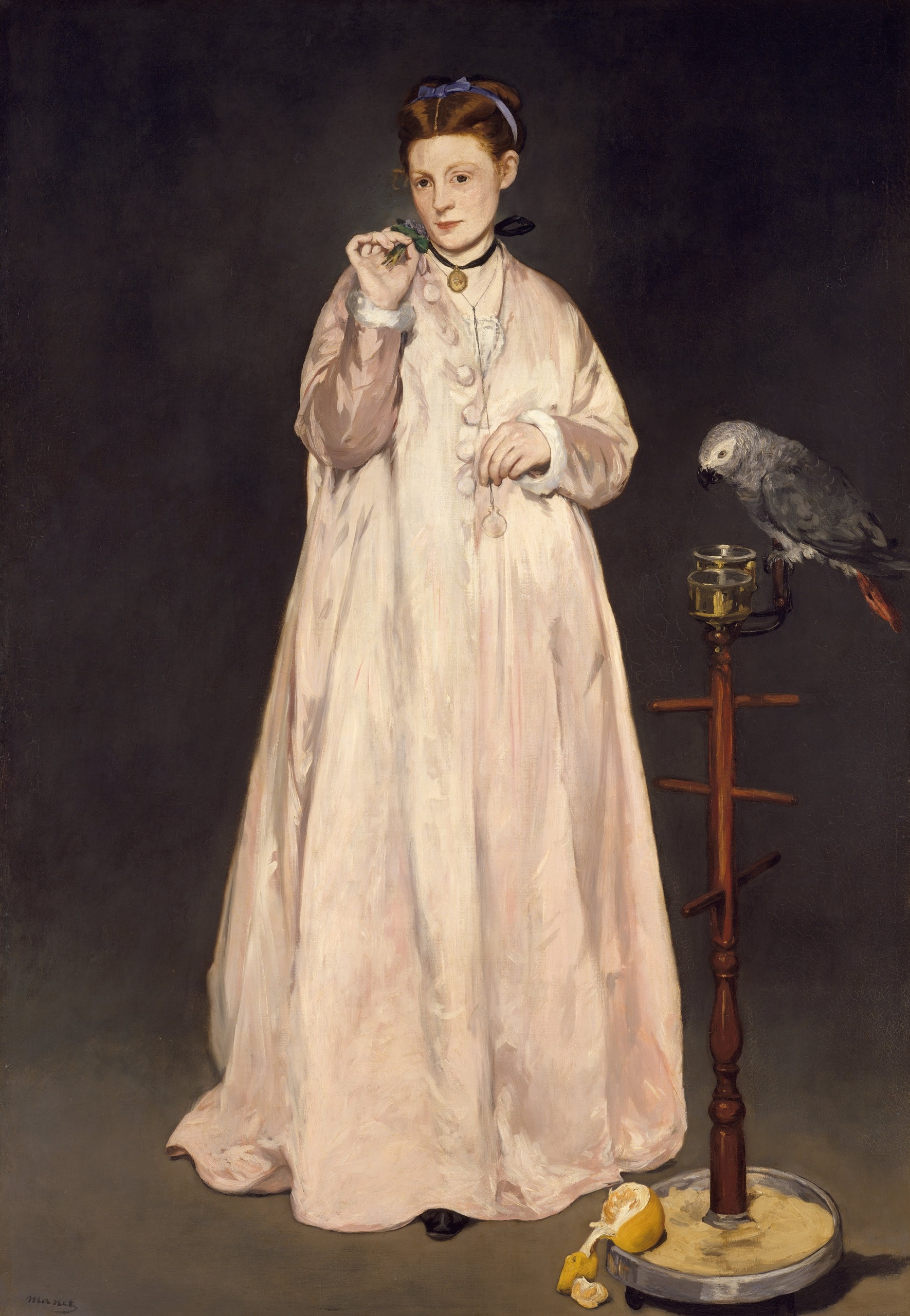
Young Lady in 1866 is a full-length portrait that Édouard Manet painted in that same year: a young woman with reddish hair stands in a long pale pink silk dressing gown and raises a small bunch of violets to her face, while a grey parrot sits beside her on a tall wooden perch; it is also known as Woman with a Parrot. The original, oil on canvas measuring 185.1 x 128.6 cm, belongs to the Metropolitan Museum of Art in New York. We hand-paint it to order in oil on canvas, tall and narrow like Manet’s canvas, in 8 portrait sizes from 30 x 45 to 128 x 191 cm or made to measure. A photograph of your finished painting reaches you before we pack it.
| Title: | Young Lady in 1866 |
| Other titles: | Jeune dame en 1866 (French title) · Woman with a Parrot |
| Painter: | Édouard Manet (1832–1883) |
| Year painted: | 1866 |
| Original size: | 185.1 cm x 128.6 cm (height x width) |
| Original technique: | Oil on canvas |
| Painting style: | Realism and Impressionism |
| Located at: | The Metropolitan Museum of Art, New York, United States |
| Our reproduction: | Hand-painted in oil on canvas, 8 sizes or made to measure |
Young Lady in 1866 – Édouard Manet
What does Young Lady in 1866 show?
A young woman stands full-length against a dark ground. Her reddish hair is pinned up with a blue ribbon, and a black ribbon with a small gold pendant circles her neck. Her loose pale pink silk gown closes with large buttons and falls to the floor, showing only the tip of a black shoe.
Her right hand lifts a tiny bunch of violets to her face; her left holds a long cord with a small round lens. She looks straight at us, calm and unsmiling.
To her right stands a tall wooden perch with crossbars, a round base and two small glass cups at the top, where an African grey parrot with a red tail looks down. A half-peeled orange lies on the floor at its foot. The background is an even dark grey-brown, and Manet’s signature sits at the lower left.
Who is the young lady, and where does the title come from?
The sitter is Victorine Meurent, Manet’s favourite model. The title gives not her name but only the year in which the canvas was made. The work was exhibited as Lady in Pink and as Young Lady in 1866.
When Manet showed it at the Paris Salon of 1868, viewers thought of Gustave Courbet’s Woman with a Parrot of 1866. Courbet’s nude had caused a scandal at the Salon that year, and Manet’s canvas recalled it through its realism and its bird. Manet drew criticism too, and the public began calling his picture Lady with a Parrot.
Our sources do not explain the violets, orange or lens, so we invent no meaning. Visibly, the parrot is almost her equal partner, its perch balancing the right side.
Why is Young Lady in 1866 so well known?
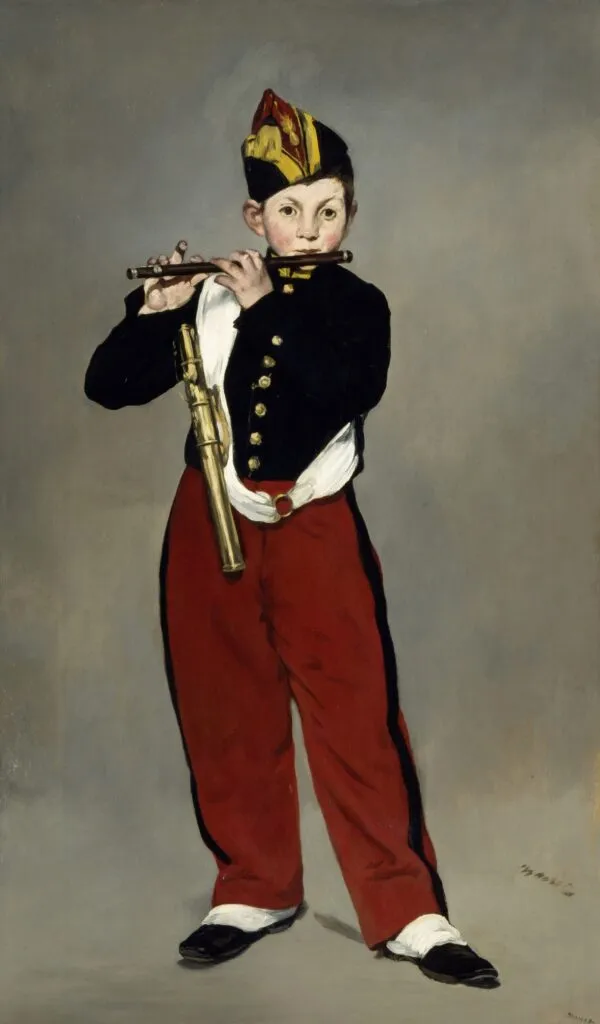
Together with Boy Carrying a Sword, which hangs in the same museum, it was the first of Manet’s works to enter a gallery collection.
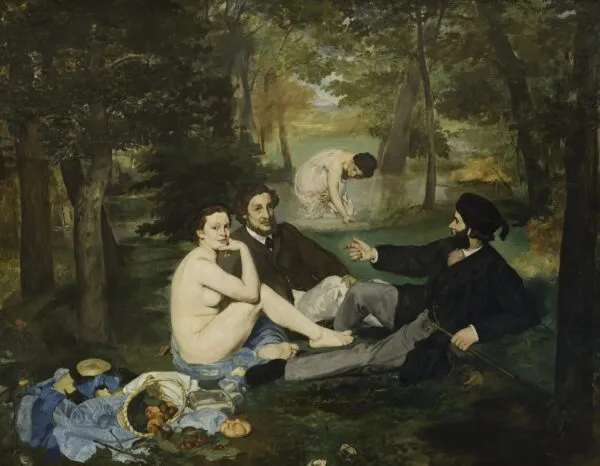
Manet (1832–1883), a Parisian from a wealthy family, trained under Thomas Couture and copied Velázquez and Titian in the Louvre. He was among the first nineteenth-century artists to paint modern life and is a pivotal figure between Realism and Impressionism. Le Déjeuner sur l’herbe (1863) and Olympia (1865) caused great controversy and are seen as the start of modern art.
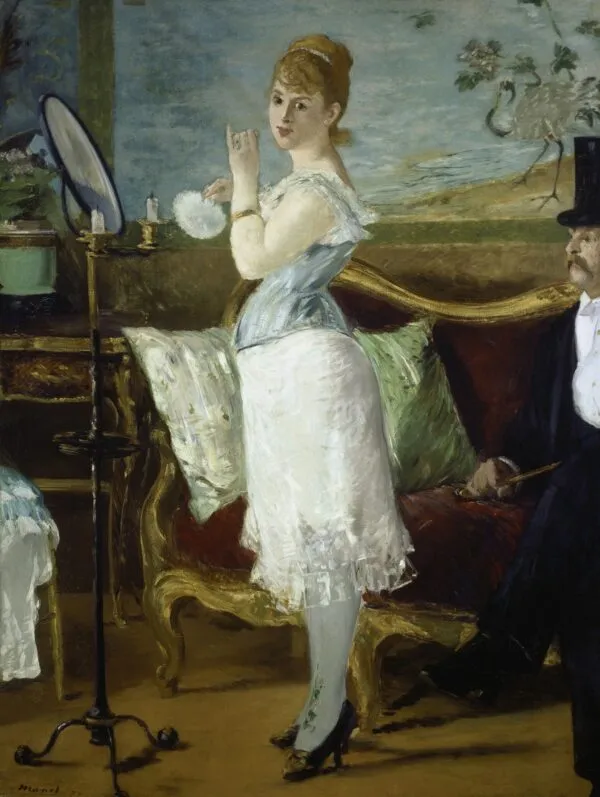
Like Olympia, painted a year earlier, the lady with the parrot meets our gaze calmly. The Wikipedia article on this painting, in English, covers its exhibitions and provenance.
Where is the original, and who owned it?
The original, oil on canvas, 185.1 cm high and 128.6 cm wide, is in the Metropolitan Museum of Art in New York, accession number 89.21.3. It was first shown in May 1867 at Manet’s own exhibition on the Avenue de l’Alma in Paris (now Avenue George-V), as catalogue number 15.
In January 1872 Manet sold it to the dealer Durand-Ruel, who five years later passed it to the textile magnate and collector Ernest Hoschedé, a friend of Claude Monet. At the Hôtel Drouot sale of 6 June 1878 it went to Henri Hecht.
Back with Durand-Ruel, it went in 1881 to J. Alden Weir, acting for Erwin Davis. Davis offered it at a New York sale in March 1889, bought it back, and by letter on 21 March 1889 gave it to the museum with Manet’s Boy Carrying a Sword and Bastien-Lepage’s Joan of Arc.
Young Lady in 1866 or another Manet?
This canvas painting suits lovers of quiet upright portraits, pale silk on a dark ground and small details found slowly.
For another woman Manet put into costume, see Mademoiselle V. in the Costume of an Espada. Le Bon Bock has a relaxed beer-hall mood, Chez le Père Lathuille brings Parisian sociability, and The Battle of the Kearsarge and the Alabama offers the sea and gun smoke.
All our famous Manet paintings, each painted to order, are on the Édouard Manet page.
How do we hand-paint Young Lady in 1866?
Manet’s original is an oil on canvas more than one metre eighty tall. Ours is an oil painting reproduction on new canvas, worked in oil on canvas in the size you choose, one layer after another.
The painter first places the upright figure and the vertical of the perch, on which the whole composition rests, then lays in the dark grey-brown ground in thin layers, deep but never flat black.
The pink silk takes longest: Manet built its folds with broad strokes of pink and near-white, and our painter follows their direction so the fabric catches the light. Last come the violets, the blue ribbon, the pendant, the parrot, the glass cups and the orange.
Which size suits which wall?
In short: 30 x 45 or 40 x 55 cm for a shelf, 45 x 65 and 59 x 81 cm for a bedroom, 72 x 105 and 80 x 120 cm beside a sofa or between two windows, and 105 x 145 or 128 x 191 cm for a tall wall or a stairwell.
Our 8 upright sizes, width x height, are 30 x 45, 40 x 55, 45 x 65, 59 x 81, 72 x 105, 80 x 120, 105 x 145 and 128 x 191 cm. Manet’s canvas is 128.6 x 185.1 cm (width x height), so all seven sizes up to 105 x 145 cm are smaller, while 128 x 191 cm is almost exactly as wide and a little taller.
As a painting for the living room it works best at 80 x 120 or 105 x 145 cm, where face and parrot read from the doorway; the tall format also fits between a door and a window.
Can I order a different size or a frame?
Yes. For other proportions we keep the woman, the perch and the parrot whole and adjust only the dark ground at the sides. Send us the size you need for your wall and we will quote a price and a date.
Your young lady travels rolled, stretched on a stretcher bar or framed; our workshop in Slovenia stretches, frames and protects every canvas.
The moulding is picked in our 3D app, which is for choosing the frame only; a view of the painting on your own wall is a separate service. A slim gold moulding echoes the pendant, while dark wood sets off the pink silk.
How long do painting and delivery take?
Work on your lady with the parrot begins once you confirm the order, and she is ready to ship within 15 to 45 working days. Before packing we send you a photograph of the finished painting and correct anything you ask.
Within Slovenia and across the EU the parcel travels with no customs duties, and every order is covered by our returns policy.
The soft pink figure and her parrot suit bird lovers, a new home or anyone fond of nineteenth-century fashion. Unsure of the wall? With a wall art voucher, your friend picks the size of the parrot painting.
Frequently asked questions
Where can I see the original?
At the Metropolitan Museum of Art in New York, accession number 89.21.3.
Who is the woman holding the violets?
Victorine Meurent, who was Manet’s favourite model.
Is it a print?
No. Each one is a hand-painted copy: the painter applies it with brushes and oil paint on real canvas.
How big is the original?
It is 185.1 cm high and 128.6 cm wide; our largest size, 128 x 191 cm, is about as wide.
Can I order the lady with the parrot in a size that is not listed?
Yes, write to us with the width and height you have in mind and we will quote you.
How long will I wait for my order?
15 to 45 working days, and before dispatch you receive a photograph of the finished work.
Is it suitable for a bedroom?
Yes. The calm figure in her pale pink gown suits a bedroom, and in a narrow upright size a dressing room or hallway too.
Why is it also called Woman with a Parrot?
The Paris public gave it the nickname after the Salon of 1868, when it was compared with Courbet’s Woman with a Parrot.
- Subject: Victorine Meurent in a long pink dressing gown with violets, a grey parrot beside her on a wooden perch.
- Original: oil on canvas, 1866, 185.1 x 128.6 cm, Metropolitan Museum of Art, New York.
- Ours: an Édouard Manet reproduction painted by hand in oil on canvas, 8 sizes from 30 x 45 to 128 x 191 cm, or made to measure.
- Worth knowing: with Boy Carrying a Sword, the first work by Manet to enter a gallery collection.